Isolation: The Card Player
In The Card Player, painted in 1944, the activity is immediately familiar: a solitary figure sits at a table, engaged in a game of cards. The work belongs to the wartime period, and its dark palette and enclosed interior contribute to its subdued and solitary mood.
The sparsely decorated interior and the figure’s turned-away face make the player difficult to identify. The cards, chair and table, however, are clearly recognisable, grounding the scene in the familiar details of everyday life. The ordinary details of the scene are therefore more legible than the identity of the player themself. This tension gives the work its atmosphere, with the human figure becoming a means of conveying a sense of isolation and psychological uncertainty through form and colour.
Grief: Grieving Women
In Grieving Women, the figure becomes a vehicle for a different kind of emotional expression. Two women occupy the centre of the composition, physically connected through the clasping of their hands. One leans towards her companion, whilst the other stands with lowered eyes and a restrained expression.
Their physical proximity suggests consolation or mutual support, yet their separation within the enclosed space creates a contrasting sense of isolation. Colquhoun avoids a highly descriptive treatment of either woman, instead conveying their emotional state through pose, simplified form and colour. Grief is suggested less through dramatic gesture than through the women’s posture, proximity and lowered gazes.
Abstraction and Movement: Dancer by a Stove
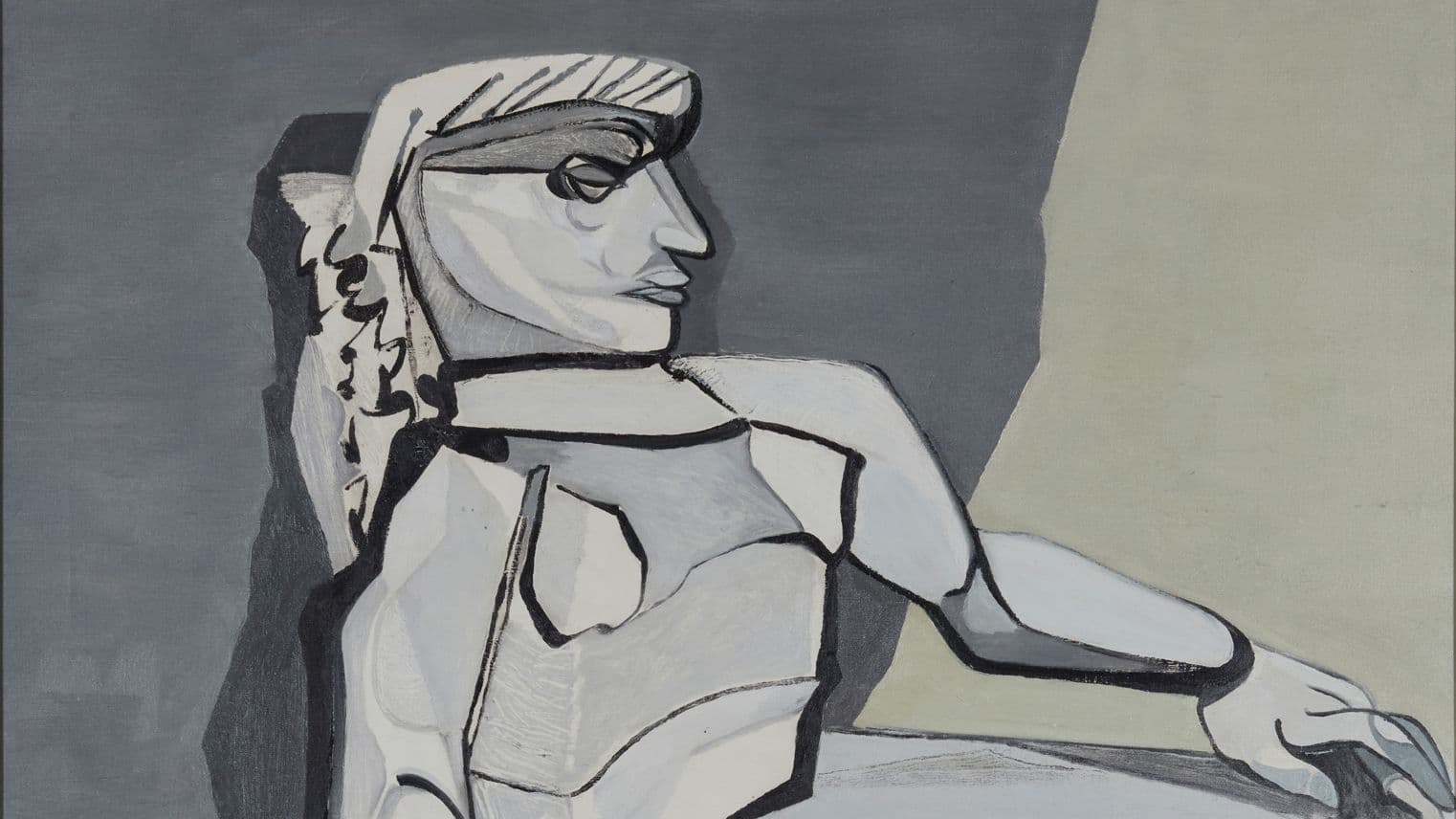
By Dancer by a Stove, painted in April 1958, Colquhoun’s treatment of the figure had become markedly more abstract. The composition recalls his earlier interest in figures positioned around a stove, including the monotype Woman Leaning on a Stove, 1946, in the Arts Council Collection. The dancer is not defined by the details of their appearance; instead, their body is shaped through broad areas of light and dark.
The restricted palette of greys and whites is particularly striking. Where colour had often provided much of the emotional intensity in Colquhoun’s earlier work, here expression is carried almost entirely by tone, silhouette and structure. The result is a figure that appears to emerge from the surrounding space rather than simply occupy it.
The Figure Across Colquhoun’s Career
Together, the three works trace the remarkable flexibility of Colquhoun’s treatment of the figure: from the psychological ambiguity of The Card Player, through the shared grief of Grieving Women, to the increasingly abstracted movement of Dancer by a Stove.
Across these very different compositions, the figure remains central to Colquhoun’s exploration of the emotional and formal possibilities of painting, changing markedly in appearance while retaining its expressive power.