Lucian Freud was one of the most significant figurative painters of the 20th century, best known for his uncompromising portraits and nudes that examine the physical and psychological presence of the human body.
Working almost exclusively from life, Freud developed a distinctive painterly language marked by dense impasto, close observation and an intense focus on flesh, surface and form.
Born in Berlin in 1922, Freud moved to Britain in 1933 following the rise of Nazism. He trained at the Central School of Art, the Cedric Morris School of Painting at Dedham and later at Goldsmiths’ College, where his early work showed the influence of Surrealism and Northern Renaissance painting. By the 1950s, however, Freud had turned decisively towards a more direct and physically engaged form of realism.
Freud was closely associated with the School of London, alongside artists such as Francis Bacon, Frank Auerbach and Leon Kossoff, who shared a commitment to figurative painting at a time when abstraction dominated international art. His sitters included friends, family members, fellow artists and, later in life, public figures, all depicted with the same unflinching scrutiny.
Throughout his career, Freud rejected idealisation, instead presenting the body as weighted, vulnerable and distinctly human. His paintings are characterised by prolonged sittings, a limited but expressive palette and a tactile handling of paint that emphasises the physical reality of his subjects.
Lucien Freud's Prints
Lucian Freud’s prints closely parallel the intense observation and precision of his painted work. An artist for whom printmaking was an extension of his artistic practice, Freud used etching and drypoint to produce prints which capture the essence of their subject, with an intensity and skill rarely seen in the medium.
Freud used printmaking as an extension of his commitment to direct, unidealized figuration, translating his focus on psychological presence and physical realism into a linear, monochrome language. Freud’s prints often feature portraits, nude studies and close observational studies of sitters, often rendered with dense, crosshatched lines mirroring the layered handling of paint in his canvases. Freud was often drawn to subjects that he had a personal connection to, none more so than his beloved whippets Eli and Pluto who appear in his printed work and are portrayed in his most highly prized etchings.
Freud’s skill as a printmaker is never clearer than in Eli where the whippet’s coat seems luminous and glossy, his paws appearing almost to move in his sleep and the blanket beneath him textured and warm. Creating a three-dimensionality and emotive quality extremely difficult to produce within the medium of etching, Freud’s true skill as a draughtsman is apparent.
Freud’s printmaking is highly regarded for its intimacy and technical control. The scarcity of impressions, combined with the directness of his etched line, has made his prints particularly sought after in the secondary market, where they are valued as rare extensions of his deeply observational figurative practice.
Lucian Freud exhibited widely during his lifetime, with major retrospectives at institutions including Tate Britain, The Metropolitan Museum of Art, and Centre Pompidou. His works are held in leading public and private collections worldwide.
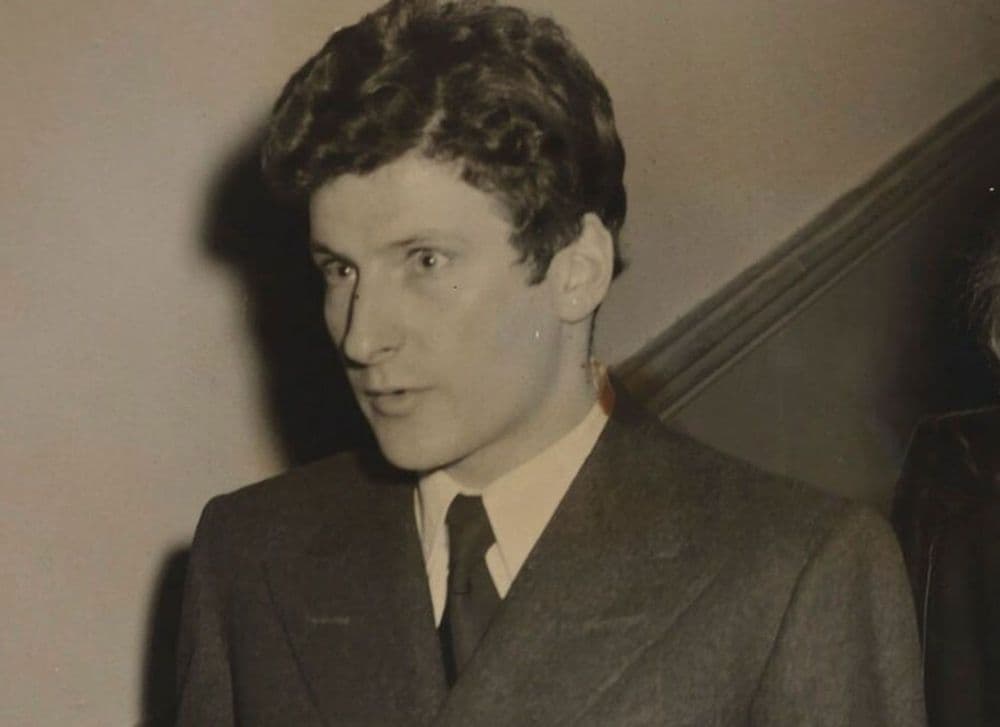
Illustrated: Unknown photographer, Public domain, via Wikimedia Commons