How the Isle of Man Shaped Knox’s Clock Designs
Knox’s childhood on the Isle of Man had a profound influence on his work. The island preserves layers of Neolithic, Celtic, early Christian, Norse and medieval history, including carved crosses and standing stones.
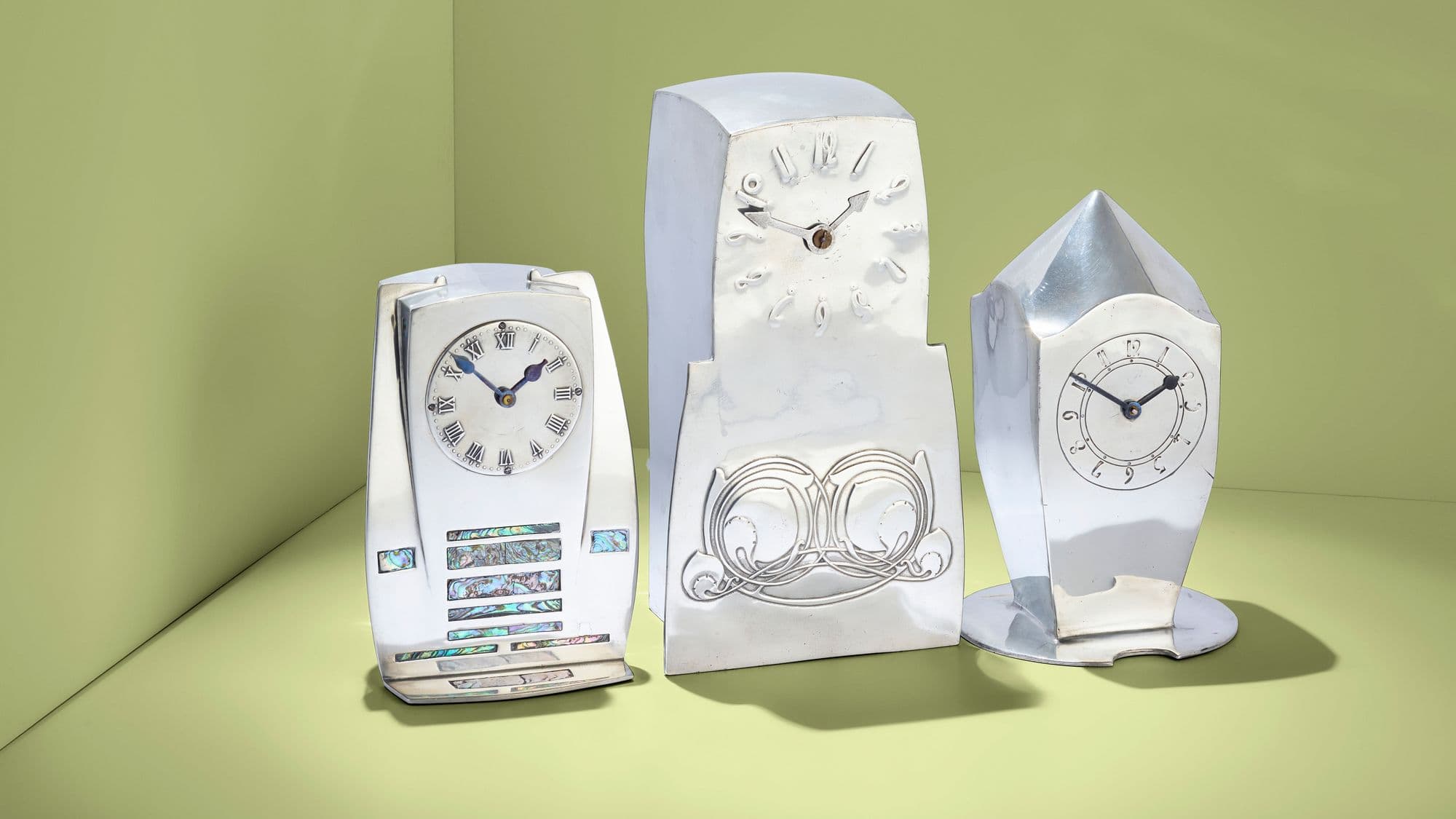
He did not simply reproduce these sources. Interlaced ornament was loosened, stretched and reorganised to suit the form of each object. On some clock cases it appears as twisted Celtic decoration surrounding an enamel dial. On others, the entire silhouette recalls a standing stone or monumental cross.
The landscape was as important as the ornament. A tall clock with a broad base and narrowing upright section can suggest an ancient stone seen against the horizon, translated into a functional object for a modern interior.
From Celtic Revival to Art Nouveau
Not every Knox clock is dominated by Celtic ornament. His work also absorbed the elongated curves of Art Nouveau and the increasing simplification of form that would become associated with Modernism.
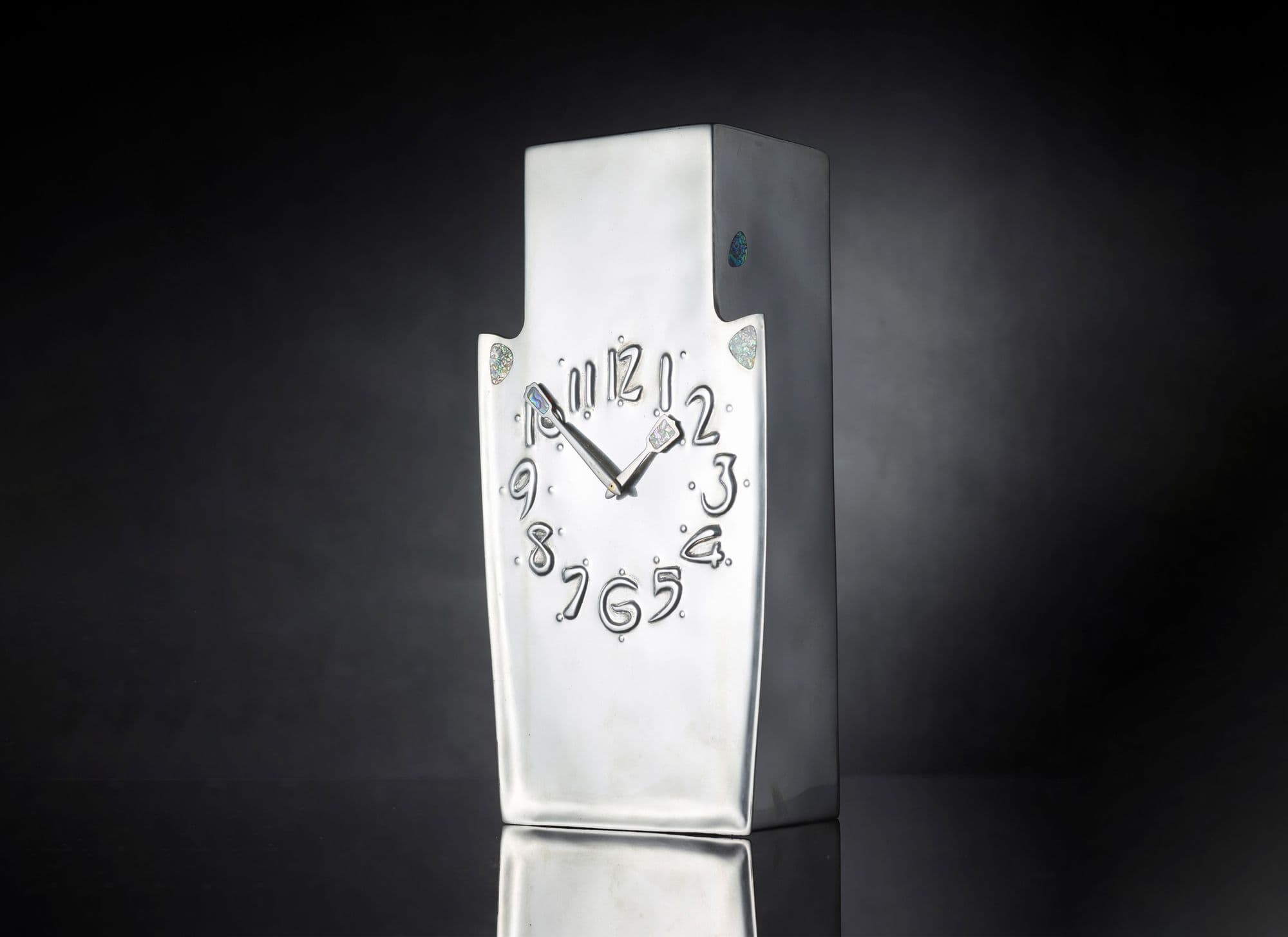
Some Tudric clocks retain intricate interlace and richly coloured enamel. Others depend upon little more than proportion, surface and a few carefully placed details.
This range makes the clocks particularly revealing. They show Knox working between historical reference and abstraction rather than following a single recognisable formula.
Why Are Some Knox Clocks Compared with Mackintosh?
Certain large Knox clocks have tall, spare cases divided by vertical lines and repeated squares. Applied panels of abalone shell may provide the only substantial decoration.
These designs are sometimes compared with the contemporary work of Charles Rennie Mackintosh, particularly the elongated furniture and repeated geometric motifs used in his Glasgow interiors.
The comparison does not necessarily indicate that one designer copied the other. Instead, it places both men within a broader change in British design around 1900, when ornament was increasingly being reduced to line, proportion, rhythm and geometry.
How to Read Liberty Marks and Model Numbers
Marks are a crucial part of identifying a Liberty clock, but they need careful interpretation.
A Tudric clock may be stamped with:
- the word TUDRIC;
- a numerical model or design number;
- MADE IN ENGLAND on some examples;
- additional foundry, retailer or registration marks.
A Cymric silver clock may carry:
- the word CYMRIC;
- L&CO or a related Liberty mark;
- British silver hallmarks;
- a model number;
- separate marks on removable components.
The model number identifies the design rather than one unique clock. Two genuine examples of the same model may therefore carry the same number.
Marks should be compared with recognised examples. Their placement, typeface and relationship to the object matter just as much as the wording.
Does a Tudric Mark Mean a Clock Was Designed by Knox?
No. A Tudric mark establishes a relationship with Liberty’s pewter range, but it does not automatically identify Knox as the designer.
The attribution should be supported by evidence such as:
- an appearance in an original Liberty catalogue;
- a surviving design or archival record;
- a recognised model number;
- publication in specialist literature;
- comparison with museum examples;
- a well-established auction history;
- acceptance by recognised Knox scholars.
This distinction matters because Liberty employed several designers, while later objects have also been produced in styles inspired by Knox.