What Is a Pallasite Meteorite?
Pallasites are a rare type of stony-iron meteorite composed principally of olivine crystals within an iron-nickel metal matrix. They take their name from Peter Simon Pallas, the 18th-century naturalist whose study of a remarkable mass found in Siberia helped draw scientific attention to material that would later be recognised as extraterrestrial. Their combination of silicate and metal immediately distinguishes them from more familiar stony or iron meteorites.
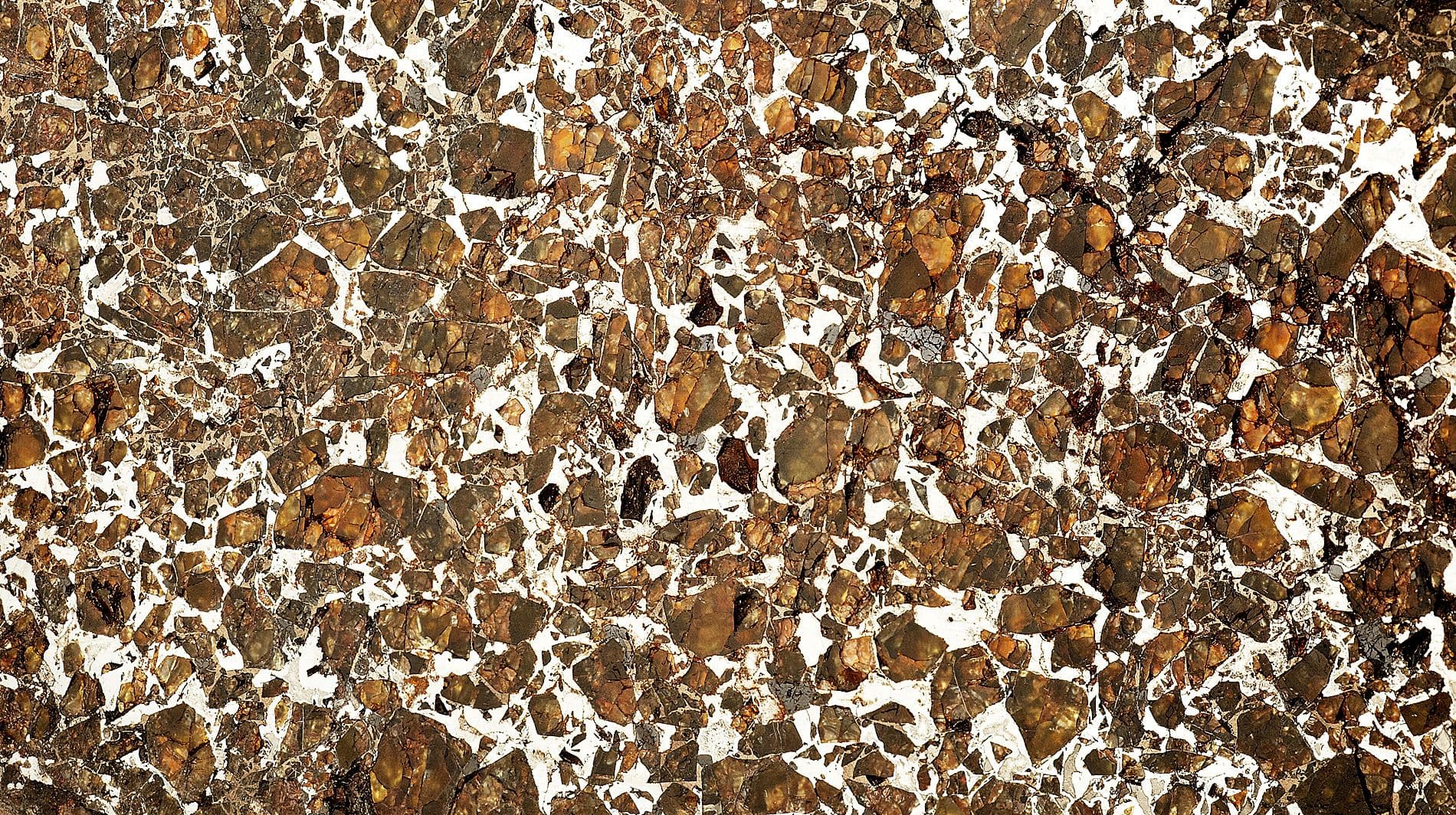
In an uncut specimen, however, their extraordinary internal structure may not be obvious. It is when some pallasites are sliced and polished that the relationship between crystal and metal is revealed.
Why Do Pallasites Contain Olivine Crystals?
The crystals visible within pallasites are olivine, a silicate mineral also found on Earth and elsewhere in the Solar System. Traditionally, pallasites were interpreted as material formed close to the boundary between the metallic core and rocky mantle of differentiated asteroids. Research into their origins has produced a more complex picture, however, and different pallasite groups may not all share exactly the same formation history.
For collectors, what remains extraordinary is the material itself: ancient silicate crystals enclosed within extraterrestrial metal, preserving evidence of processes that took place during the early history of the Solar System.
Are Pallasite Meteorites Rare?
Yes. Pallasites represent only a small proportion of known meteorites. But rarity alone does not make every pallasite equally desirable.
Some named pallasites are represented by considerably more recovered material than others, and individual specimens can vary dramatically in quality. A particularly fine slice may have large, well-defined olivine crystals and an attractive balance between crystal and metal, while another specimen from the same meteorite may present very differently. This makes the quality of the individual piece particularly important at auction.
What Makes a Pallasite Meteorite Valuable?
With pallasites, the answer is unusually visual. Classification, rarity, mass and provenance remain important, but collectors may also respond strongly to the arrangement, clarity and colour of the olivine crystals revealed within a specimen.
Olivine Colour and Transparency
Olivine can vary considerably in appearance. Some crystals are darker or more opaque, while particularly attractive specimens may contain translucent yellow, golden or green areas. When a thin slice is illuminated, these crystals can become especially striking.
Colour alone does not determine value, but the quality and appearance of the olivine can contribute significantly to the appeal of a prepared specimen.
Crystal Size and Structure
The distribution of olivine within the surrounding metal gives each pallasite slice its own pattern. Large, clearly defined crystals can be particularly impressive, although there is no single ideal arrangement. Balance, preservation and the overall visual character of the specimen all contribute to its appeal.
Size and Weight
Large pallasite specimens can have considerable presence, but weight should not be considered in isolation. With a prepared slice, for example, the quality of the exposed structure may be more compelling than sheer mass. A smaller specimen displaying exceptional crystals can therefore be significant in its own right.
Provenance and Classification
The identity of the meteorite matters. A recognised meteorite name, classification, find history and established ownership provide context for the specimen and allow meaningful comparison with other material.
Labels, invoices, certificates and previous auction records should remain with the meteorite wherever possible.
Why Are Pallasite Meteorites Cut Into Slices?
Cutting a pallasite can reveal a structure that remains largely hidden in the complete meteorite. Slices allow light to pass through thinner areas of olivine while the surrounding iron-nickel matrix remains opaque. The result can be extraordinarily effective, particularly when a specimen contains large translucent crystals. This does not mean that a slice is automatically more valuable than an uncut pallasite.
Natural masses, end pieces, slices and worked specimens appeal in different ways. A complete specimen preserves the meteorite's external form, while an expertly prepared slice can reveal its internal structure.
For valuation purposes, the quality of the meteorite and the individual specimen remain more important than assuming one format is inherently preferable.
Pallasite Meteorites and Peridot: Are They the Same?
This is where terminology can become confusing. Olivine is the mineral found within pallasite meteorites. Peridot is the gem variety of olivine.
Exceptionally clear and attractive olivine within some pallasites may therefore be described as gem-quality, but not every olivine crystal within a pallasite should simply be called peridot. For collectors, the significance lies not merely in the presence of a familiar mineral but in its extraterrestrial context.
The Seymchan Meteorite
Seymchan is one of the best-known meteorites associated with spectacular pallasite specimens. It was first discovered in Russia's Magadan region in the 20th century. Some Seymchan material is metal-rich, while other specimens contain the olivine crystals characteristic of pallasites.
When cut and prepared, particularly fine examples can reveal striking areas of translucent olivine surrounded by bright metallic structures.
Does Preparation Affect the Value of a Pallasite?
Preparation matters because cutting and polishing determine how clearly the internal structure of a pallasite can be seen. Good preparation can reveal olivine and metal cleanly while retaining as much of the original material as possible. Poor preparation, damage or deterioration can have the opposite effect.
There is another consideration with iron-bearing meteorites: stability. Exposure to moisture can contribute to corrosion of the metallic component of some meteorites. Condition should therefore be assessed carefully, particularly when a specimen has been stored for a long period. If you own a pallasite, avoid attempting to repolish, coat or otherwise treat it before seeking specialist advice.