How Can We Possibly Know a Rock Came From Mars?
This is perhaps the most extraordinary thing about Martian meteorites: their origin isn't based on appearance or assumption. Scientists can study their mineral and chemical composition, isotopes and other characteristics to establish their relationship with Mars.
Some Martian meteorites contain tiny pockets of trapped gas. Analysis has shown compositions closely corresponding to measurements of the Martian atmosphere made by spacecraft. Together with other geological evidence, this provides a compelling fingerprint connecting these rocks to Mars. So although nobody watched these particular rocks leave the planet, their chemistry helps tell us where they came from.
For a collector, that makes classification fundamental. A rock that looks unusual isn't enough. When Martian material comes to auction, there should be scientific evidence supporting the attribution.
Not All Martian Meteorites Are the Same
“Mars rock” sounds like a single category. In reality, Martian meteorites provide evidence of different rocks and geological processes on the planet. Three names in particular frequently appear in the history of their classification: shergottites, nakhlites and chassignites.
- Shergottites form the largest group and are igneous rocks associated with volcanic activity on Mars.
- Nakhlites are also igneous, but have a different mineralogical character and have played an important role in research into the geological and environmental history of the planet.
- Chassignites are much rarer and are rich in olivine. The group takes its name from a meteorite that fell near Chassigny in France in 1815. It is this last group that gives Lyon & Turnbull a particularly interesting auction connection.
NWA 2737: A Rare Piece of Mars
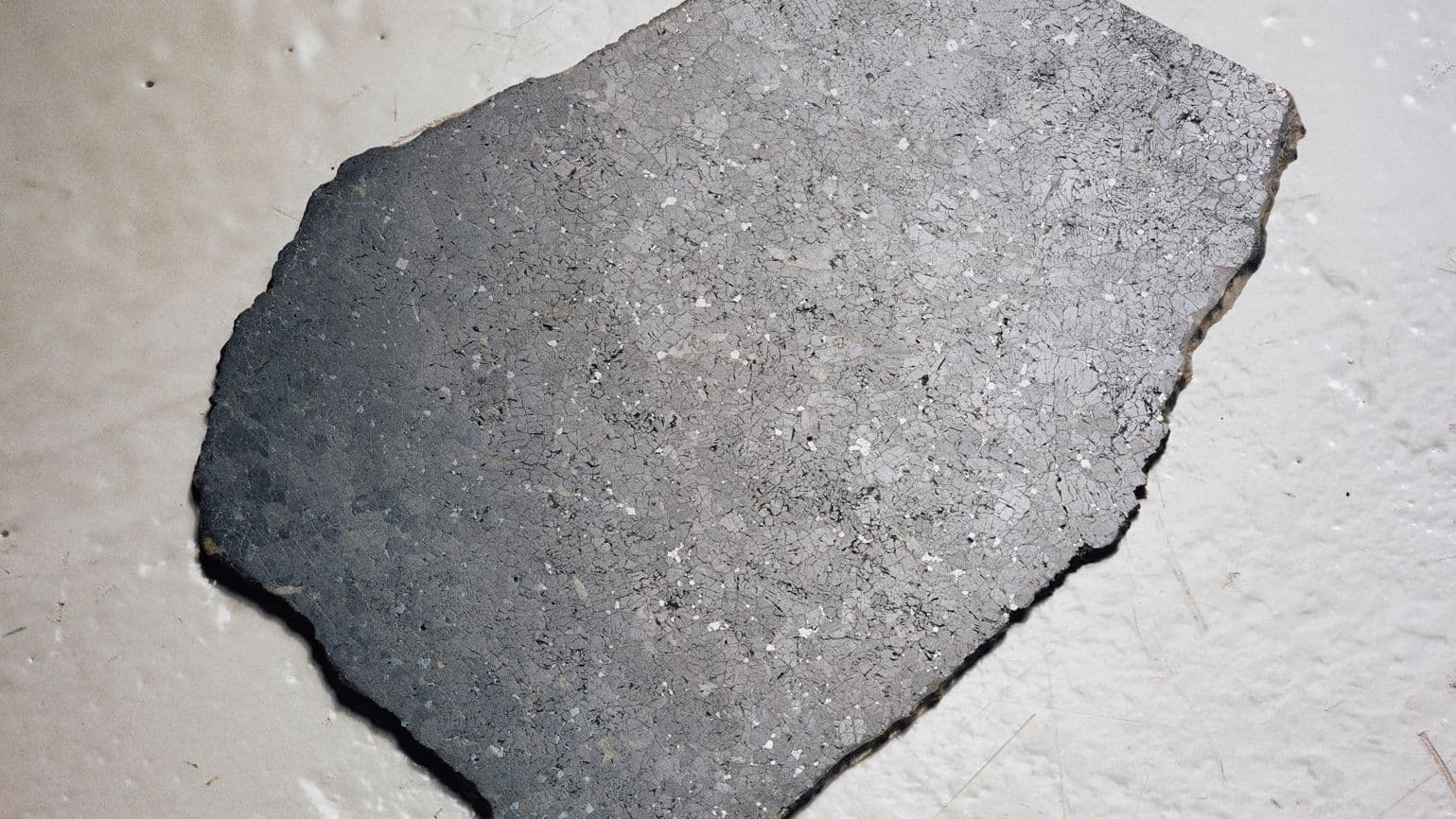
In 2025, Lyon & Turnbull offered NWA 2737, an exceptionally rare Martian chassignite. Its importance wasn't simply that it came from Mars. Its classification placed it within an unusually scarce group of Martian meteorites.
That distinction is useful when thinking about value. “Martian” is only the beginning of the description. Exactly what kind of Martian meteorite it is can be much more revealing.
What Can Make a Martian Meteorite Valuable?
There is no simple price for a piece of Mars. The first question is exactly what the material is. Its recognised meteorite designation and scientific classification establish the foundation for an assessment.
From there, specialists consider the individual specimen. Its mass matters, but so can its form, condition and the amount of material available from that particular meteorite.
Provenance is especially important. Classification records, old collection labels, invoices and previous auction history help establish how a specimen has travelled through collections after its much longer journey through space. For this reason, a small meteorite accompanied by strong documentation shouldn't be dismissed simply because of its size.
What Does a Martian Meteorite Look Like?
Perhaps surprisingly, a Martian meteorite does not necessarily look dramatically different from an Earth rock to an untrained eye. Some specimens retain an exterior altered by their passage through Earth's atmosphere. Others have been cut to reveal their internal structure, allowing their minerals and textures to be examined more clearly. This is also why photographs alone cannot prove that a stone originated on Mars.
If you have inherited something labelled as a “Martian meteorite”, the label itself may actually be important. Keep the specimen, its box, labels, certificates and paperwork together until a specialist has had an opportunity to assess them.
Are Martian Meteorites Rarer Than Lunar Meteorites?
Both Martian and lunar meteorites represent exceptionally small parts of the meteorite record on Earth, and new material continues to be classified. Comparing their rarity purely by the number of named meteorites can also be misleading. Pieces recovered from the same original fall may receive different find designations, while subsequent research can change how individual specimens are grouped or understood.
For the auction market, the more useful question is usually not whether Mars or the Moon is rarer, but how significant the particular specimen is within its own classification. Collectors interested in planetary material can also explore our guide to Lunar Meteorites.
Can You Really Own a Piece of Mars?
Yes. Naturally fallen Martian meteorites can enter private collections where their recovery, ownership and export comply with the relevant laws. They are fundamentally different from material deliberately collected from another planet by a space agency.
No Martian rock has yet been returned to Earth by a human or robotic sample-return mission. The Martian material currently available to collectors arrived here naturally as meteorites. That makes these rocks an extraordinary accident of celestial mechanics: pieces of another planet delivered to Earth without anyone going there to collect them.