Lot 6
JOHN WILLIAM WATERHOUSE R.A., R.I. (BRITISH 1849-1917)
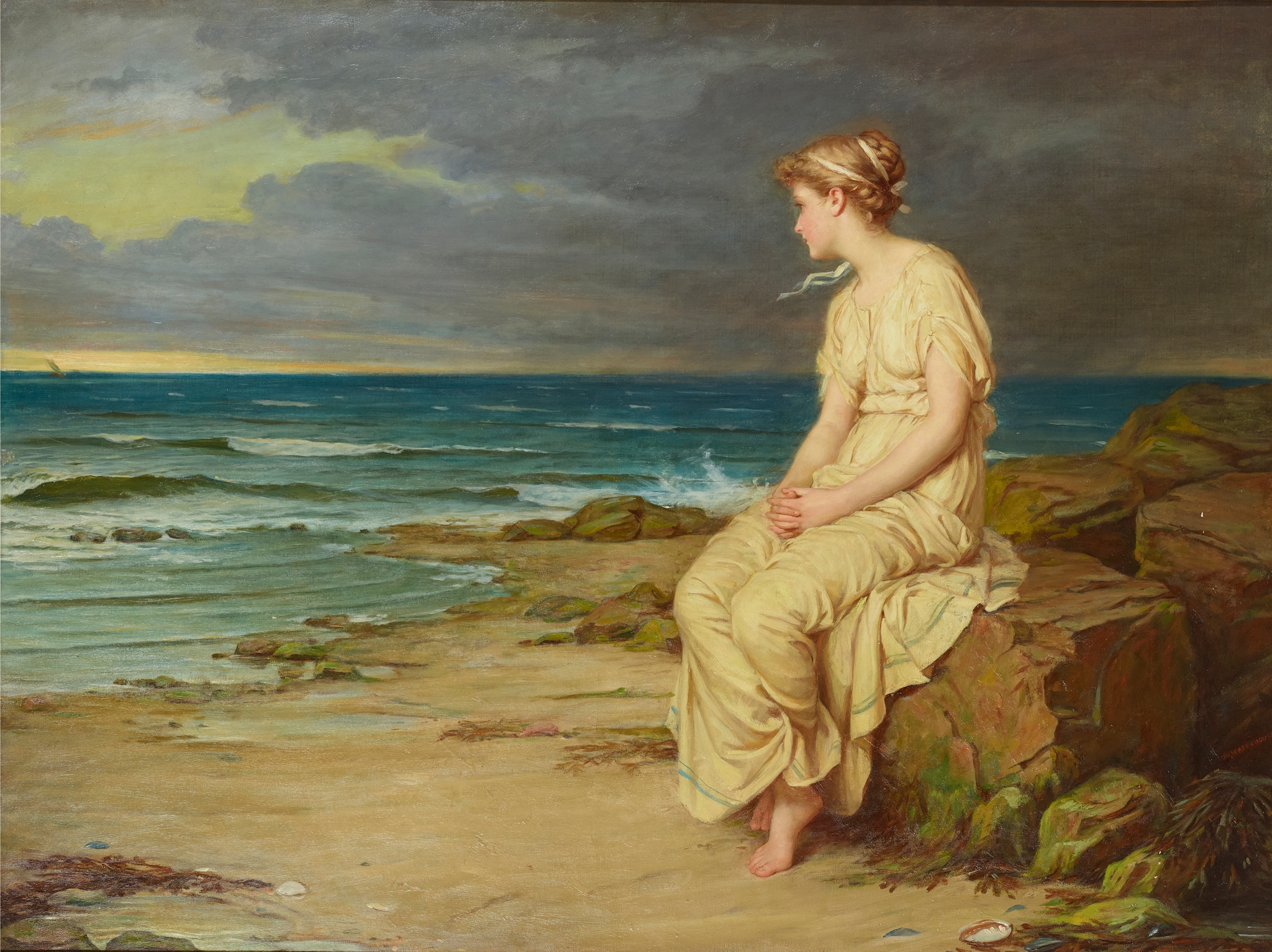
MIRANDA

Poetry & Myth: Romantic Art in the Victorian Age
Auction: 02 July 2026 from 14:00 BST
Description
Signed, oil on canvas
Dimensions
76cm x 101.5cm (30in x 40in)
Provenance
Private Collection, Scotland;
Bonhams, 4 November 2006;
Sotheby's, London 17 December 2015
Exhibited:
Royal Academy, 1875, no.76;
Groninger Museum; Royal Academy, London; Montreal Museum of Fine Arts, J.W. Waterhouse - The Modern Pre-Raphaelite, 2008-2010, no.3
Literature:
J.A. Blaikie, 'J.W. Waterhouse, A.R.A.', In Magazine of Art, 1886, p.3;
Anthony Hobson, The Art and Life of J W Waterhouse RA, 1980, illustrated p.29, pl.18 (transposed), cat.no.16;
Anthony Hobson, J.W. Waterhouse, 1989, p.20;
Peter Trippi, J.W. Waterhouse, 2002, pp.32-33
Footnote
"O, wonder!
How many goodly creatures are there here!
How beauteous mankind is!
O brave new world,That has such people in't."
- William Shakespeare, The Tempest (Act V, Scene I)
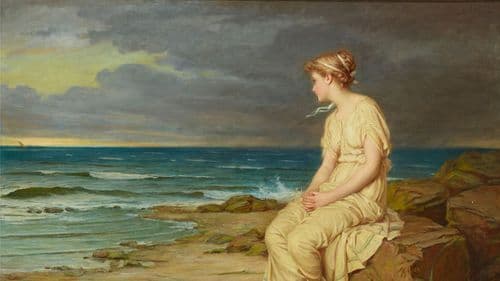
John William Waterhouse’s Miranda (1875) occupies a significant position within the artist’s early oeuvre, representing both his first known depiction of a Shakespearean heroine and only his second exhibit at the Royal Academy. Long believed lost for nearly 130 years before its rediscovery in a Scottish private collection in 2004, the painting has since been recognised by scholars including Anthony Hobson and Peter Trippi as an important precursor to the themes and pictorial strategies that would later define Waterhouse’s mature work.
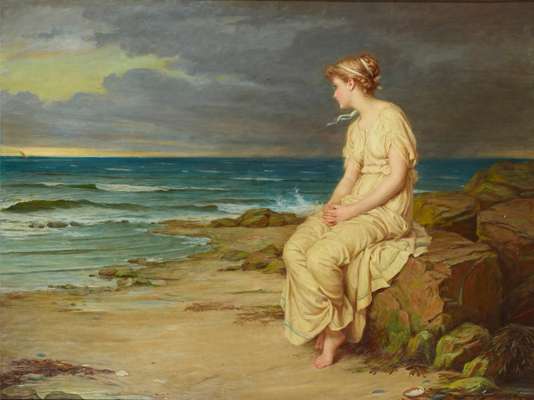
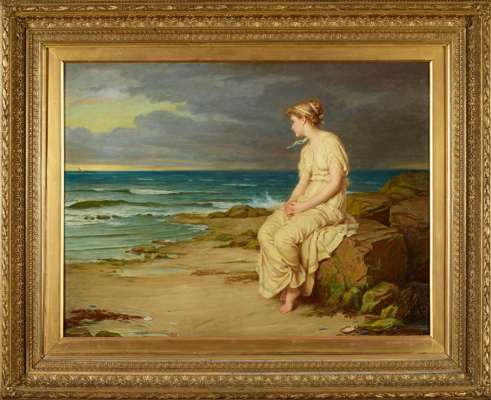
Inspired by William Shakespeare’s The Tempest, the painting depicts Miranda seated alone upon a rocky shoreline, gazing toward a distant ship that is soon to be engulfed by the magical storm conjured by her father, Prospero. Rather than illustrating the climactic wreck itself, Waterhouse chose a quieter and more contemplative moment of anticipation, thereby transforming a dramatic literary subject into an introspective meditation on solitude, femininity, and emotional restraint.
The composition departs notably from the more theatrical interpretations of The Tempest popular among Victorian artists. Contemporary depictions often portrayed Miranda in states of overt anguish or alarm as she witnessed the destruction of Ferdinand’s ship. Waterhouse instead presents a restrained and psychologically subtle heroine. As James A. Blaikie observed in his 1886 discussion of the artist, the painting is “in no sense a dramatic illustration of Shakespeare, but rather… a purely academic study of the figure.” Blaikie further praised the “satisfying potency of colour and a finely graduated brilliance of illumination” that lend the figure both force and delicacy. This emphasis upon atmosphere rather than narrative spectacle reveals Waterhouse’s growing interest in emotional ambiguity and poetic interpretation rather than literal storytelling.
“In a foreground of sea-shore Miranda, lightly draped, is seated on a rock, watching with clasped hands and partly averted face the brave ship tossing in the offing; the blue sea breaks unheeded on the sand, her eyes being wholly absorbed by the vessel, which is yet to suffer through the magic of Prospero.” J.A. Blaikie, 'J.W.Waterhouse, A.R.A.', In Magazine of Art, 1886
The painting also demonstrates the strong influence of Neo-Classicism upon Waterhouse’s early style. Miranda is dressed not in seventeenth-century costume appropriate to Shakespeare’s heroine, but rather in Grecian drapery resembling a classical chiton or toga. This stylistic decision aligns with the pervading fashion for Neo-Classicism amongst London artists at the time.
At the same time, the work introduces themes that would remain central throughout Waterhouse’s artistic production. Water, femininity, melancholy, and magic converge in Miranda in ways that anticipate later masterpieces such as The Lady of Shalott and his celebrated depictions of Ophelia. The sea functions not merely as a backdrop but as a psychological and symbolic presence. Miranda’s fixed gaze toward the distant vessel suggests both longing and apprehension, while the calm surface of the waves contrasts with the latent violence of Prospero’s approaching storm. This tension between serenity and impending catastrophe imbues the composition with emotional complexity.
The rediscovery of Miranda has therefore altered scholarly understanding of Waterhouse’s artistic development. Prior to its reappearance, the painting was known only through a reversed black-and-white reproduction published in Anthony Hobson’s 1980 monograph. Seeing the work in colour revealed the sophistication of Waterhouse’s early handling of luminous sea tones, atmospheric light, and subtle modelling of form. The painting demonstrates that by the age of twenty-six Waterhouse had already begun to cultivate the poetic sensibility and technical refinement associated with his later Pre-Raphaelite masterpieces. Furthermore, the possibility that the model was the artist’s sister Jessie, who also appeared in Whispered Words exhibited the same year, adds a personal dimension to the work’s introspective character.
Waterhouse would revisit the subject of Miranda in 1916 and 1917, producing dramatically different interpretations shaped by the emotional climate of the First World War. Those later paintings depict the storm and shipwreck with heightened drama and anguish, contrasting sharply with the calm restraint of the 1875 canvas. Seen in retrospect, the early Miranda emerges not merely as a youthful experiment but as the foundation of one of Waterhouse’s most enduring imaginative themes.