Lot 7
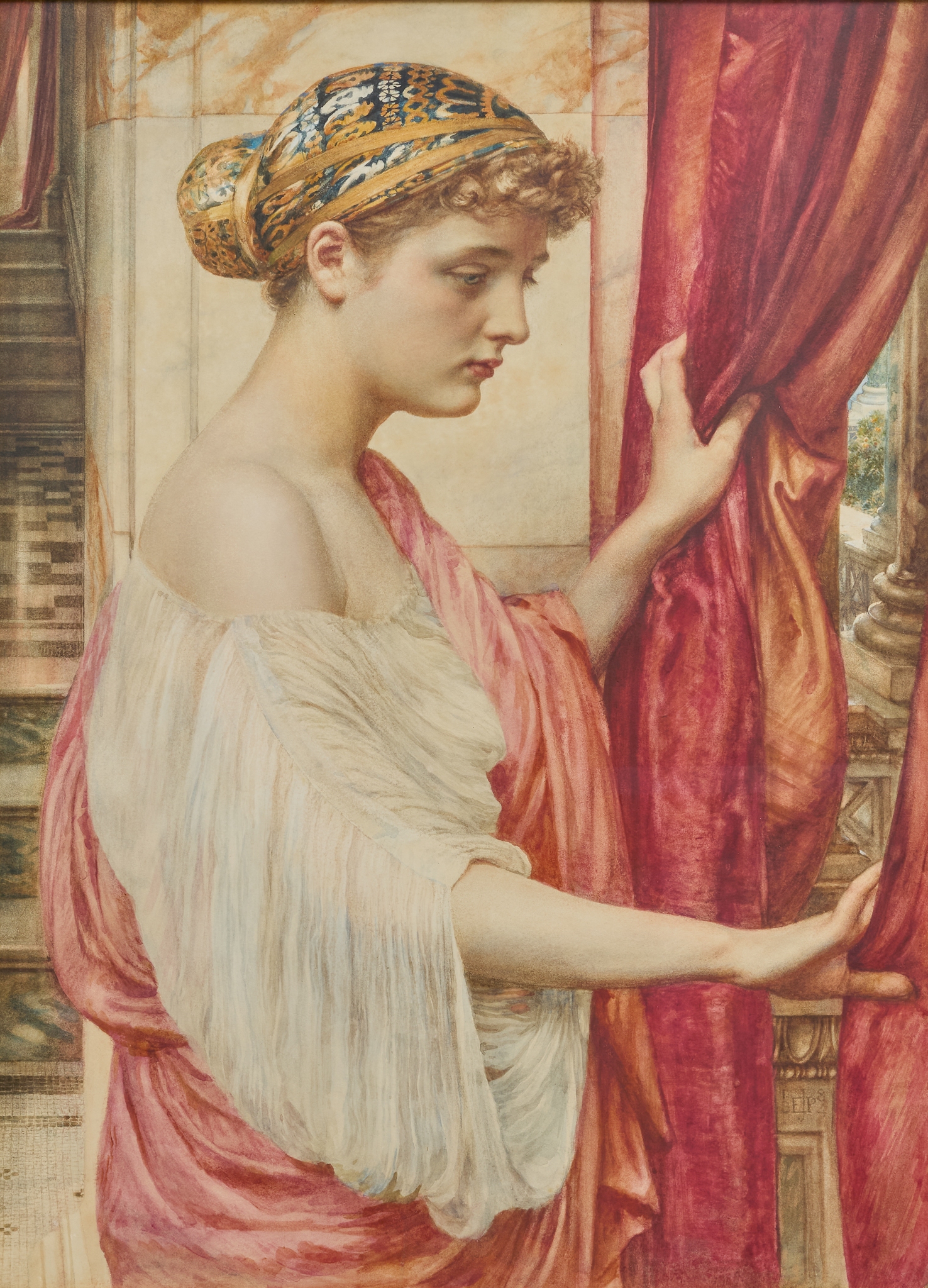
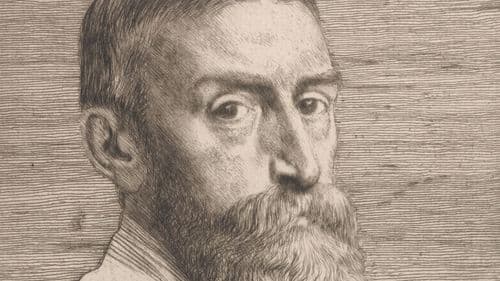
SIR EDWARD JOHN POYNTER BT., P.R.A., R.W.S. (BRITISH 1836-1919)
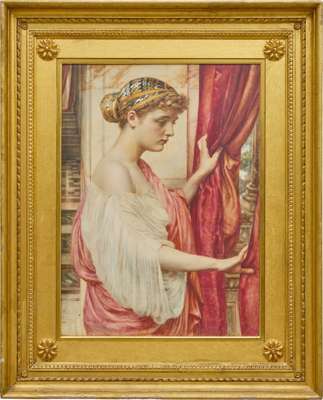
PSYCHE
Poetry & Myth: Romantic Art in the Victorian Age
Auction: 02 July 2026 from 14:00 BST
Description
Signed with monogram and dated 1884, watercolour
Dimensions
75cm x 55cm (29.5in x 21.5 in)
Provenance
Peter Nahum, London;
Private collection;
Sotheby’s, London, 7 December 2009;
Sotheby’s, London, 15 December 2016
Exhibited: London, Royal Watercolour Society, 1884, no.170
Footnote
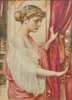
The subject of Psyche derives from the celebrated tale of Cupid and Psyche recounted by Apuleius in The Golden Ass and later popularised in the nineteenth century through William Morris's The Earthly Paradise. Poynter depicts the heroine at a moment of emotional crisis: standing at a balcony and drawing back a curtain, Psyche gazes across the garden of Cupid's palace on the morning after she has betrayed her lover's trust by illuminating his sleeping form. Having revealed Cupid's identity, she has lost him, and the melancholy introspection that characterises the composition suggests her dawning awareness of separation and regret.
The watercolour belongs to a distinguished series of idealised classical heroines that occupied Poynter during the late 1870s and 1880s. Beginning with Zenobia Captive in 1878 (lot 3 in this collection), the artist developed a sequence of half-length female figures set within richly appointed marble interiors, including Helen (1881) and Psyche in the Temple of Love (1882, Walker Art Gallery, Liverpool). These works exemplify Poynter's refined classicism, combining archaeological precision with a poetic sensibility that was widely admired by his contemporaries. As Cosmo Monkhouse observed in his essay on the artist in The Art Journal Easter Annual 1897, Poynter's small-scale works "charm by their daintiness and refinement, and often also by the delicate opalescence of their colour. Nothing that is not beautiful is allowed to enter into their composition."
Painted in 1884 and exhibited at the Royal Watercolour Society the same year, Psyche demonstrates Poynter's mastery of the medium at the height of his career. The subject also held particular resonance within his artistic circle: his brother-in-law Sir Edward Burne-Jones had illustrated Morris's retelling of the myth and collaborated on decorative schemes inspired by the romance during the 1870s. The present work therefore stands at the intersection of Victorian classicism and the broader revival of interest in the Cupid and Psyche story that captivated artists, writers and designers of the period.