Lot 5
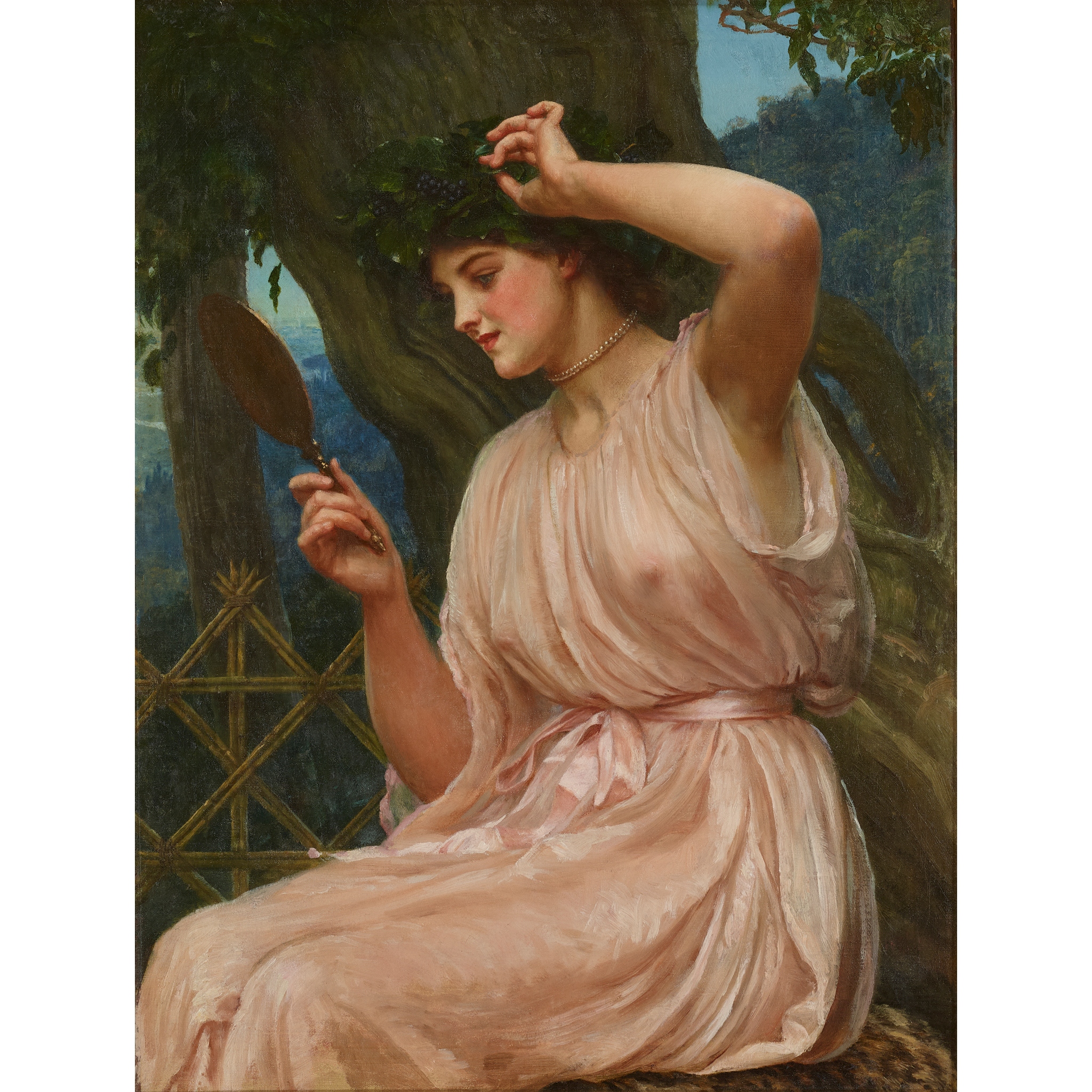
SIR EDWARD JOHN POYNTER BT., P.R.A., R.W.S. (BRITISH 1836-1919)
PHYLLIS 'EST HEDERAE VIS MULTA, QUA CRINES RELIGATA FULGES'



Poetry & Myth: Romantic Art in the Victorian Age
Auction: 02 July 2026 from 14:00 BST
Description
Oil on canvas
Dimensions
62.2cm x 47cm (24.5in x 18.5in)
Provenance
with Agnew's, London;
The 9th Duke of Marlborough;
Christie's, London, 14 May 1904;
Sotheby’s, New Delhi, 8 October 1992;
Christie’s, London, 16 December 2015
Footnote
Painted in 1897, Phyllis holds a distinguished place within Sir Edward Poynter's oeuvre as the first major work exhibited following his election as President of the Royal Academy. The appointment marked the culmination of a remarkable career that had seen Poynter emerge as one of the foremost exponents of classical painting in Victorian Britain. Trained in Paris under Charles Gleyre and celebrated for his intellectually ambitious historical compositions, Poynter succeeded Lord Leighton as President after the deaths of both Leighton and Sir John Everett Millais in rapid succession. As President, Director of the National Gallery, and later a baronet, he became the pre-eminent artistic figure of the Edwardian era.
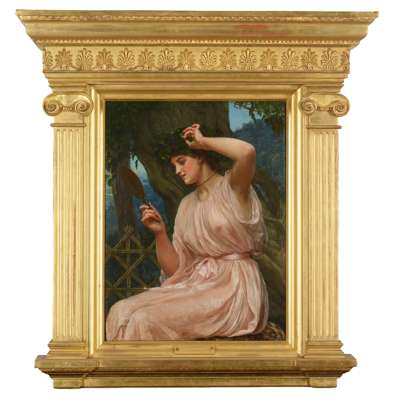
The painting illustrates a passage from Horace's Odes (Book IV, Ode XI), in which the poet invites the beautiful Phyllis to join him in celebrating the birthday of his patron Maecenas. The inscription from the poem, translated loosely as "There is abundant ivy, with which, bound in your hair, you shine resplendent," refers to the wreath that adorns the young woman's head. Poynter depicts Phyllis in a secluded pastoral setting, crowning herself with ivy while contemplating her reflection in a hand mirror. The motif allowed the artist to unite classical scholarship with an elegant study of feminine beauty, a combination that had become one of his hallmarks.
Throughout his career Poynter returned repeatedly to subjects drawn from classical literature, presenting them with a distinctive blend of archaeological suggestion, refined draughtsmanship and decorative richness. In works such as Diadumene (1884), The Visit to Aesculapius (1880), and Helen (1881), he explored themes of ideal beauty through solitary female figures placed within carefully conceived classical settings. Phyllis belongs to this celebrated sequence and exemplifies the artist's mature style, in which narrative gives way to mood and poetic evocation.
The painting was warmly received when exhibited at the Royal Academy. The Art Journal devoted particular attention to the work, praising Poynter's "refined and academic powers of expression" and observing that the composition faithfully captured the spirit of Horace's verse. The critic noted the contrast between the cool shade of the overhanging tree and the luminous flesh tones of the figure, while the distant blue landscape contributed an atmosphere of idyllic tranquillity. Such qualities reveal the artist at the height of his powers, combining classical learning with a sensuous appreciation of colour, light and form.
As one of the earliest works exhibited under Poynter's presidency, Phyllis may be regarded as a statement of the values he championed throughout his career: technical accomplishment, literary cultivation, and an enduring belief in the relevance of classical art to the modern age.