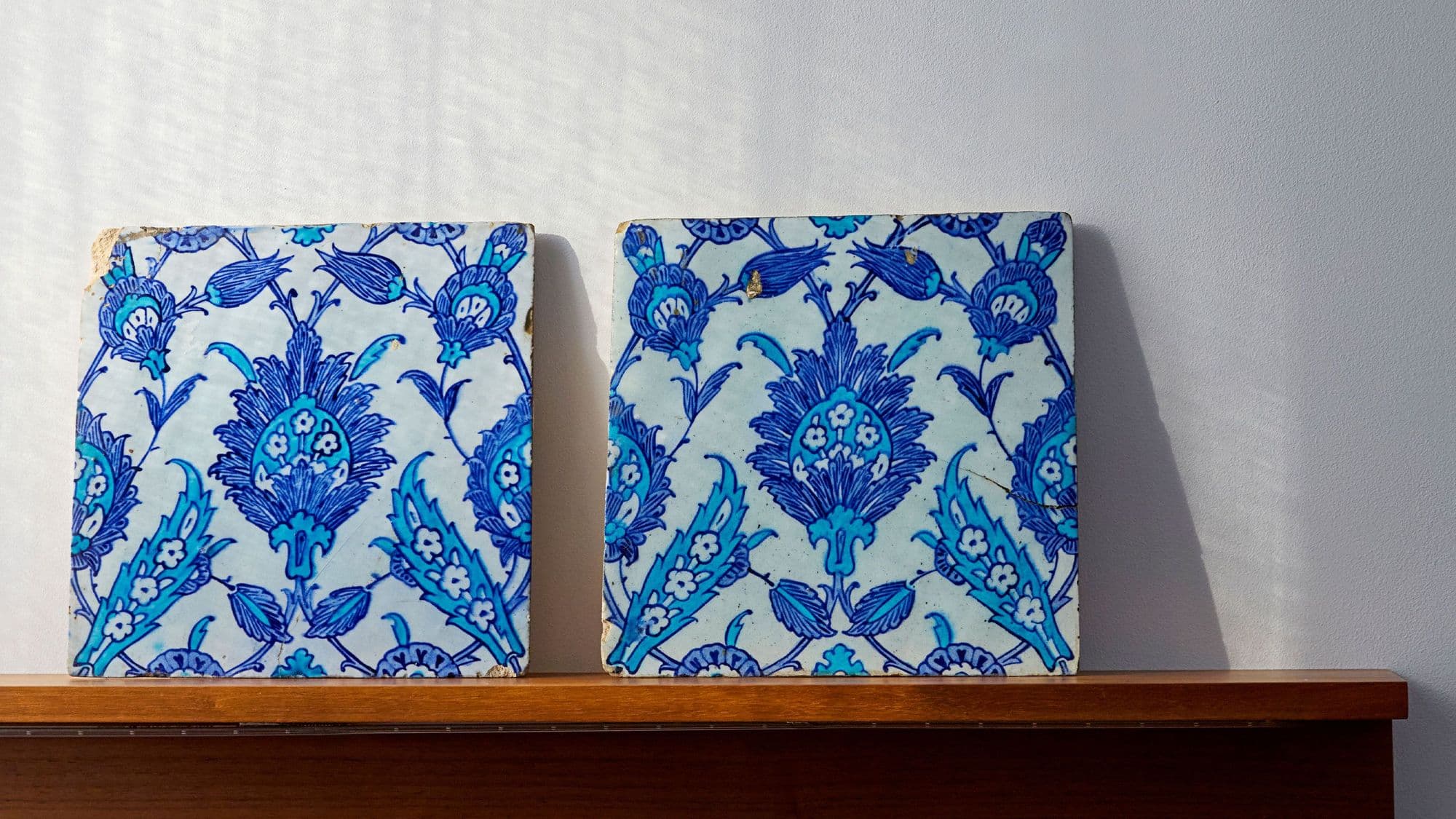
Iznik, Damascus, Ottoman & Qajar are all names synonymous with the production of exquisite ceramic tiles. Now divorced from their original context, individual tiles are prized for their beauty and extraordinary craftsmanship.
Why are Islamic Tiles Popular?
Today they are considered works of art and sell for vast prices at auctions houses around the world. Originally created to add colour to external facades the use of tiles grew from discrete segments to elaborate designs covering entire exteriors and interiors of mosques, shrines, palaces and houses across the Middle East. Just like clothes on a person, tiles cloth buildings reflecting light and surroundings and projecting the unique culture of the Islamic world.
How were Tiles Made?
Clay was initially used to make both luxury vessels and tiles up to the 12th century. After this period stone paste (originally used in Egypt) was introduced to create a finer more translucent porcelain. Glazes add an impervious layer protecting and preserving the tile and creating a glassy surface and a sense of luxury. Lustre is perhaps one of the best-known glazes recognised by its metallic sheen and multi-coloured reflections.
This technique originated in Egypt in the 8th century where it was used to decorate glass however it was likely first adapted in Basra, Iraq for pottery. Whilst early examples can be found in the at Samarra in Iraq from the 9th century the most prolific period of lustre tile production was between 12th – 14th centuries at the potteries of the Kashan.