Jessie M. King and the Glasgow Style
King was born at the manse in New Kilpatrick, near Glasgow, to Church of Scotland minister James Watters King and Mary Anne Anderson. Raised in a strict religious household, she was discouraged from pursuing art and reportedly concealed her childhood drawings from her mother.
She nevertheless enrolled at the Glasgow School of Art in 1892, studying during one of the most important periods in the institution’s history. Glasgow was then developing an international reputation for progressive architecture, illustration and decorative design. King emerged as part of the generation of women artists subsequently described as the Glasgow Girls.
In 1898, she received a prize in the South Kensington National Art Competition. She later taught book decoration and design at the Glasgow School of Art, where she remained until her marriage in 1908. Her career developed alongside those of artists and designers including Charles Rennie Mackintosh, Margaret Macdonald Mackintosh and Frances Macdonald McNair, although King established a visual language entirely her own.
What Is Jessie M. King’s Style?
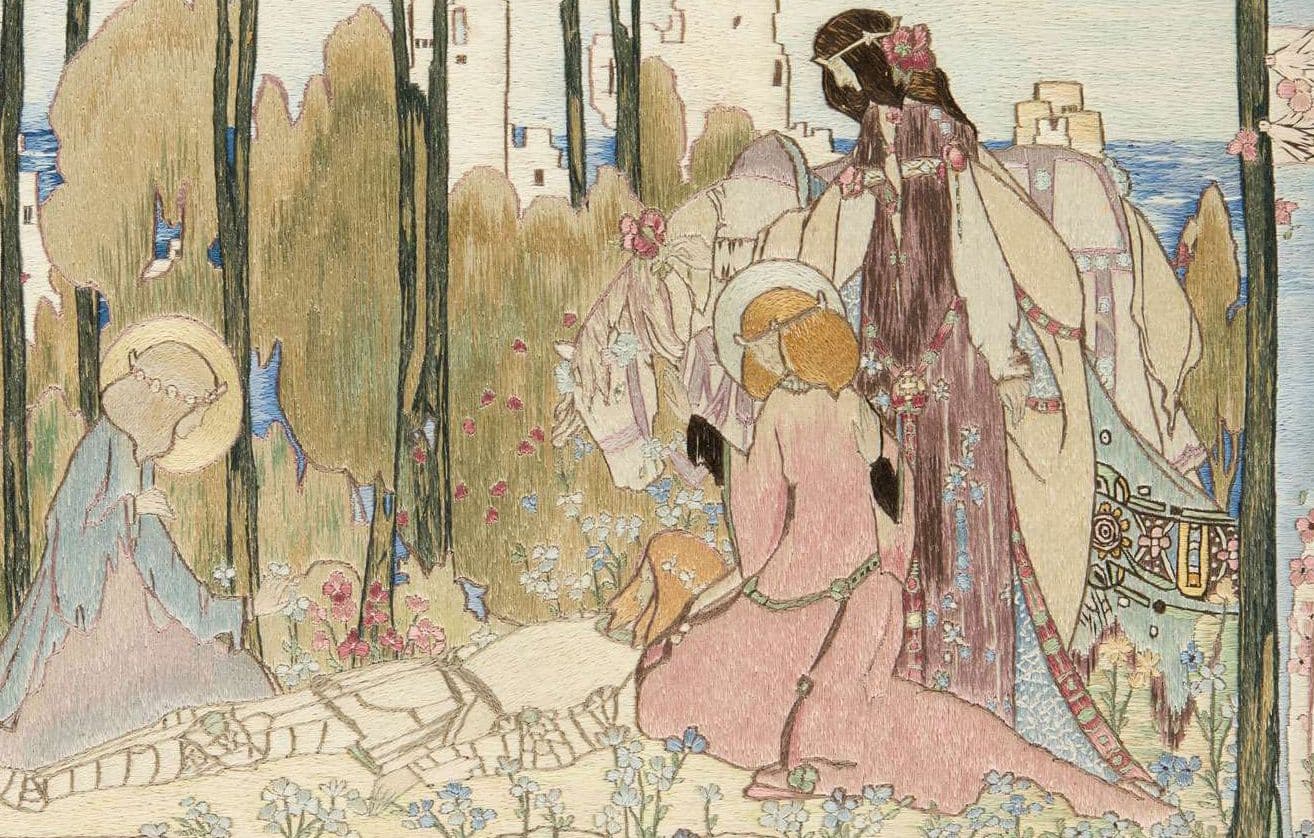
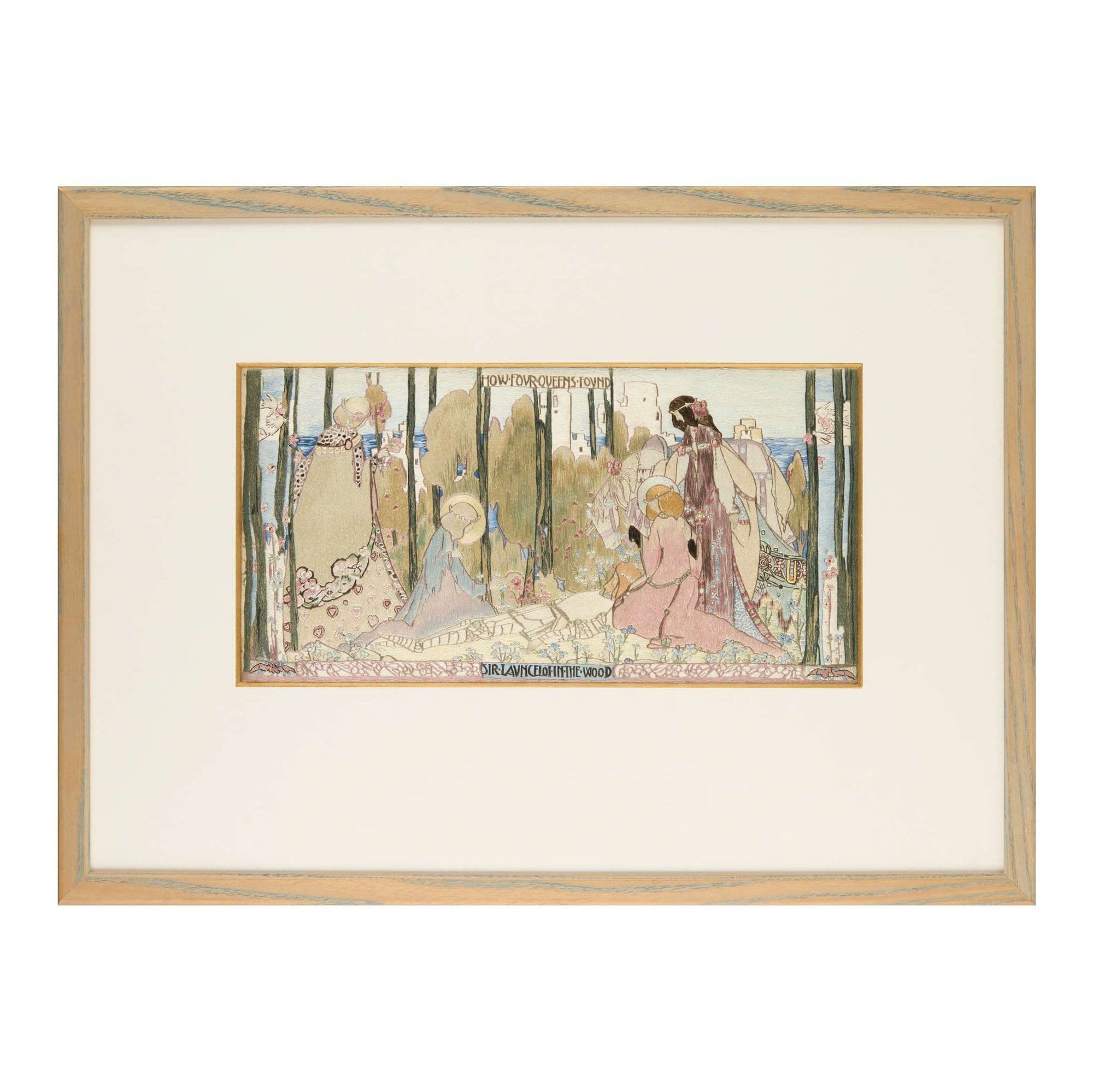
King is best known for finely drawn figures, enchanted landscapes and intricate arrangements of flowers, leaves, stars and decorative lines. Her illustrations frequently evoke medieval romances, legends and fairy tales, yet their flattened compositions and rhythmic forms belong firmly to the visual culture of the early 20th century.
She resisted the straightforward imitation of nature, preferring to draw from imagination. This approach gave her work its peculiar combination of delicacy and intensity: elongated figures inhabit densely patterned worlds that appear both ancient and strikingly modern.
King’s reputation was first established through book illustration and design. She created book covers, frontispieces, bookplates and complete illustrated volumes, working for publishers in Britain and continental Europe. Her designs were particularly well suited to the printed page, where her controlled lines and carefully balanced compositions remained clear even at a small scale.
Her practice, however, extended far beyond books. King designed jewellery, silver, wallpaper, fabrics, costumes and interiors, as well as ceramics and other works for Liberty & Co. National Galleries of Scotland describes her as a designer of fabrics, wallpaper, costumes, interiors, ceramics and silver, demonstrating the breadth of a practice that crossed traditional distinctions between fine and decorative art.
The Importance of the 1902 Turin Exhibition
King’s international reputation was strengthened at the 1902 International Exhibition of Modern Decorative Art in Turin. Her binding for L’Évangile de l’Enfance received a gold medal, confirming her position as one of the leading young designers associated with the Glasgow movement.
The exhibition brought the radical character of Scottish design before an international audience. For King, its recognition was particularly significant: she was building a professional identity at a time when women artists were frequently defined as amateurs or confined to a narrow range of supposedly feminine crafts.
Jessie M. King and E. A. Taylor
In 1908, King married Ernest Archibald Taylor (1874–1951), an artist and designer whose work encompassed furniture, stained glass, interiors, oil painting, watercolour and etching.
Taylor had joined the Glasgow furnishing firm Wylie & Lochhead in 1898 and became chief designer in its art furniture department in 1901. His furniture combined restrained forms with characteristic details including pierced hearts, stylised roses and panels of stained or mirrored glass. He also taught, wrote about art and design, and later acted as the Paris correspondent for the influential magazine The Studio.
King and Taylor were not simply husband and wife but participants in a shared creative life. They occasionally collaborated on furniture and interior schemes, taught together and maintained extensive relationships with artists, designers and students. Their daughter, Merle Elspeth Taylor, was born in 1909. Works preserved by the family have since provided an unusually personal record of King and Taylor’s domestic and professional lives.
The Shealing Atelier in Paris
King and Taylor moved to Paris in the early 1910s, where they established the Shealing Atelier. The school and studio offered instruction in oil and watercolour painting, design and the applied arts. University of Glasgow records describe Taylor as a professor at the Studio School of Drawing and Painting and identify the couple’s venture as the Shealing Atelier of Oil and Watercolour Painting, Design and the Applied Arts.
Paris placed King and Taylor close to contemporary developments in European art and design. The colour, movement and theatricality associated with the Ballets Russes offered an alternative to the more restrained palette of King’s earlier work. Her designs from this period often became bolder in colour and more adventurous in composition.
Some scholars have connected King’s Parisian work with the transition from Art Nouveau towards Art Deco. It is more accurate, however, to see her as part of a wider generation whose simplified forms, brilliant colours and integrated approach to art and design anticipated elements of the emerging style.