The painting also embodies the Jewish Echo’s review of the exhibition in which it was declared that ‘his sense of colour and form is superb. Most of the pictures have inner balance and a calm monumentality which is enhanced by his mural-like technique ... Adler creates a world of his own.’ (20 June 1941). Adler’s work was also included in the landmark Exhibition of Jewish Art organised by Schotz and Herman at the Jewish Institute in Glasgow in December 1942.
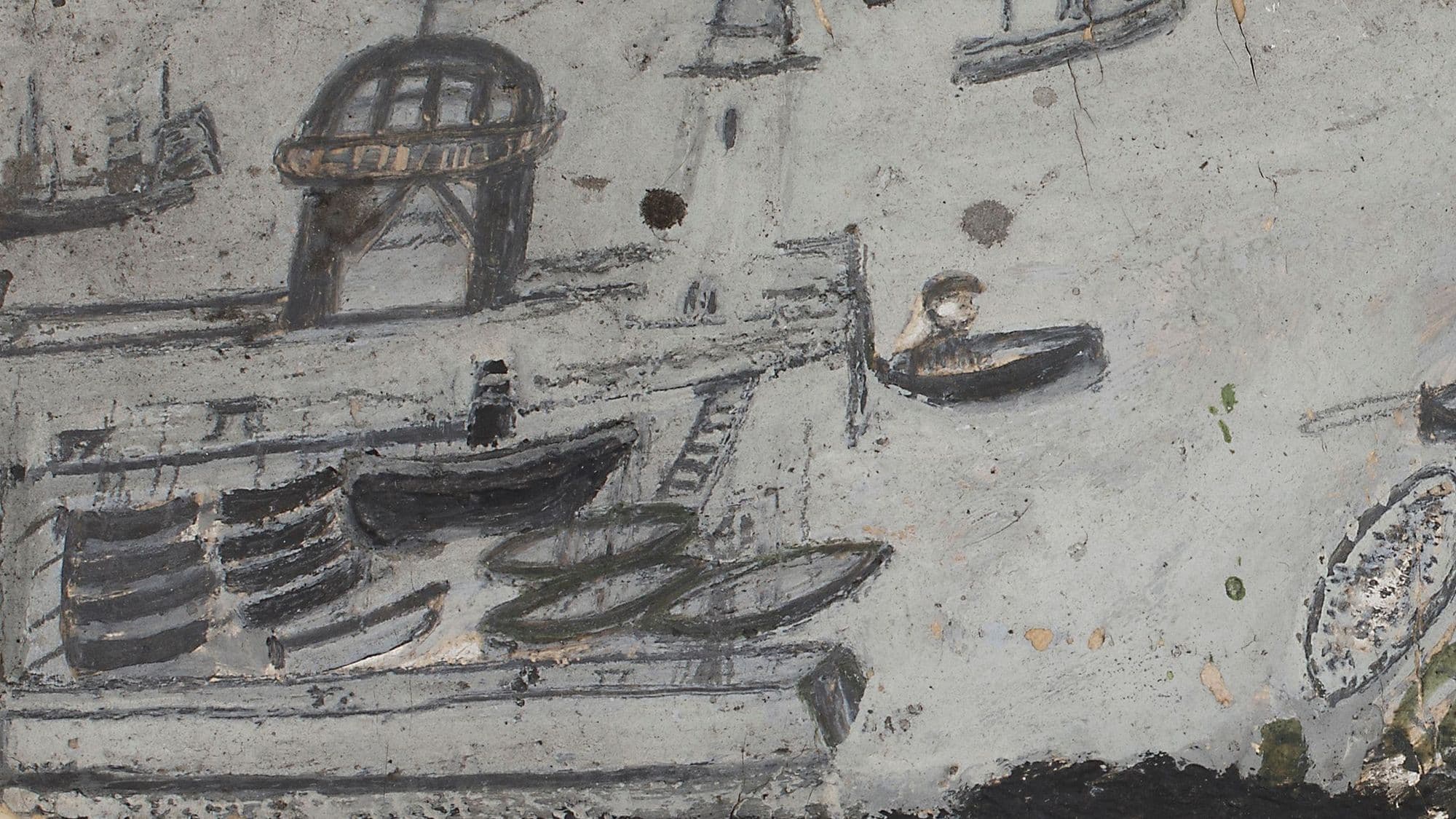
The Peasant and his Wife is an extraordinary bringing together of Adler’s profound compassion for mankind and his technical innovations. The monumentality of the figures is infused with the dignified emotion seen on their faces and expressed in the tenderness of their poses. The textured, layered technique is presented by way of a palette of muted earth tones, which is combined with the brilliantly coloured geometry of the setting. As Sarah Mac Dougall has pointed out, Adler’s work of this period reveals his assimilation of that of his Modernist contemporaries including Fernand Léger, Picasso and perhaps the Surrealists, realised within his own distinctive visual language.
After a sojourn in Kirkcudbright from August 1942 until September 1943, Adler moved to London in 1943 where his neighbours at 77 Bedford Gardens included the Neo-Romantics Robert Colqhoun and Robert MacBryde. He was to have a tremendous impact on their work, as well as on other leading Modern British artists of their generation. Indeed, the face of the seated woman in The Peasant and his Wife could be mistaken for a quotation from a painting by Colquhoun. The depth of impact that Adler had on British art is proven by the fact that a Memorial Exhibition of his work was organised by the Arts Council of Great Britain in 1951, two years after his death.
The importance of The Peasant and his Wife is demonstrated by its inclusion in several major exhibitions, including the international touring solo show of 1985-1986, proving Fergusson’s declaration that Adler’s work embodied ‘an unusual combination of great force and extreme sensibility’ (as quoted in the Jewish Echo, 6 June 1941).