Lot 52
JANKEL ADLER (POLISH 1895-1949)
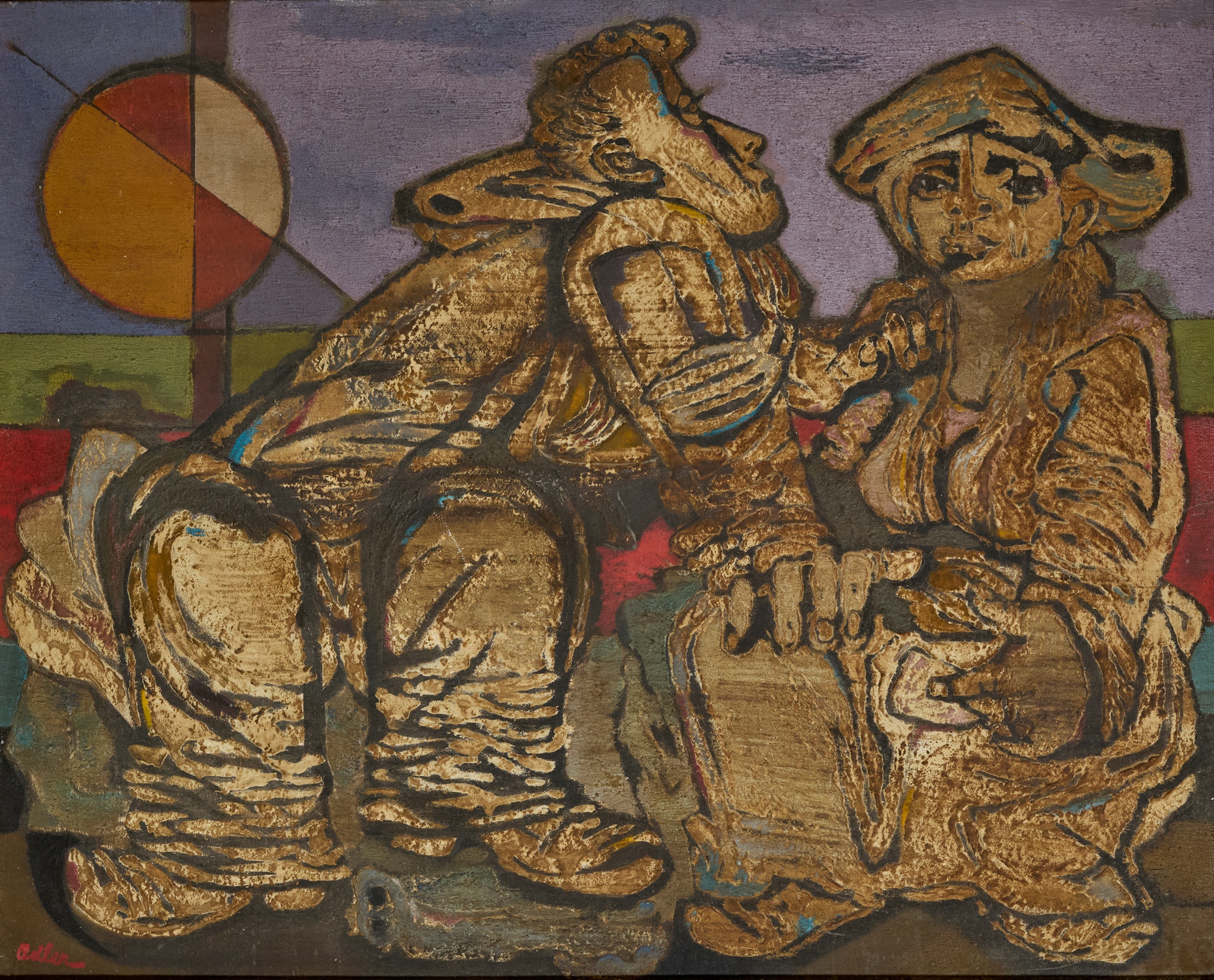
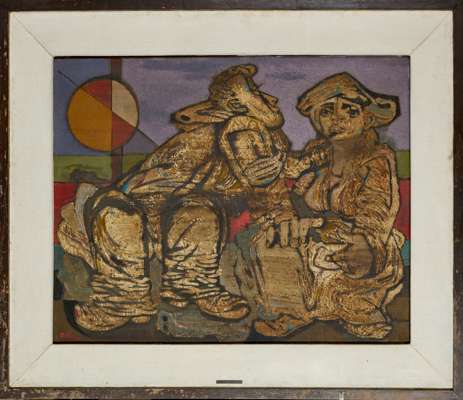
THE PEASANT AND HIS WIFE, c.1941
Auction: MODERN MADE | Lots 1 - 422 | Fri 01 May at 10am
Description
signed (lower left), oil on canvas
Dimensions
85cm x 110cm (33 ½in x 43 ¼in)
Provenance
Gift of the Artist to the late owner's grandfather, c.1941-42
Footnote
Exhibited:
Scottish National Gallery of Modern Art, Edinburgh, New Painting in Glasgow 1940-46, 6 July-4 August 1968 and tour to Scottish Arts Council Gallery, Glasgow, 7-28 September 1968 and Art Gallery and Regional Museum, Aberdeen, 5-19 October 1968, no.6 (reproduced in black and white on the catalogue cover);
Art Gallery and Museum, Kelvingrove, Glasgow, Jewish Art: Paintings and Sculpture by 20th-century Jewish Artists of the French and British Schools, 5 September-7 October 1979, no.3;
Städtische Kunsthalle, Dusseldorf, Jankel Adler 1895-1949, 1 November-8 December 1985 and tour to Tel Aviv Museum, 23 December 1985-11 February 1986 and Muzeum Sztuki, Lodz, 28 February-13 April 1986, no.67.
The Peasant and his Wife of c.1941 by the Polish-Jewish artist Jankel Adler is a rare and major example of European Modernism painted in Britain. It is also a testament to the time the artist spent in Glasgow between 1941 and 1942. The work has remained in the same private Glaswegian collection ever since it was acquired from Adler in about 1941 by the late owner’s grandfather, in lieu of a dental bill.
Adler was born in Tuszyn, Poland in 1895. He studied in Belgrade, Barmen and Dusseldorf and joined various progressive art groups in Poland and Germany, where he met Otto Dix. In 1931 he became friends with Paul Klee when they were teaching at Dusseldorf Art Academy. As a result of his work being declared ‘degenerate’ by the Nazis, Adler fled to Paris in 1933, where he met Pablo Picasso. He spent much of the next two years travelling before returning to France.
Following the outbreak of the Second World War, Adler joined the Polish army and was evacuated out of Dunkirk to Scotland, arriving on 22 June 1940. He moved to Glasgow on 6 December that year and was given a medical discharge on 23 January 1941. He lived first at 142 Renfrew Street in the city before moving to 15 Newton Street. By the time of his arrival, Adler was recognised as a major figure in the European avant-garde and his work was represented in the collections of public galleries including those in Berlin, Lodz, Moscow and Tel Aviv.
Adler was welcomed into Glasgow’s art world and soon held a solo exhibition in the Jewish sculptor Benno Schotz’s studio. As Head of Sculpture and Ceramics at Glasgow School of Art, Schotz was in an ideal position to introduce Adler to the Glaswegian artists’ community, as well as to re-unite him with his fellow Polish-Jewish émigré artist Josef Herman, whom Adler had known in Warsaw.
In 1972, Herman recalled:
“His gift for making friends was prodigious … he was a joy to be with. His conversation ranged wide … his mode of painting was built upon traditions of many countries and many peoples. In this lay his sophistication … He had an incessant thirst for rich and complex styles.” (Josef Herman, ‘Notes from a Glasgow Diary: 1940-43’, The Scottish Art Review, vol. XIII, no.3, 1972, pp.2-3)
The arrival of the Scottish Colourist John Duncan Fergusson and his dance pioneer partner Margaret Morris in Glasgow in 1939 had done much to energise the local art scene. In 1940 they were co-founders of the progressive discussion and exhibiting society the New Art Club, of which Adler became a member; he was to exhibit with its offshoot, the New Scottish Club, in November 1942. Adler also became involved with The Centre, established by David Archer as a bohemian café, bookshop and discussion forum. Fergusson and Adler acted as its Chair and Vice-Chair respectively. Herman declared “These were the two men who gave Glasgow of the times a rare atmosphere. It was in their presence that one felt as though art was at the centre of the city’s life.” (op.cit., p.5). Adler himself claimed “For the painter, the bagpipe sounds are a new colour to his palette” (as quoted in typescript of Michael Middleton, ‘Jankel Adler: A Talk given at Ben Uri Art Gallery, London on 16 March 1950’, Ben Uri Gallery Archive).
When asked to write the foreword to the catalogue for Adler’s exhibition at Annan’s Gallery in Glasgow in June 1941, Fergusson could be referring to The Peasant and his Wife when he explained:
“It is as an ‘idea’ that I’d like to present Adler. Adler the man I don’t know. I’ve only met him a few times, but Adler the ‘idea’ I knew immediately I saw his paintings with their unusual combination of great force and extreme sensibility … These works of Adler’s are some of the best modern paintings I’ve seen.”
The painting also embodies the Jewish Echo’s review of the exhibition in which it was declared that ‘his sense of colour and form is superb. Most of the pictures have inner balance and a calm monumentality which is enhanced by his mural-like technique … Adler creates a world of his own.’ (20 June 1941). Adler’s work was included in the landmark Exhibition of Jewish Art organised by Schotz and Herman at the Jewish Institute in Glasgow in December 1942.
The Peasant and his Wife is an extraordinary bringing together of Adler’s profound compassion for mankind and his technical innovations. The monumentality of the figures is infused with the dignified emotion seen on their faces and expressed in the tenderness of their poses. The textured, layered technique is presented by way of a palette of muted earth tones, which is combined with the brilliantly coloured geometry of the setting. As Sarah Mac Dougall has pointed out, Adler’s work of this period reveals his assimilation of that of his Modernist contemporaries including Fernand Léger, Picasso and perhaps the Surrealists, realised within his own distinctive visual language.
After a sojourn in Kirkcudbright from August 1942 until September 1943, Adler moved to London in 1943 where his neighbours at 77 Bedford Gardens included the Neo-Romantics Robert Colqhoun and Robert MacBryde. He was to have a tremendous impact on their work, as well as on other leading modern British artists of their generation. The depth of impact that Adler had on British art is proven by the fact that a Memorial Exhibition of his work was organised by the Arts Council of Great Britain in 1951, two years after his death.
The importance of The Peasant and his Wife is demonstrated by its inclusion in several major exhibitions, including the international touring solo show of 1985-1986, proving Fergusson’s declaration that Adler’s work embodied ‘an unusual combination of great force and extreme sensibility’ (as quoted in the Jewish Echo, 6 June 1941).