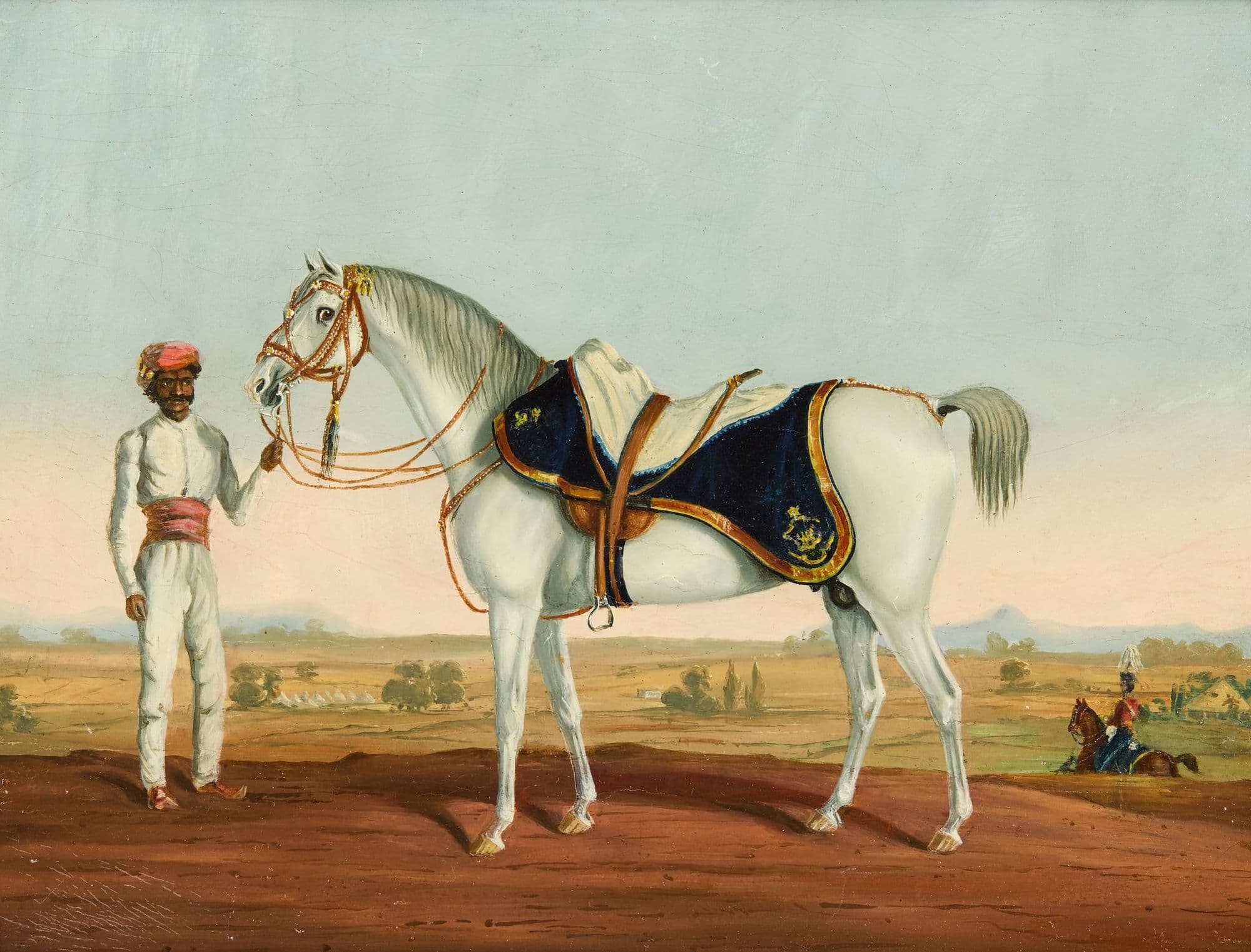
Silhouetted against empty plains and a large sky, the painting emphasises the muscular features of this magnificent horse and leaves us wondering about the identity of its owner. The golden insignia, dark blue saddle blanket and presence of a lone calvary man cantering into the distance connect this military painting with the 4th (The Queen’s Own) Regiment of (Light) Dragoons. This elite fighting force initially raised in 1685 was trained to fight both on horseback and foot and served in India and Afghanistan between 1822 to 1842.
As the British East India Company grew and expanded its territories in South Asia during the late 1700s, so its employees sort to capture in paint its exotic landscapes, wildlife and population. By employing local artists and encouraging a European palette and painting style a new genre of paintings was born which has collectively become known as ‘Company’ paintings. These paintings were usually created in watercolour with a linear perspective and shading. Aesthetically they appear as an evolution of the romanticised scenes of India created by the likes of Thomas and William Daniell.
Horse and Groom shows stylistic similarities to the work of Shaykh Muhammad Amir of Karraya, widely acknowledged as 'by far the most talented and original' of all Calcutta painters specialising in work for the British (Archer, 1972). Shaykh Muhammad Amir of Karraya was known for his distinctively curved shadows cast by horse and groom and was popular with the city's colonial elite in the second quarter of the 19th Century. Shaykh Muhammad Amir success enabled him to create a large studio employing many artists to work in his style to satisfy the ever-increasing demand for his work.
In 2023 Lyon & Turnbull sold a major album of watercolours by this leading practitioner; a work of far greater extent than any other known single collection of his work and a spectacular evocation of the lost world of Calcutta in the era of Company rule. The Balfour Album achieved £112,700 inc premium at auction.
On the reverse of this picture is an old handwritten note which finally reveals subject, historical insight and poignant loss: