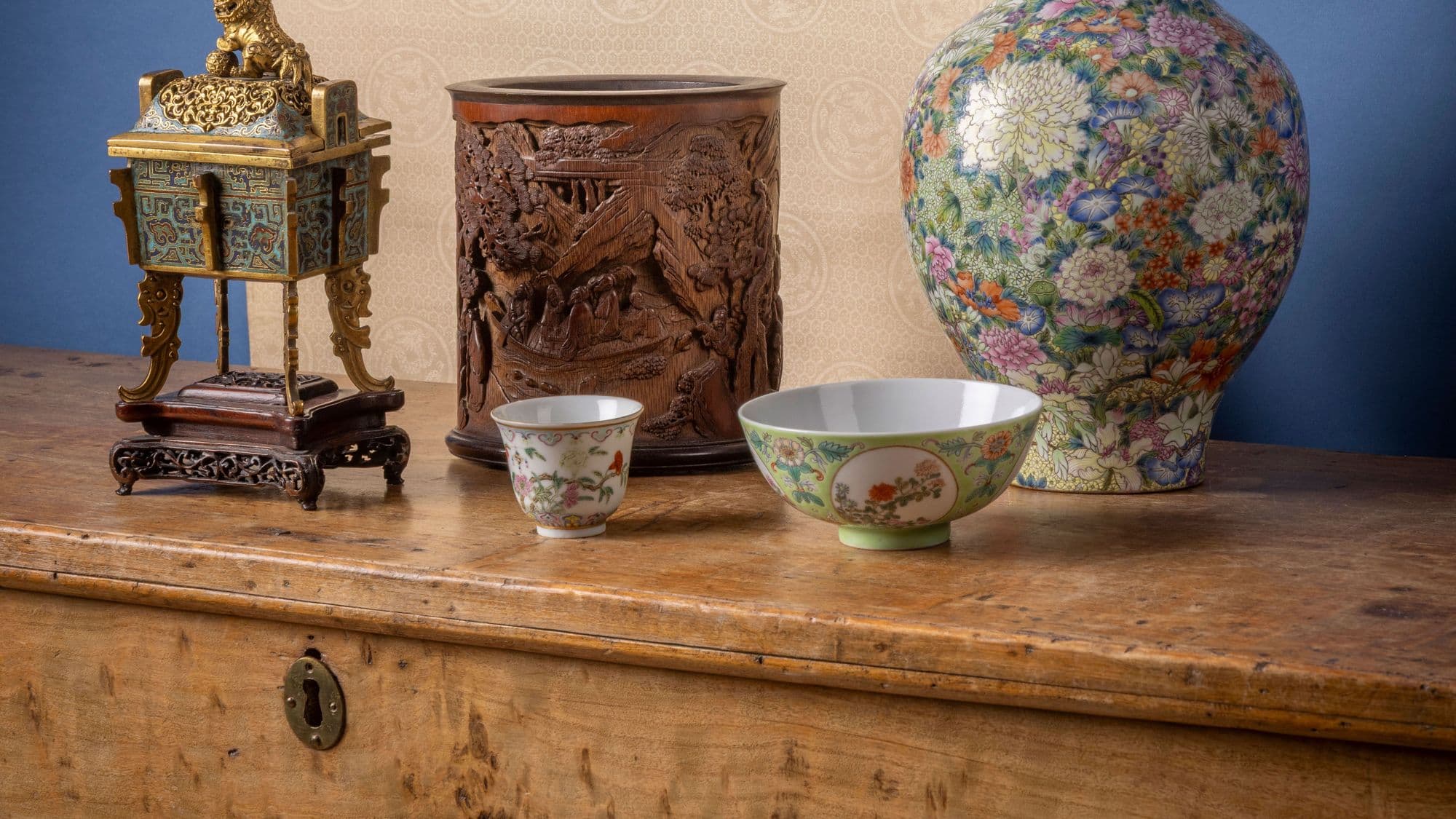
Chinese Famille Rose Porcelain
Among the Chinese blue and white and famille rose ceramics is a Chinese Famille Rose Sweetmeat Set, dating to the Qing dynasty, 18th century, is particularly notable.
Dishes from the set bear Christie’s labels to the reverse reading ‘CHRISTIES, 10th June 1999’ and inscribed ‘707/9’, indicating that they were offered at Christie’s South Kensington on 10 June 1999, lot 707. The labels provide an established provenance and a notable connection to the London auction market.
Famille rose is a term used for Chinese porcelain decorated with a palette characterised by opaque pink enamels alongside a wider range of colours. Introduced during the Qing dynasty, it became an important part of both Chinese domestic and export porcelain production.
Straits Chinese Porcelain
Another noteworthy ceramic is a Straits Chinese Famille Rose Four-Section Tiffin Carrier bearing a Xu Shunchang mark and dating from the late Qing dynasty to Republic period, 19th–20th century.
Characteristic of the rich cultural exchange between China and Southeast Asia, Straits Chinese porcelain represents an important and highly collectable category within Chinese export ceramics. Straits Chinese or Peranakan porcelain was produced in China for communities in Southeast Asia, particularly in the Straits Settlements. Its distinctive forms and decoration reflect the interaction between Chinese manufacture and Southeast Asian tastes and customs.
Chinese Export Silver
For metalware in the collection, the unusual Lot 27, a Chinese Export Silver Epergne and Spill Vase, is particularly notable. The pieces were made by Wing Sang, Shanghai, and Wang Hing, Hong Kong. Chinese export silver encompasses silver produced principally for international and expatriate markets, particularly during the 18th, 19th and early 20th centuries. Maker's marks, retailer's marks, decoration, provenance and condition can all assist specialists when researching individual pieces.
Chinese Furniture and Jardinière Stands
The collection also demonstrates a strong appreciation for Chinese furniture. An outstanding highlight is Lot 45, a Chinese Black-Lacquered Hardstone-Inlaid Four-Leaf Screen.
Combining black lacquer with hardstone inlay, the screen exemplifies the sophisticated decorative techniques associated with Chinese furniture and interiors of the late Qing dynasty to Republic period, while its four-leaf format lends it both decorative presence and versatility.
Various jardinière stands are both decorative and utilitarian pieces for the household, something that can be glimpsed through the images illustrated here.
Japanese Art and Satsuma Ware
The collection continues later in the sale with six lots of Japanese art, Lots 239–244, culminating in Lot 242, a Large Japanese Satsuma Vase, dating to the Meiji period. Satsuma ware became one of the best-known forms of Japanese ceramics in Western collections during the Meiji period (1868–1912). Examples produced for the international market are often characterised by finely painted decoration and extensive gilding.