Louis C. Tiffany (1848-1933) established Tiffany Studios (1885-1930) as a collaborative workshop amid the industrial bustle of New York’s Golden Age. As founder and artistic director, Tiffany set the creative direction, maintained extensive design reference files, and closely supervised production at a time of rapid industrial development.
His artistic vision was realised through the expertise of skilled designers and crafts people across the city. Rather than designing every object himself, he relied on specialist teams to develop and refine designs under his guidance.
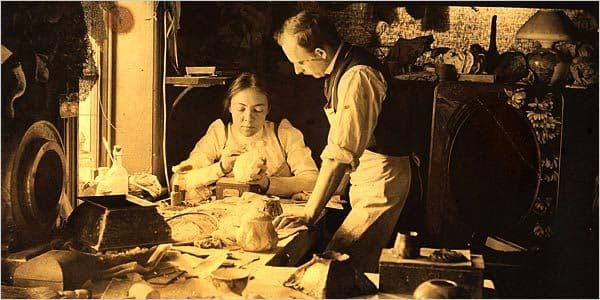
Among the most significant of these collaborators was Clara Driscoll (1861-1944), head of the Women’s Glass Cutting Department from the late 1890s. Drawing inspiration from the natural world, Driscoll designed many of Tiffany Studios’ most celebrated leaded-glass lamps including the Dragonfly, Wisteria, Butterfly, Poppy and Fern models. Her rediscovered letters reveal that she was responsible for developing original concepts, producing detailed drawings, creating clay and plaster models, and selecting the colours and arrangement of individual pieces of Favrile glass.
Illustrated: Clara Driscoll, 1901 | From The Metropolitan Museum of Art, Unknown Photographer, Public domain, via Wikimedia Commons