The Rediscovery of Cedric Morris
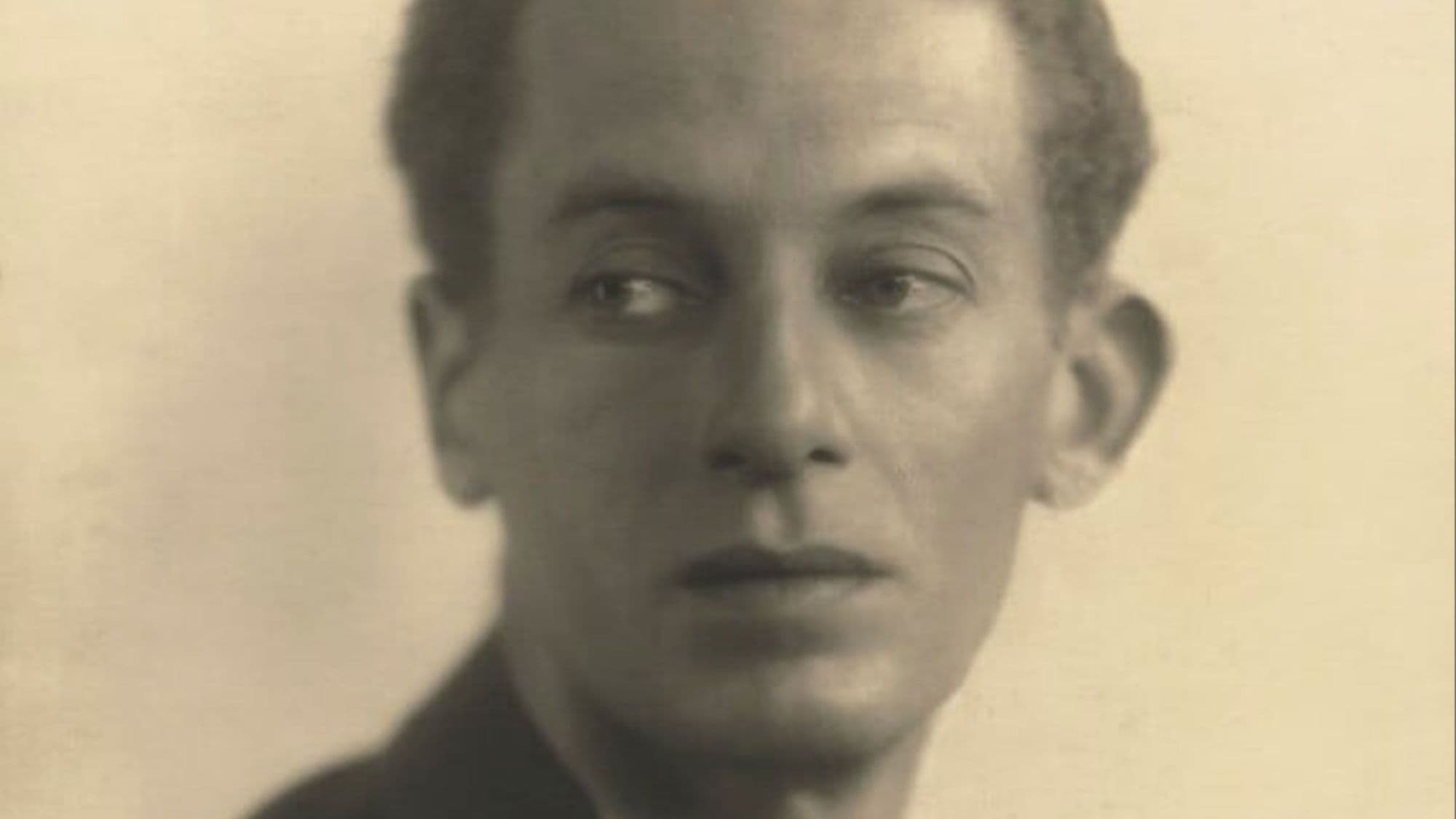
Indeed, a revival of interest in Morris’s achievements was witnessed in the 1960s and 1970s, including the retrospective exhibition mounted by the National Museum of Wales and the Welsh Arts Council in 1968. A further retrospective was held by David Wolfers at his influential New Grafton Gallery in London in 1975.
Wolfers had been introduced to Morris by the artist and collector Natalie Bevan, who formerly co-owned Morris’s paintings Paysage du Jardin no.2 of 1931 and The Blue Poppy of 1932, which were sold by Lyon & Turnbull in 2026 and 2025 respectively (Letter from Wolfers to Morris of 11 October 1974, Personal Papers of Cedric Morris and Arthur Lett-Haines, Tate Archive, TGA 83176).
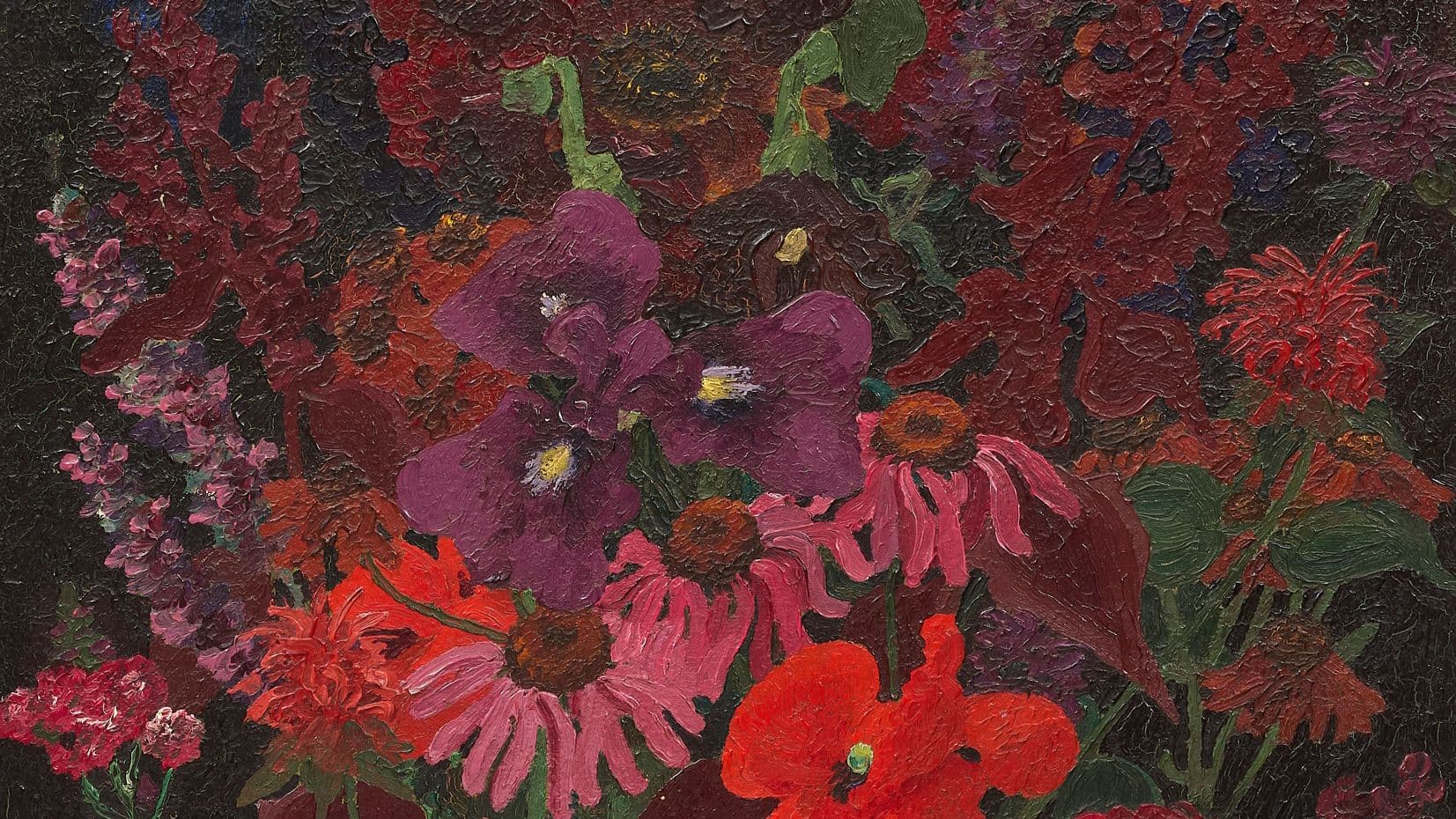
Experiment in Red was one of twenty-nine works shown by Wolfers, covering his career from 1922 to 1963, of which Greek Wallside, Turkey (no.18) and Palace at Oeiras, Portugal (no.27) are now in the collection of Gainsborough’s House. Such was the exhibition’s success that its run was extended to 14 July 1975 (letter from Wolfers to Morris of 14 July 1975, TGA 83176).
From London to Nairobi
As Wolfers reported to Morris, Experiment in Red was ‘sold at your preview party to the owner of the Firmin Gallery in Nairobi’, for the sum of £325 (letters of 27 November 1975 and 1 October 1975, TGA 83176).
The gallerist referred to was Kathleen Firmin (née Barry), who, following the death of her photographer and mountaineer husband Arthur Firmin, ran a gallery that specialised in hand-tinted prints of Arthur’s photographs, as well as paintings and prints.
As Morris had travelled in north Africa in 1921, 1925 and 1926, it was fitting that Kathleen selected Experiment in Red, believing it would appeal to the cultured community of the capital of Kenya – then, as now, one of the most important cities in the Commonwealth, geopolitically, economically and culturally.
It was, in fact, during a royal tour of the Commonwealth, on behalf of her ailing father, King George VI, that Queen Elizabeth II came to Kenya for the first time in February 1952 and it was during this tour, at Treetops Lodge, north of Nairobi in the Aberdare National Park, that she received the tragic news of her father’s passing, thus becoming queen.
Experiment in Red later passed to Linda Lomonaco, Kathleen Firmin’s long-time assistant, who had worked with her hand-tinting Arthur’s prints. Linda went on to run Monaco Fine Arts Ltd in Nairobi, from where Experiment in Red was acquired in 2006.
After spending more than five decades in Africa, the painting returned to the UK, bringing renewed attention to a work which embodies Richard Morphet’s declaration that:
Cedric is one of the most exceptional colourists in twentieth century British art. It is not only the intensity of his colours that tells, but above all the originality and the strange beauty of the relationships between them which he established … he not only made each painting’s basic elements of colour, material and composition come alive in its own right in ways uniquely his own, but he fused them with a personal vision of extraordinary directness.
(Morphet, op. cit., p.87)
We are grateful to David R. Mitchell, Curator, Muddy Feet Consulting for his help with our research.