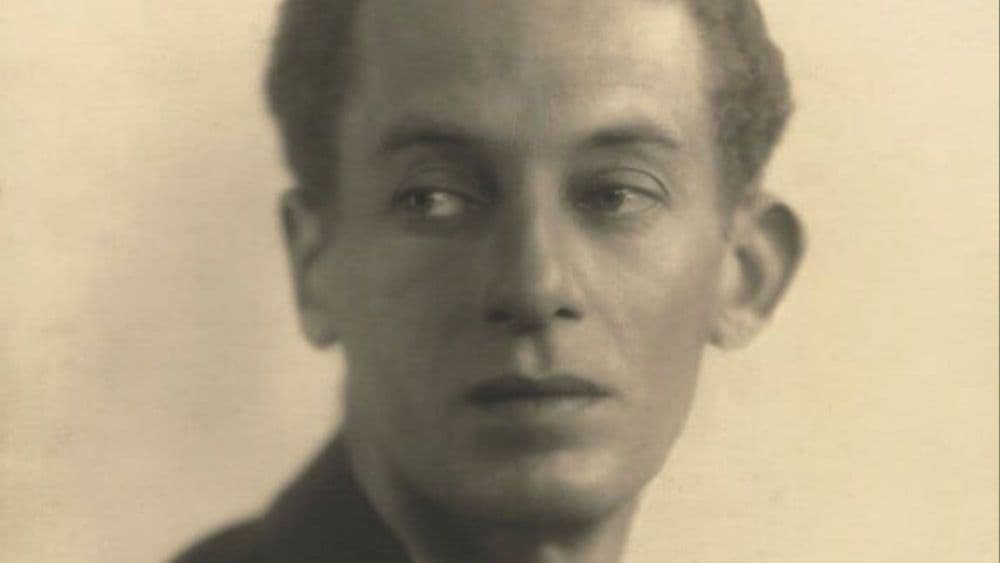
Sir Cedric Lockwood Morris was one of the most distinctive figures in twentieth-century British art, a painter of luminous still lifes and landscapes, a gifted plantsman and a formidable teacher whose influence extended well beyond his own studio practice.
Born in Sketty, Swansea, in 1889, Morris was raised in a well-to-do family and initially steered towards a conventional career. Art, however, prevailed. After time in Paris before the First World War, where he absorbed aspects of Post-Impressionism and modern French painting, Morris returned to Britain with a confident sense of colour and composition that would define his mature work.
In the 1920s, he established himself within London’s avant-garde circles, exhibiting alongside leading modern British artists. Yet the capital’s social life proved distracting. Morris later reflected that there were “no landscapes out of the window” and in 1929 he and his lifelong partner, the artist Arthur Lett-Haines, left London for rural Suffolk. They settled at The Pound in Higham, where the surrounding valley and expansive skies offered both visual stimulus and a new rhythm of life.
It was here that Morris’s twin passions, painting and horticulture, began to intertwine fully. An accomplished and adventurous plantsman, he developed gardens of remarkable originality, cultivating rare species and experimenting with colour and form in the soil as he did on canvas. His move to Benton End, Hadleigh, in 1940 further cemented this union of art and garden. Benton End became not only a celebrated garden but also the home of the East Anglian School of Painting and Drawing, founded by Morris and Lett-Haines.
As a teacher, Morris was demanding, perceptive and quietly radical. Among his students was Lucian Freud, who credited Morris with sharpening his observational discipline. Morris encouraged independence of vision, precision in drawing and an uncompromising approach to colour. His influence on a generation of post-war British painters was considerable, even if understated.
Morris’s own paintings are characterised by bold brushwork, flattened pictorial space and a distinctive handling of colour. His still lifes, often flowers from his own garden, are neither decorative arrangements nor botanical studies alone. They carry structural strength, clarity of line and an intense chromatic presence. His landscapes, particularly those of East Anglia, combine intimacy with breadth, often constructed in strong planes of colour and simplified form.
Throughout his long career, Morris remained independent of artistic fashion. Though connected to modernist circles, he never aligned himself fully with any movement. His work resists easy categorisation: rooted in observation, yet stylised; romantic in subject, yet modern in execution.
Knighted in 1984 shortly before his death, Morris left behind a legacy that extends beyond painting. He shaped one of Britain’s most significant artist-led schools, cultivated plant varieties still grown today, and demonstrated that art and life, studio and garden, could exist as a single, coherent practice.
Today, Cedric Morris is recognised not only as a leading figure in modern British art, but as a singular creative force whose vision bridged cultivation and canvas with rare authority.