Lot 48
SIR CEDRIC LOCKWOOD MORRIS (BRITISH 1889-1982) §
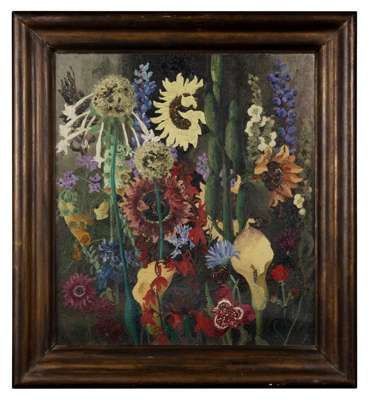
PAYSAGE DU JARDIN No.2, 1931
Auction: MODERN MADE | Lots 1 - 422 | Fri 01 May at 10am
Description
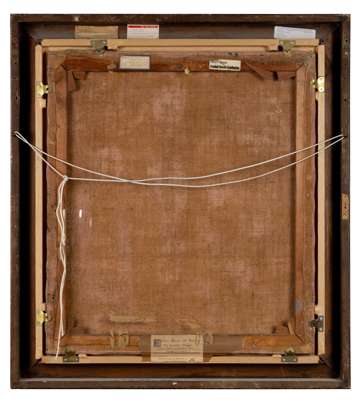
signed and dated (lower left), oil on canvas
Dimensions
71.2cm x 63.6cm (28in x 25in)
Provenance
Acquired from the Artist by Robert (Bobby) Bevan (1901-74) and thence by descent to the present owner.
Footnote
Exhibited:
Leicester Galleries, London, Recent Paintings by Cedric Morris, April 1932, no.30;
The Minories, Colchester, The Flower in Art, August – September 1967, no.31;
National Museum of Wales, Cardiff, Cedric Morris Retrospective, 16 June – 29 July 1968, no.33 with tour to Cyfartha Castle Gallery, Merthyr Tydfil, Wrexham Public Library, Glynn Vivian Gallery, Swansea and The Minories, Colchester;
Gainsborough’s House, Sudbury, The Bevan Collection, 5 – 27 August 1978, no.55;
Tate Gallery, London, Cedric Morris, 28 March – 13 May 1984, no.48, illus. col. p.84;
Scottish National Gallery of Modern Art, Edinburgh, From Sickert to Gertler: Modern British Art from Boxted House, 15 March – 22 June 2008 and partial tour to Gainsborough's House, Sudbury, 4 October - 13 December 2008 and Brighton Museum & Art Gallery, 17 April to 12 September 2010, illus. col. pl.29.
Literature:
Reynolds, Gwynneth and Diana Grace (eds), Benton End Remembered: Cedric Morris, Arthur Lett-Haines and the East Anglian School of Painting and Drawing, Unicorn Press, Norwich, 2017, illus. col. p.50;
St Clair, Hugh, A Lesson in Art and Life: The Colourful World of Cedric Morris and Arthur Lett-Haines, Pimpernel Press Limited, London, 2023, p.80.
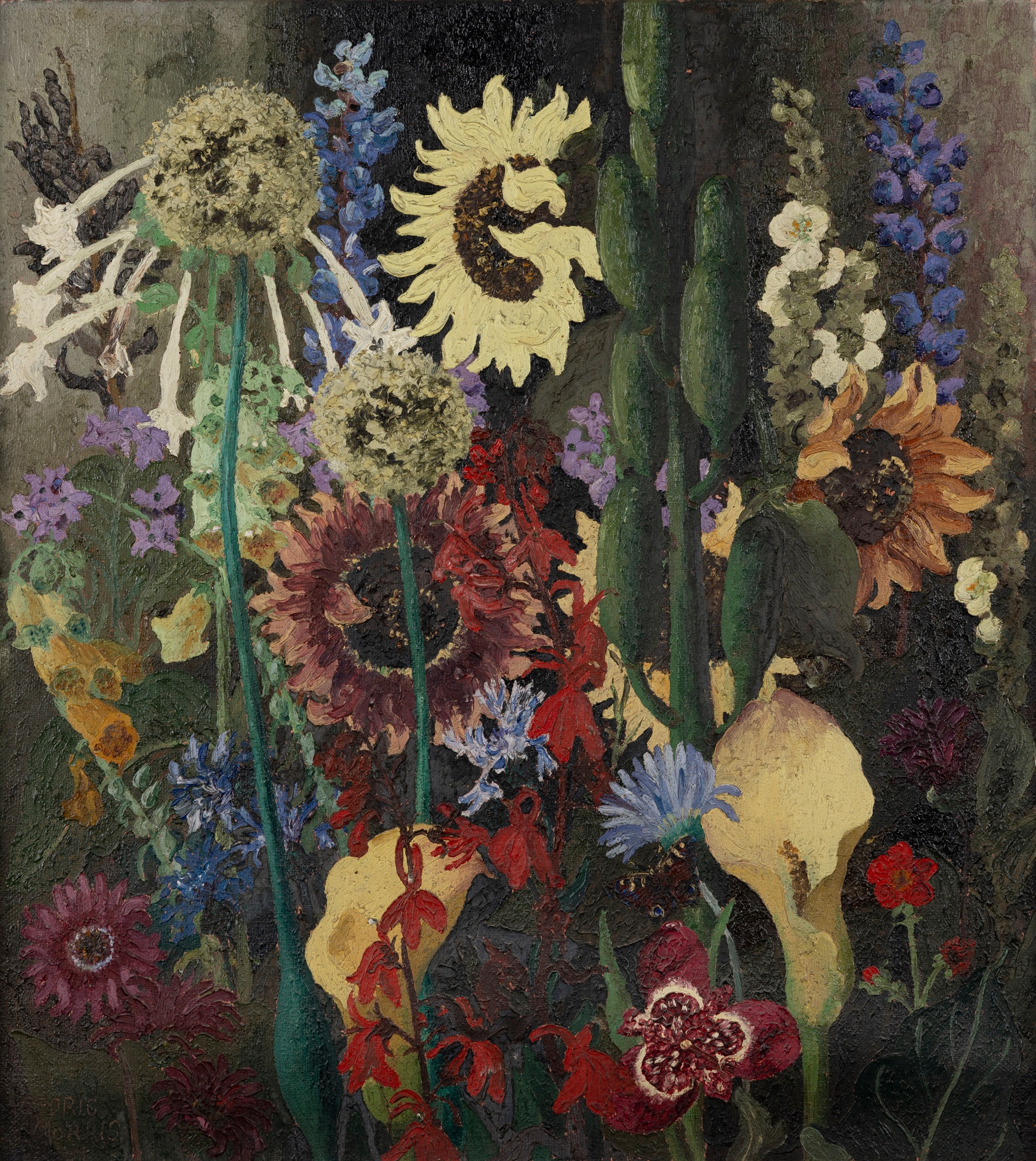
Paysage du Jardin no.2 of 1931 by Cedric Morris epitomises the artist’s twin loves of painting and gardening as befits his reputation not only as a leading British artist of the twentieth century but also as a pioneering plantsman. Moreover, it was created during an auspicious period in Morris’s career and was acquired from him by the advertising executive and renowned collector Robert (Bobby) Bevan. The painting has remained in Bevan’s family to this day.
Morris, Bevan and the latter’s future wife, Natalie Ackenhausen, became friends in the artistic milieu of London of the late 1920s. After professional success in the British capital, in 1929 Morris and his partner Arthur Lett-Haines moved to The Pound, a farmhouse in Higham, Suffolk. Over the next eleven years, Morris transformed its four acres of land into ‘a beautiful, romantic garden where woodcock swooped in winter and nightingales sang on summer evenings’ (Hugh St Clair, A Less in Art & Life: The Colourful World of Cedric Morris & Arthur Lett-Haines, London, 2023, p.63) and Bobby was able to attend the couple’s parties which the artist Joan Warburton recalled ‘showed me what real parties were! … Everyone behaved disgracefully and had a lovely time!’ (as quoted in Richard Morphet, Cedric Morris, London, 1984, p.48).
Paysage du Jardin no.2, translates to ‘Garden Landscape’ and can be understood as a portrait of Morris’s horticultural success. It brims with botanical beauty, symbolism and the sheer pleasure of gardening. Featuring a mix of cottage garden plants and rare exotics, it also includes short-lived flamboyant bursts of colour like the sunflowers. The Himalayan Lily with green seedpods at the right of centre is accompanied by Hollyhocks, Chicory, Lords and Ladies, Cornflowers, Foxgloves, Lupins, Onions and others, whose flower heads, petals, stems, natural colours and textures are brought together in a triumph of powerful abundance.
The painting can also be read as a lexicon of the Victorian language of flowers, allowing Morris to express his knowledge and symbolist intent and adding an extra layer of interpretation to the work. Those chosen represent fecundity, majesty, pride, distinction, ardour, delicacy, youth, purity and imagination, amongst other references. Realised through the generous and expressive application of oil paint, his dynamic subjects are presented together in the frontal plane. Morris signed and dated the work into the surface whilst it was still wet.
Bevan was the son of the Camden Town painter Robert Polhill Bevan and became Chairman of the advertising agency S. H. Benson Ltd. Natalie, a painter, ceramicist and muse to several leading modern British artists, married him in 1946 and they moved to Boxted House, Boxted a year later. Situated some twelve miles from Benton End in Hadleigh, to where Morris and Lett-Haines moved in 1940, the friendship between the quartet flourished during the post-war period, in tandem with the growth of the Bevans’ collection of Contemporary, twentieth-century British and European art
Paysage du Jardin no.2 has been widely exhibited, from Morris’s successful solo exhibition at the Leicester Galleries in London in 1932, to his touring retrospective of 1968, Tate exhibition of 1984 and various iterations of the Bevans’ collection, most recently the touring exhibition mounted by the National Galleries of Scotland in 2008 to 2010.
The widespread press coverage that attended the 1932 exhibition could be referring to Paysage du Jardin no.2 when it declared ‘Mr Morris’s large flower pieces must be among the loveliest works of modern times’ (Daily News, 13 April 1932) and that ‘his flower pictures are really like gardens. You feel that he is taking you, as indeed he is, to beautiful bits in his own garden. He grows the flowers he wants to paint and he loves growing them as much as painting them.’ (Daily News, 12 April 1932).
We are grateful to David R. Mitchell, Curator, Muddy Feet Consulting for his help with our research.