Ye Zhongsan and the Ye Family
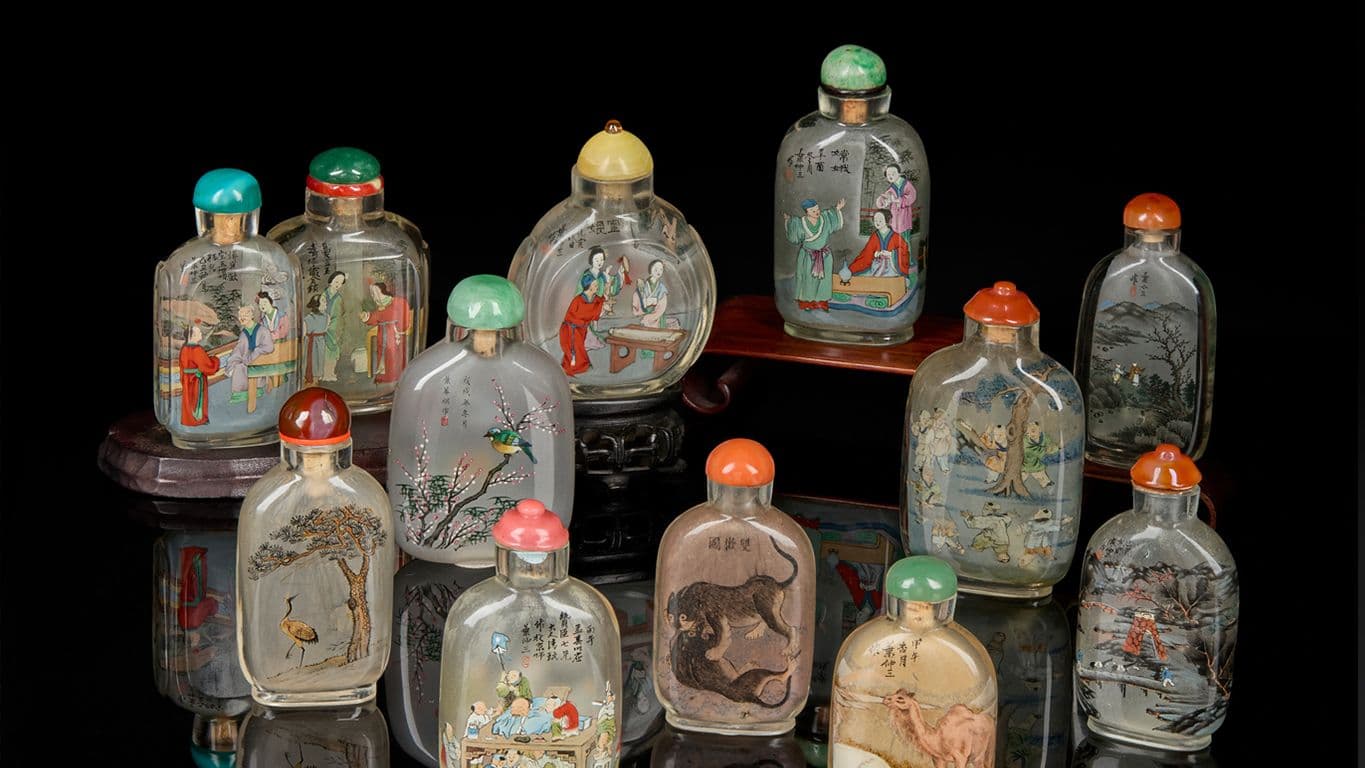
Ye Zhongsan (1875–1945) was one of the foremost masters of Beijing inside-painting during the late Qing dynasty and early Republic period. Alongside Zhou Leyuan, Ma Shaoxuan and Ding Erzhong, he was one of the Four Great Inside Painters who helped establish the artistic standards of the medium.
His work is recognised for its vivid colours, refined brushwork and carefully composed imagery, often complemented by inscriptions. His subjects ranged from figures, landscapes, flowers and birds to animals and literary subjects drawn from classical Chinese literature.
Literary narratives formed an important part of Ye's repertoire. His paintings drew upon celebrated works including Strange Tales from a Chinese Studio (Liaozhai Zhiyi), Pu Songling's (1640–1715) collection of supernatural stories, and Dream of the Red Chamber (Honglou Meng), the eighteenth-century novel by Cao Xueqin (1710–1765).
These subjects demonstrate how inside-painted bottles could serve as miniature illustrations of familiar literary narratives, translating complex scenes and characters into remarkably small compositions.
Ye Xiaofeng and the Family Studio
Ye's artistic legacy continued through his sons. His eldest son, Ye Xiaofeng (1900–ca. 1969), trained under his father from an early age and specialised particularly in figure painting, while also depicting animals and insects.
He sometimes assisted his father, who would add finishing details and inscriptions to paintings begun by his son. This collaborative approach reflects the importance of the family studio in preserving techniques and maintaining a recognisable artistic tradition.
Ye Bengqi and Imperial Enamelled Glass
Ye Bengqi (active ca. 1930–1960), the third son of Ye Zhongsan, is particularly renowned for his convincing reproductions of Imperial enamelled glass snuff bottles. According to an interview with Hugh Moss in 1974, he studied genuine Imperial examples in Beijing's Palace Museum, memorising their designs before recreating them at the family's Apricot Grove Studio. His work demonstrates the family's interest in both the preservation of traditional techniques and the study of earlier Chinese decorative arts. Ye Bengqi also practised inside-painting.
Ye Shuying and the Next Generation
The tradition continued through Ye Shuying (b. 1939), granddaughter of Ye Zhongsan and daughter of Ye Bengqi. Considered one of the earliest women to practise this art, she began around 1957. Trained by her father and uncle Ye Xiaofeng, she painted figures, flowers and birds, goldfish and insects. Her work represents the continuation of the Ye family's inside-painting tradition into the second half of the twentieth century.
Ma Shaoxuan and the Family Workshop
Ma Shaoxuan (1867–1939) was another leading figure of the Beijing School, celebrated for his fine brushwork, inscriptions and accomplished portraits. His ability to capture individual likenesses on a miniature scale demonstrates the expressive potential of inside-painting.
The family attribution of some works associated with Ma Shaoxuan is particularly significant. Production was not necessarily confined to the master himself, as his elder brother Ma Shaoxian, his nephew and other workshop members could contribute to works bearing the family name or reflecting its style.
This workshop tradition illustrates the collaborative nature of Chinese inside-painting and the importance of distinguishing between individual artists and family production.
Zhu Zhanyuan and Yan Yutian
Zhu Zhanyuan was a relatively rare artist associated with the style of Zhou Leyuan, whose compositions influenced later Beijing painters. His surviving works demonstrate how artists outside established family lineages adapted the approaches of earlier masters, contributing to the development of the school.
Yan Yutian was another artist associated with the Beijing School and influenced by Zhou Leyuan. He produced lively compositions featuring figures, animals and landscapes. Together, these artists demonstrate the breadth of Beijing inside-painting beyond its best-known masters and family workshops.
The Legacy of the Beijing School
The development of Chinese inside-painted snuff bottles reflects both individual artistic achievement and the transmission of specialist skills across generations.
From Ye Zhongsan's literary narratives and varied subjects to the successive generations of his family, the workshop tradition associated with Ma Shaoxuan and the individual approaches of Zhu Zhanyuan and Yan Yutian, the Beijing School encompassed a remarkable range of styles and subjects. United by a demanding technique, these painters transformed small glass bottles into sophisticated works of miniature art and established the Beijing School's important place in Chinese snuff-bottle history.