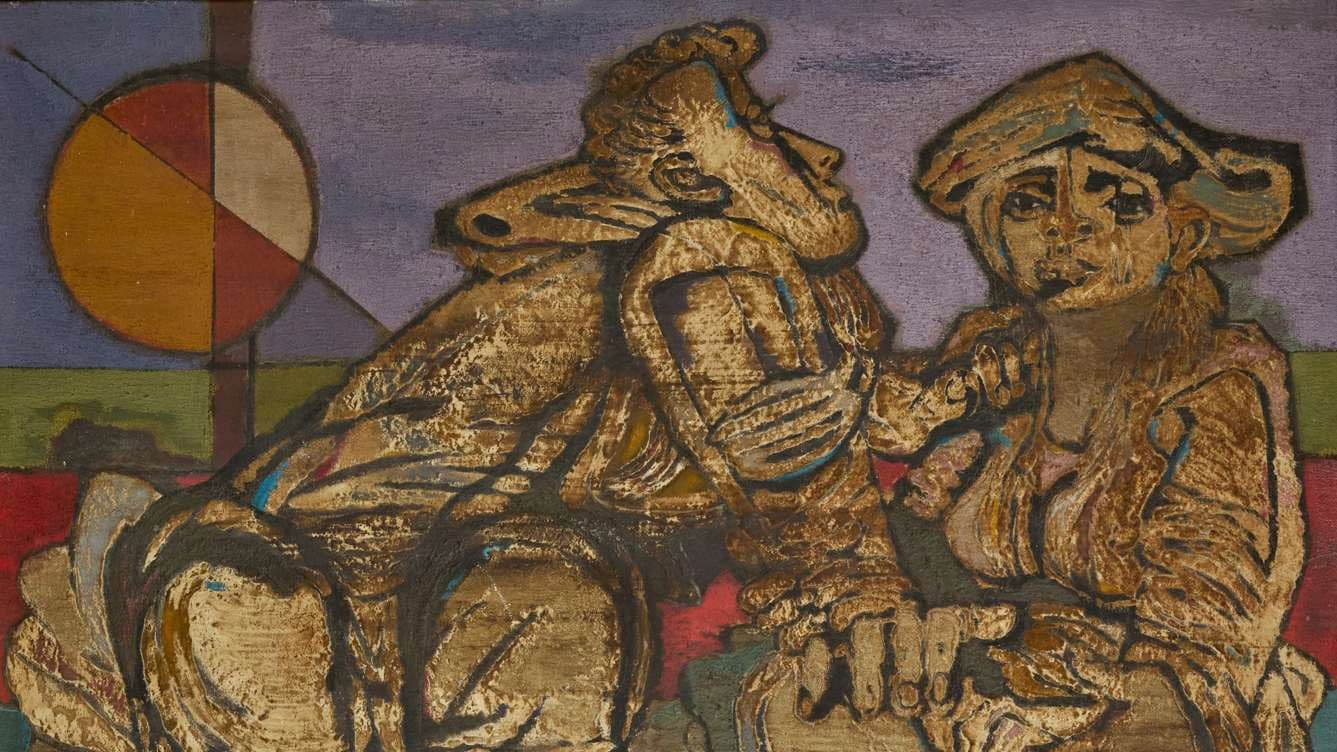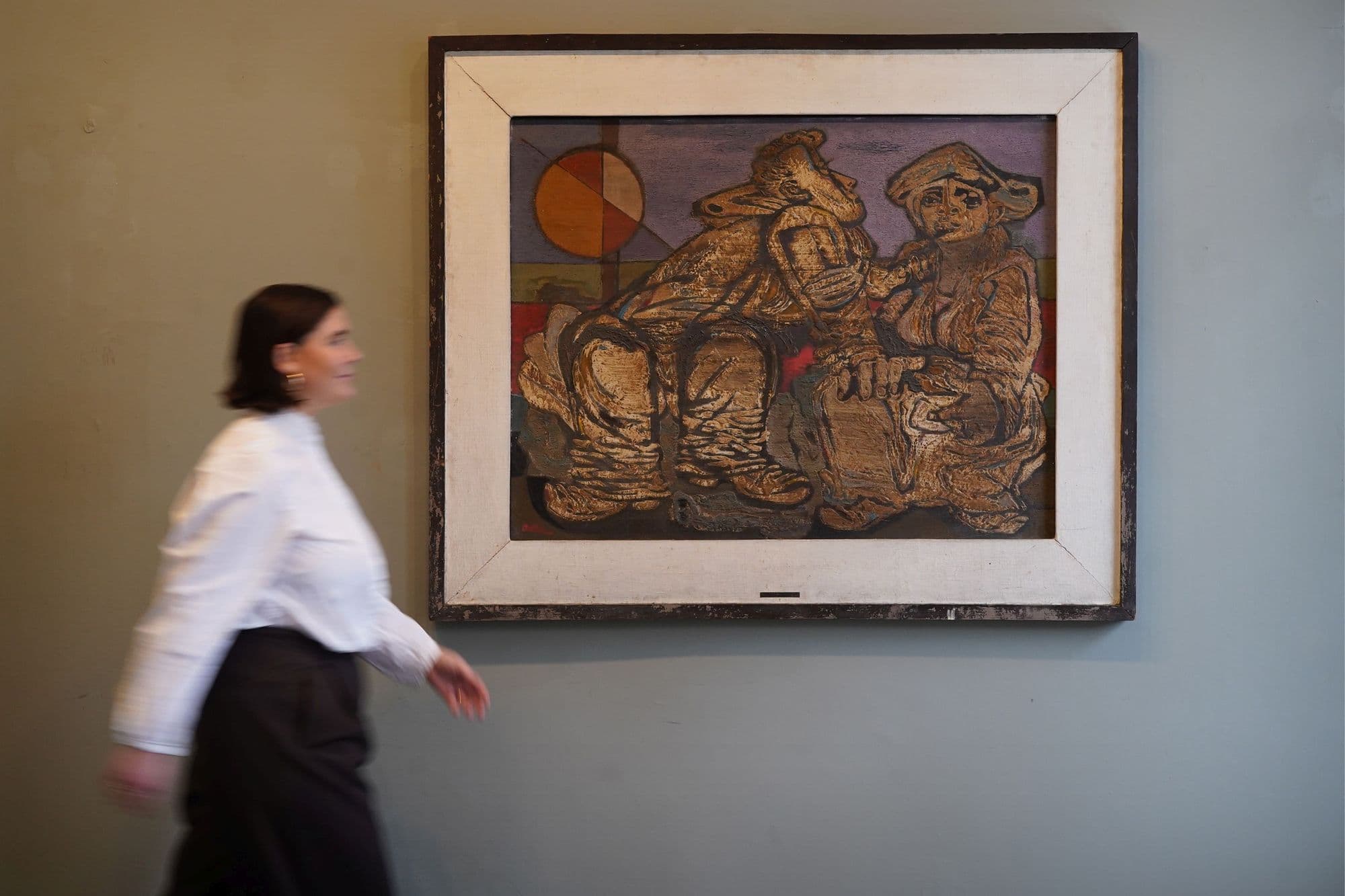
A rare example of European Modernism painted in Glasgow around 1941 by influential Polish-Jewish artist, Jankel Adler (1895-1949), is going on display in Glasgow this week.
It's the first time Adler's The Peasant and his Wife will have been seen in public for 40 years.
The painting has been in the same Glasgow family since the late owner’s grandfather, Adler's dentist in the city, received it in exchange for dental work.
Viewing will be available in Lyon & Turnbull's Glasgow gallery by appointment from today (Tuesday 24th March) to Thursday 26th March and then by appointment in the company’s Edinburgh headquarters from Sunday 29th to Monday 30th March.
The painting will then travel to the Mall Galleries on The Mall in London where it will be on public display from Tuesday 28th April until the day of the auction.
Estimated to fetch between £50,000 to £80,000, the work will be sold on Friday 1 May as part Lyon & Turnbull's MODERN MADE sale.
The Peasant and his Wife was painted during the time which Adler, a major figure in the European avant-garde, spent in Glasgow as a refugee between 1941 and 1942.
He became a member of progressive art groups in Germany and in 1931 became friends with the Swiss-German painter, Paul Klee when they taught at the Dusseldorf Academy.
Adler was one of many high-profile Jewish artists who left Germany from 1933 owing to the rise of the Nazis, who declared his work ‘degenerate' and confiscated several of his works from German museums. Forced to flee, Adler travelled widely in the next few years, living mainly in Paris, where he met leading figures in the art world, including Pablo Picasso.
Lyon & Turnbull's Senior Fine Art Specialist and Co-Head of the Modern Made auction Simon Hucker explains:
"Following the outbreak of the Second World War, Adler joined the Polish army and was evacuated out of Dunkirk to Scotland, arriving on 22 June 1940. After medical discharge, he moved to Glasgow in January 1941.
"Adler was quickly welcomed into the city’s thriving art scene on which he had a tremendous impact. He held his first exhibition in Glasgow in Jewish sculptor Benno Schotz’s studio shortly afterwards.
"As Head of Sculpture and Ceramics at Glasgow School of Art, Schotz was in an ideal position to introduce Adler to the Glaswegian artists’ community, as well as to re-unite him with his fellow Polish-Jewish émigré artist Josef Herman, whom Adler had known in Warsaw."
Adler also met the Scottish Colourist, John Duncan Fergusson, and his dance pioneer partner Margaret Morris, who had moved to Glasgow in 1939.
Fergusson wrote the catalogue foreword for an exhibition of Adler’s work at Annan’s Gallery in Glasgow in June 1941, stating:
"Adler the man I don’t know. I’ve only met him a few times, but Adler the ‘idea’ I knew immediately I saw his paintings with their unusual combination of great force and extreme sensibility … These works of Adler’s are some of the best modern paintings I’ve seen."
Fergusson and Morris co-founded Glasgow's New Art Club in 1940. Adler quickly became a member of this progressive discussion and exhibiting society.
Adler was also involved with The Centre in the city, established by David Archer as a bohemian café, bookshop and discussion forum. Fergusson and Adler acted as its Chair and Vice-Chair respectively.
Adler’s work was subsequently included in a landmark Exhibition of Jewish Art organised by Schotz and Herman at the Jewish Institute in Glasgow in December 1942.
After a spell in the Scottish artists’ town of Kirkcudbright in 1942, Adler moved to London in 1943 where his neighbours at 77 Bedford Gardens in Kensington included the acclaimed Scottish painters Robert Colquhoun and Robert MacBryde, now known as the ‘Two Roberts’.
Simon Hucker notes:
"If you look at the face of the woman especially. you can really see Adler’s influence over the Roberts: it looks it could have been painted by Colquhoun.
Adler was a mentor to the two younger artists, encouraging them to paint from ‘memory and imagination’. He moved from London to Wiltshire in 1945 and died four years later at the age of 53.
The depth of impact that Adler had on contemporary British art is proven by the fact that a Memorial Exhibition of his work was organised by the Arts Council of Great Britain in 1951, just two years after his death.
The importance of The Peasant and his Wife is demonstrated by its inclusion in several posthumous major exhibitions.
It was selected for New Painting in Glasgow 1940-46, in 1968 organised by the Scottish National Gallery of Modern Art in Edinburgh which toured to Glasgow and Aberdeen.
The painting also featured in a show in 1979 at Kelvingrove Art Gallery and Museum in Glasgow called Jewish Art: Paintings and Sculpture by 20th-century Jewish Artists of the French and British Schools.
It was included too in the 1985 exhibition at Städtische Kunsthalle, Dusseldorf, titled Jankel Adler 1895-1949. The show toured to Tel Aviv Museum and Muzeum Sztuki, Lodz.
Simon Hucker adds:
"It's a real privilege to be able to bring this rare and major work to the market for the first time ever.
"This is a large-scale, ambitious, fully-fledged example of European Modernism, representing the very best of Jankel Adler, but painted in Glasgow during the War, under stressed circumstances. I think you can see something of the zeitgeist in the painting its, a sense of loss of the past and some hope in modernity."
Image credit: STEWART ATTWOOD