What Types of Dinosaur Fossils Are Collectable?
Dinosaur fossils offered at auction range from individual teeth and bones to jaws, skulls and substantially complete skeletons. The significance of a specimen depends not simply on what part of the animal survives, but on the species, quality of preservation and the information that accompanies it.
Dinosaur Teeth
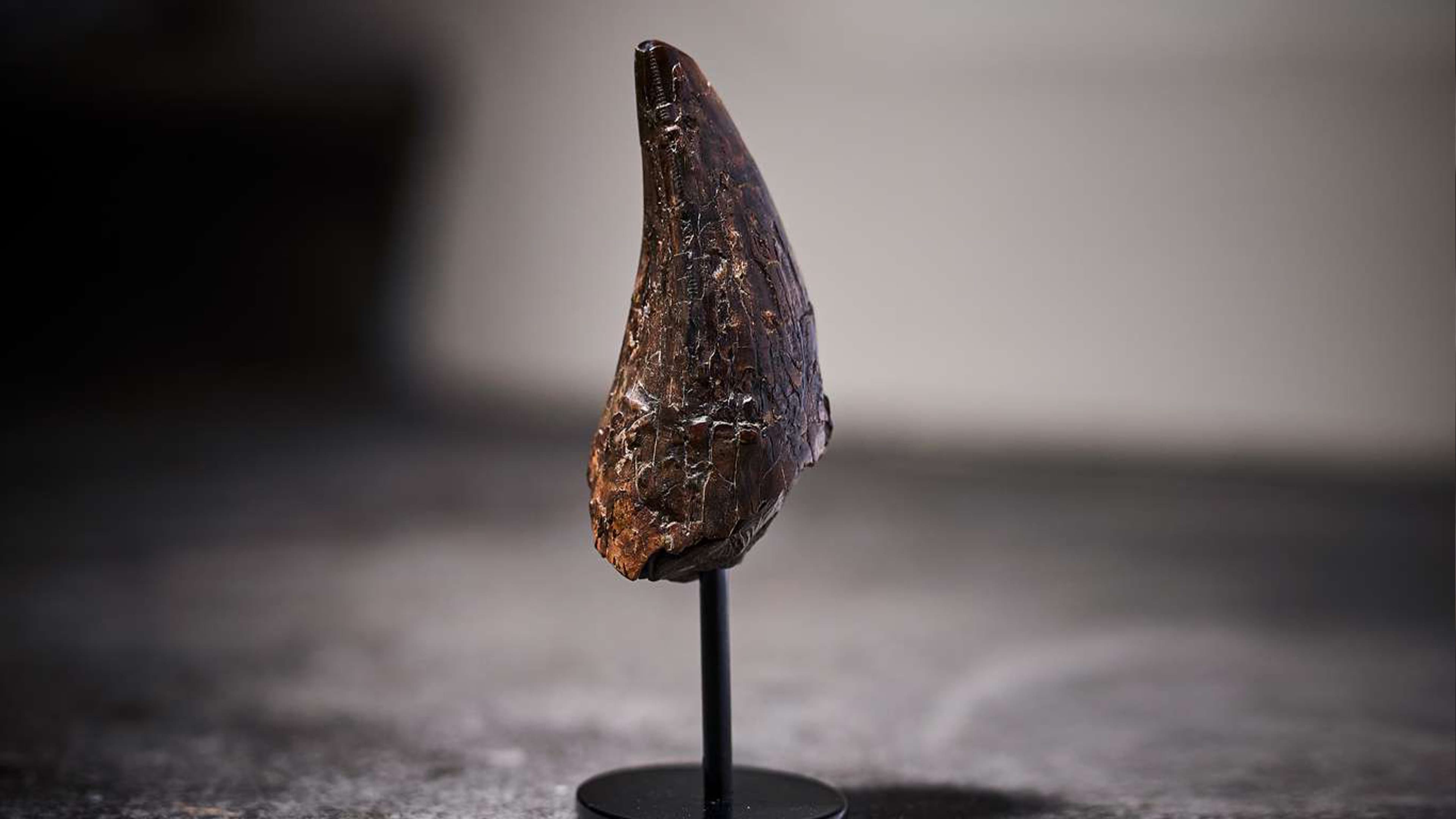
Teeth are among the most widely collected dinosaur fossils. Their form varies considerably between species, reflecting different diets and feeding behaviours, and well-preserved examples can retain remarkable detail.
Predatory theropod teeth, for example, may preserve their characteristic serrated edges and enamel surfaces. Size can attract attention, but completeness and preservation are equally important when assessing the quality of an individual tooth.
Dinosaur Bones
Vertebrae, limb bones and other skeletal elements can all be suitable for auction. Some can be confidently identified to a particular dinosaur or group, while isolated material may be more difficult to attribute precisely.
Information about where a fossil was discovered can therefore be particularly useful. Its locality and geological formation may provide important evidence for establishing its age and identification.
Dinosaur Skulls & Jaws
Dinosaur skull and jaw material is less commonly encountered than isolated teeth and bones and can range from individual cranial elements to substantially complete specimens.
With more complex fossils, it becomes particularly important to establish what is original. Preparation, repair and reconstruction may all form part of a specimen's history and should be understood when it is assessed for auction.
Dinosaur Skeletons
Articulated and substantially complete dinosaur skeletons occupy a distinctive part of the fossil market. Not every mounted skeleton consists entirely of fossil bone from a single animal. Specimens may incorporate reconstructed or cast elements, while some are composites containing material from more than one individual.
The proportion of original fossil material, overall completeness, quality of preparation and relationship between the individual bones are therefore important considerations when a skeleton is catalogued and valued.
What Makes a Dinosaur Fossil Valuable?
No single characteristic determines the value of a dinosaur fossil. Specialists consider the specimen as a whole, including its identification, rarity, preservation, provenance and the extent of any preparation or restoration.
Species and Rarity
Certain dinosaurs naturally attract considerable collector interest, but a famous name does not automatically make a fossil exceptional.
The availability of material from that species, the type of fossil represented and the quality of the individual specimen all contribute to its desirability.
Completeness and Preservation
Completeness can make a significant difference. An intact tooth retaining fine original detail may be more desirable than a larger but damaged example, while substantially complete skeletal material is much scarcer than isolated bones.
The quality of preservation also matters. Original surfaces, anatomical details and other features can help distinguish an exceptional specimen.
Provenance and Locality
Information about where a dinosaur fossil was discovered can contribute to both its identification and its history. The geological formation and locality may help establish its age and attribution, while subsequent ownership records can provide valuable provenance.
Old collection labels, invoices, photographs, certificates and previous auction records should therefore be kept with the specimen wherever possible.
Preparation, Restoration and Original Material
Preparation is an important part of revealing and stabilising many fossils after excavation. Repair and restoration may also be encountered, particularly with larger or more complex specimens.
What matters is understanding the extent of that work.
Reconstructed sections, replacement elements and composite material should be identified wherever possible. With skulls and skeletons in particular, the proportion of original fossil material can be an important part of the assessment.
Dinosaur Fossils Sold at Auction
Dinosaur fossils can attract interest from collectors internationally, particularly when strong preservation, rarity and good provenance come together. At Lyon & Turnbull, a Psittacosaurus skeleton dating to the Lower Cretaceous Period sold for £13,750 inc fees.
Past auction results can provide useful context when considering a fossil for sale, but direct comparisons need to be made carefully. Even fossils from the same species can differ considerably in completeness, condition, preparation, provenance and overall quality.