Lot 141
SAMUEL JOHN PEPLOE R.S.A. (SCOTTISH 1871-1935)
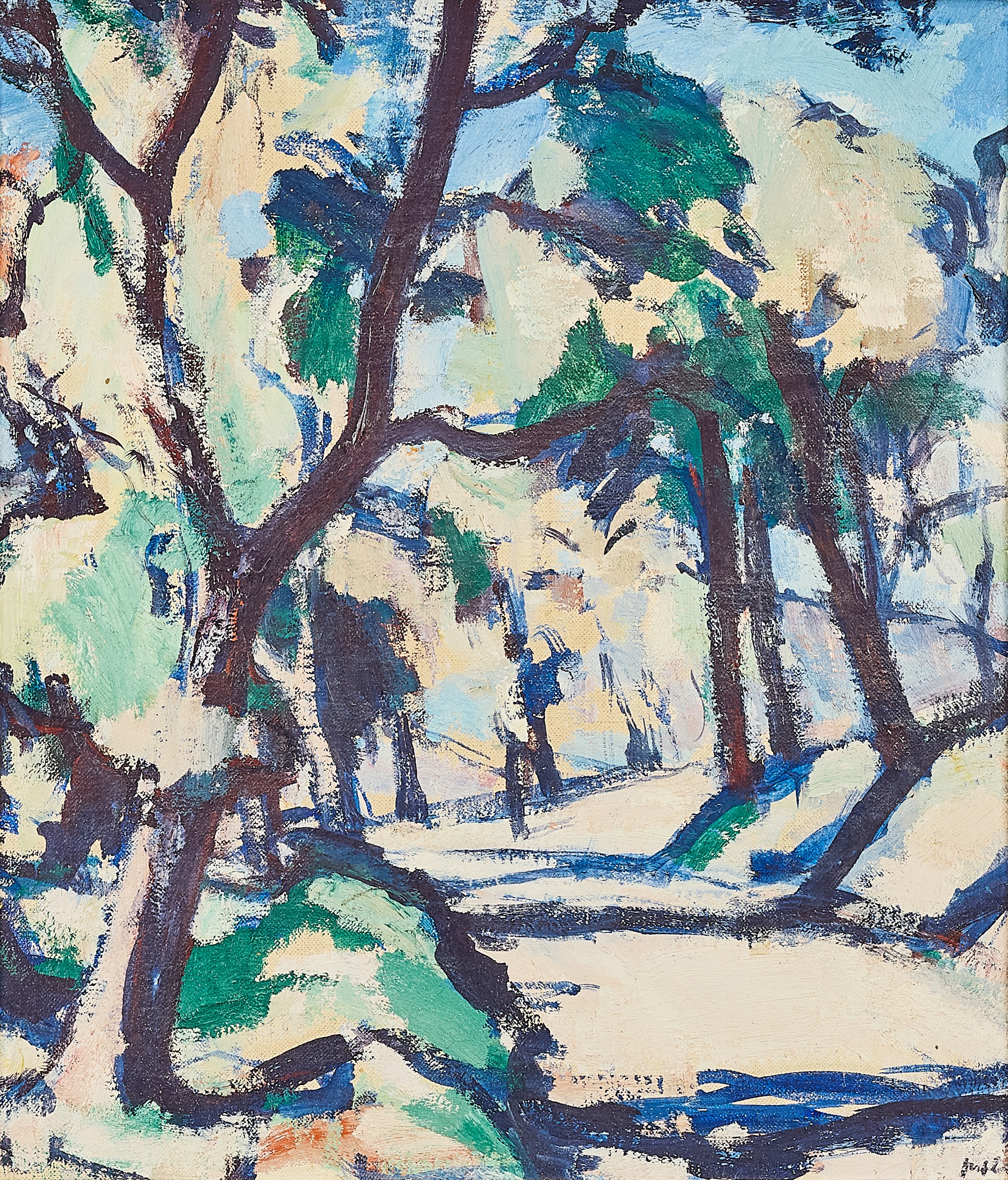
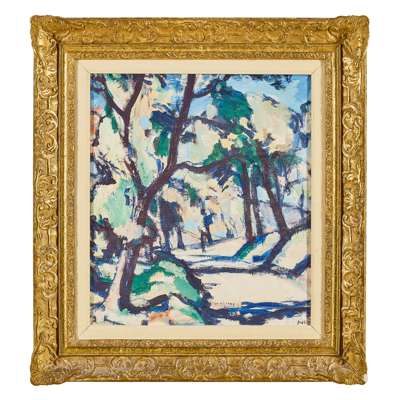
A SUNLIT WOODLAND LANE
Scottish Paintings & Sculpture
Auction: Evening Sale ft. A Century of Scottish Colourists Part II | Lots 90 to 169 | Thursday 03 December 2026 from 6pm
Description
Signed, oil on canvas
Dimensions
46cm x 41cm (18in x 14in)
Footnote
Even as an established Francophile, the light, climate and lifestyle of its southern coastal region were a revelation to Sameul John Peploe when he first visited the area in 1913. Returns trips during the 1920s included painting in places such as Cassis and Antibes with his fellow Scottish Colourists F. C. B. Cadell in the former (1924) and G. L. Hunter in the latter (1928). A Sunlit Woodland Lane is believed to depict a sunkissed scene in the south of France in which he explored his long-held interest in the aesthetic potential of nature and of trees in particular.
J. D. Fergusson first introduced Peploe to the south of France, to Cassis, during the summer of 1913. All four of the Scottish Colourists were repeatedly drawn to the region, especially during the 1920s. Peploe had an ‘intensely emotional’ response to the ‘wonderful chaos’ of nature and his landscape practice developed apace after the First World War. (see Alice Strang, The Scottish Colourists: Art and Life, Edinburgh, 2026, p.29). Trees, forests and woods were favoured subjects. The expressive potential of trees, their trunks, branches and leaves, whether singular, growing in groups, or – as seen in the present painting – lining an inviting lane – provided Peploe with an endless variety of form and character with which to connect with nature and to establish a sense of place.
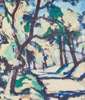
In A Sunlit Woodland Lane the heightened Mediterranean light blackens trunks and casts sharp, dark shadows across an otherwise brightly lit scene. The growing slants of trunks and branches brings irregular rhythm to the composition, combined with voluminous green growth on their tops and at their roots. A variety of brushstrokes, from long and confident, to dabs of colour layered one on top of the other, enlivens the surface of the work and the sense of natural progression. A feeling of heat radiates from the canvas and invites the viewer to seek shade.
As Frances Fowle has commented:
Trees were a common motif in … later works and, as Peploe’s colour became more muted, the influence of Cezanne became more apparent. Perhaps staying in Provence in an area not far from L’Estaque, where Cezanne had also worked, was a reminder to Peploe of the esteem in which he had always held the French artist … Peploe’s approach is more decorative than Cezanne’s, but he evokes the same sense of the trees as an integral, organic element in the Provençal landscape. (Frances Fowle, ‘Peploe in France: “A Suitable Milieu”’, S. J. Peploe, Edinburgh, 2012, p.52)
A connection between Peploe’s landscape work and that of France was symbolised by the acquisition of his paintings Paysage – Iona (Landscape – Iona) and La forêt (The Forest) for the French national collection in 1924 and 1931 respectively (both are now in the Musée National d’Art Moderne, Centre Pompidou, Paris, acc.nos. JP 363 P. and JP 527 P); the latter is of particular relevance to the present painting as it is a brightly-lit south of France wooded scene. Similar subject matter was explored in Scotland, from Dumfriesshire to Inverness-shire via Perthshire, including in some of Peploe’s final paintings before his death in Edinburgh in 1935.