Lot 140
SAMUEL JOHN PEPLOE R.S.A. (SCOTTISH 1871-1935)
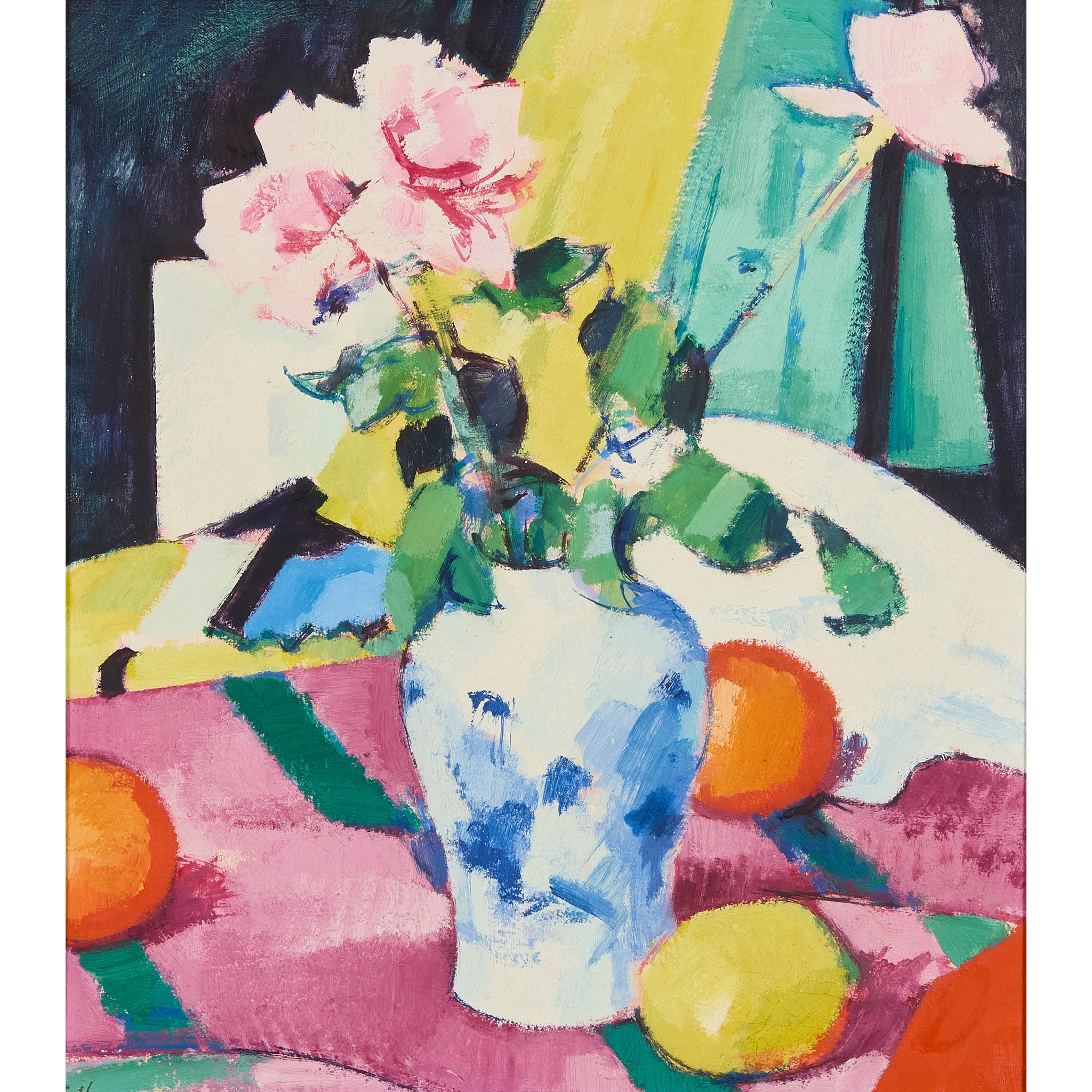
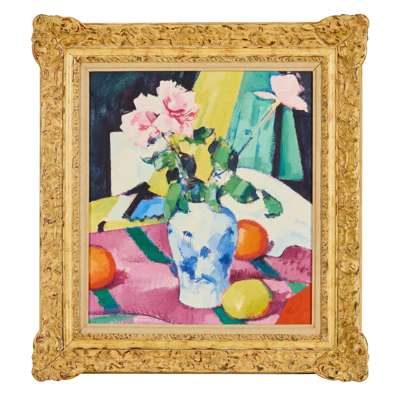
STILL LIFE OF ROSES AND FRUIT
Scottish Paintings & Sculpture
Auction: Evening Sale ft. A Century of Scottish Colourists Part II | Lots 90 to 169 | Thursday 03 December 2026 from 6pm
Description
Signed, oil on canvas
Dimensions
46cm x 41cm (18in x 16in)
Provenance
Richard Green Gallery, London
Acquired from the above and thence by descent to the present owner
Footnote
Still Life of Roses and Fruit is an outstanding example of the paintings for which Samuel John Peploe is most celebrated and which have come to represent the achievements of the four artists now known as the ‘Scottish Colourists’ overall.
John Duncan Fergusson declared that ‘the spirit of freedom and colour’ characterised his work and that of his fellow Colourists, namely Peploe, F. C. B. Cadell and G. L. Hunter. Moreover, Fergusson described Peploe as the group’s ‘rallying point’ because it was the latter’s friendships with the other artists that bound them together, rather than any formal affiliation. (see Alice Strang, The Scottish Colourists: Art and Life, Edinburgh, 2026, pp.7 &10).
Peploe’s reputation as one of Scotland’s most important artists of the twentieth century was based on his prowess in the still life genre throughout his career. Public acclaim came with his first solo exhibition, held in Edinburgh in 1903, from which twenty works were sold including a still life to Fergusson. (see Alice Strang, ‘”I can never see mystery coming to an end”: A Life of S. J. Peploe’, S. J. Peploe, Edinburgh, 2012, p.19). He began to exhibit still lifes at the Royal Glasgow Institute that year, continuing to do so until 1934, with the span at the Royal Scottish Academy (RSA)lasting from 1905 until 1933.
The first acquisition of a work by Peploe for a public collection was Still Life in 1907, which was one of the inaugural four purchases made by the Scottish Modern Arts Association, whose aim was to ‘secure for the nation a representative collection of modern pictures’. (see Alice Strang, ‘From Annand to Zinkeisen: Forty-Five Scottish Women Painters and Sculptors’, Modern Scottish Women: Painters & Sculptors 1885-1965, Edinburgh, 2015, p.15); it is now in the collection of Edinburgh’s City Art Centre (acc.no.CAC4/1964). The most recent acquisition for a public collection is Still Life with Roses which was allocated to the Ashmolean Museum, Oxford by H. M. Government in lieu of inheritance tax in 2019 (acc.no.WA2019.117).
In 1929 Peploe wrote about his dedication to the genre, explaining: ‘There is so much in mere objects, flowers, leaves, jugs, what not – colours, forms, relation – I can never see mystery coming to an end.’ In 1917 he moved studio to 54 Shandwick Place in Edinburgh’s West End, where he was to remain until 1934. This made it his studio of longest standing and is where he is believed to have painted Still Life with Roses and Fruit. Peploe emerged from the First World War having been elected an Associate member of the RSA in March 1918 and embarked upon the roses still life series which occupied him from approximately that year until the mid-1920s.
As Alice Strang has explained: ‘Peploe changed his technique, adopting an absorbent gesso ground and reducing the amount of medium in his paint. He pushed his use of colour to the extreme and obsessively arranged objects - such as blue-and-white Chinese porcelain vases, filled initially with tulips and then usually with roses - fans; books; fruit in a variety of dishes; fabric draped on tables, chairs and as a background; mirrors and jugs – to create finely balanced compositions.’ (Strang, op.cit.p. 23).
This could be read as a description of Still Life with Roses and Fruit. An asymmetrical composition is centred on three roses in a vase, whose decoration is hinted at but not over-laboured. Peploe’s enjoyment of the subtle gradations of the titular flowers’ heads and their profiles atop slender stems, as well as those of their leaves, is clear. Carefully placed oranges and a lemon overlap and are overlapped by other elements including the edge of the canvas, hinting at the space beyond that which is seen. A bringing together of brilliantly coloured material, from striped tablecloth to yellow and green drapery in the background, draws the eye to the centre of the image in a highly skilled bringing together of colour and form.
The care which Peploe took to create his still lifes was recalled by his brother-in-law, Frederick Porter, who wrote:
All his still lifes were carefully arranged and considered before he attempted to put them on canvas. When this was done – it often took many days to accomplish – he seemed to have absorbed everything necessary for transmitting them to canvas. The result was a canvas covered without any apparent effort. The painting was direct and showed no appearance of over-painting. If a certain touch were wrong it was soon obliterated by the palette knife. The whole canvas had to be finished in one painting so as to preserve a complete continuity. If, in his judgement, it was not right then then whole painting was scraped out and painted again. Such a method demanded considerable powers of energy and concentration, but the result in Peploe’s case justified it.’ (Frederick Porter, ‘The Art of S. J. Peploe’, The New Alliance, Dec 1945 – January 1946, p.6)
Still lifes of roses related to the present painting are held in numerous UK public collections including those of the National Galleries of Scotland, National Trust for Scotland, Kelvingrove Art Gallery and Museum, Glasgow, The Fleming Collection, Aberdeen Art Gallery and the University of Dundee.