Lot 139
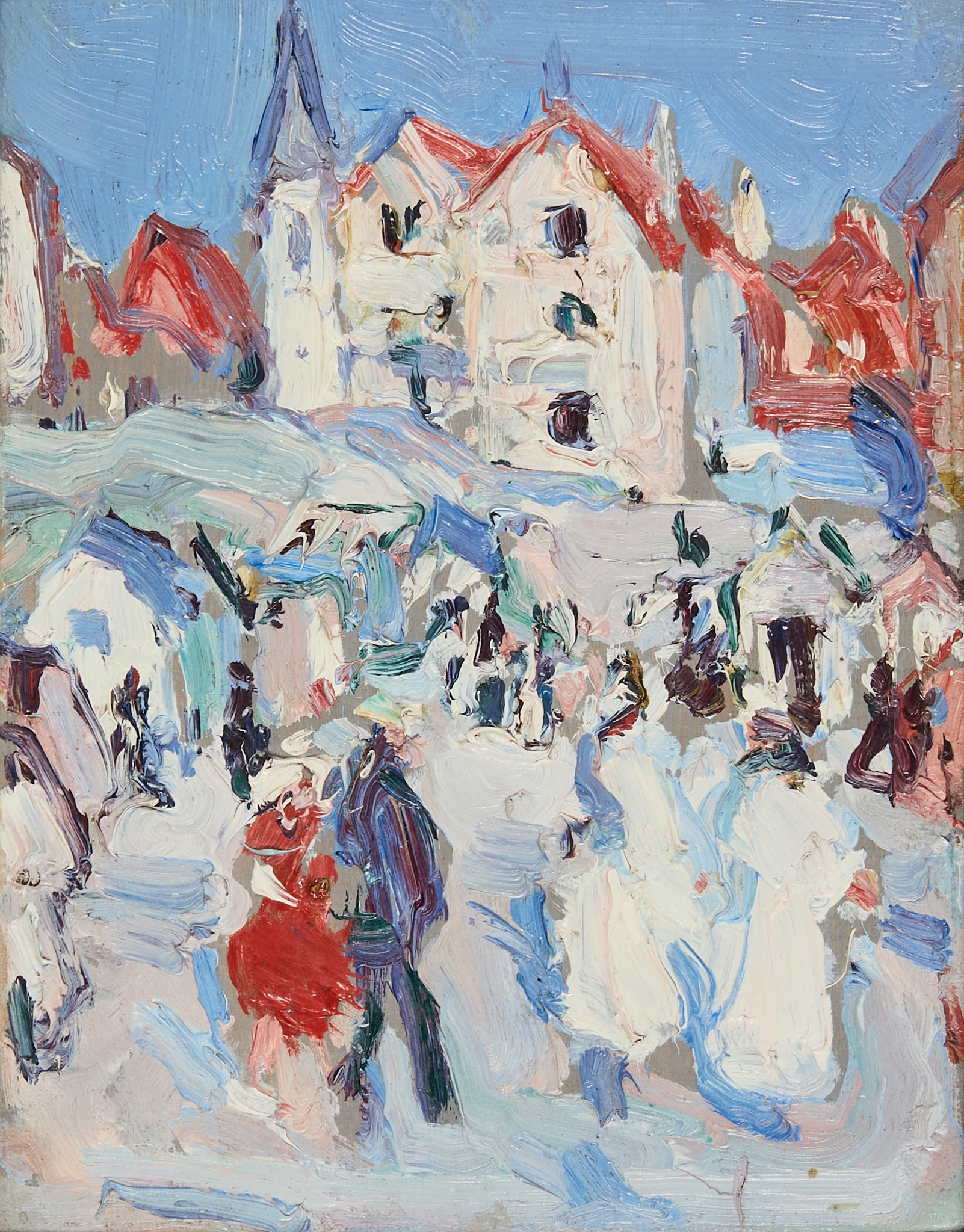
SAMUEL JOHN PEPLOE R.S.A. (SCOTTISH 1871-1935)
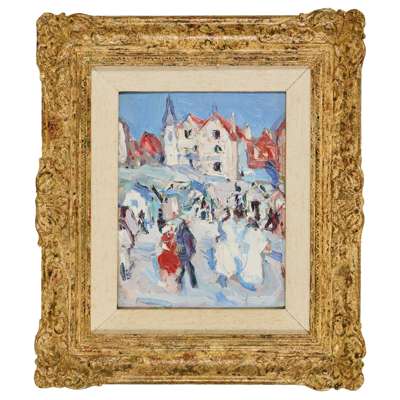
PARIS-PLAGE
Scottish Paintings & Sculpture
Auction: Evening Sale ft. A Century of Scottish Colourists Part II | Lots 90 to 169 | Thursday 03 December 2026 from 6pm
Description
Oil on panel
Dimensions
23.5cm x 18.5cm (9in x 7in)
Provenance
A. Ernest Harley, Edinburgh
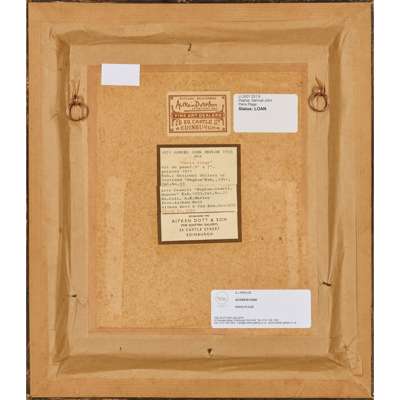
Aitken Dott & Son, Edinburgh
William Bowie (1911-2008), Glasgow and thence by descent to the present owner
Exhibited:
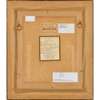
National Gallery of Scotland, Edinburgh, S. J. Peploe 1871-1935, March 1941, no.33 (incorrectly dated 1911, lent by Mrs A. E. Harley)
Scottish Committee of the Arts Council of England, S. J. Peploe 1871-1935, touring exhibition of 1953, no.21 (incorrectly dated 1911, lent by Mrs E. A. Harley)
Aitken Dott & Son, Edinburgh, October 1976 (stock no.3740)
Footnote
Samuel John Peploe’s Paris-Plage is a gem of a painting which encompasses his thrill at working outdoors in France, beside his fellow Scottish Colourist John Duncan Fergusson. Furthermore, it has belonged to two of the most important collectors of Peploe’s work, A. Ernest Harley and William Bowie.
Peploe and Fergusson are believed to have met in Edinburgh in around 1898. By this point, Peploe had trained at the Académie Julian in Paris and at the Royal Scottish Academy’s Life School in Edinburgh and had established himself in a studio in the Albert Buildings at 24 Shandwick Place in the Scottish capital. Following the success of his first solo exhibition, held in 1903, the following year he and Fergusson began to spend the summers together, painting in France, ‘which had a significant effect on their work and ultimately lead them both to move to Paris, Fergusson in 1907 and Peploe in 1910’. (Alice Strang, ‘”I can never see mystery coming to an end”: A Life of S. J. Peploe’, S. J. Peploe, Edinburgh, 2012, p.19).
The present work was painted during one of the friends’ stays on the Côte d’Opale between 1904 and 1907. Basing themselves in the nearby artists’ colony of Étaples, they worked along the coast including at Paris-Plage (now known as Le Touquet) and Berck. As Fergusson recalled ‘we worked all day, drawing and painting everything. And we thoroughly enjoyed the food and wine.’ (quoted in Margaret Morris, The Art of J. D. Fergusson: A Biased Biography, Glasgow 1974 (2010 edition), p.45).
Extant photographs show the pair on the beach at Paris-Plage, dressed in three-piece suits and with their ‘pochade boxes’ on the sand beside them. These were portable kits for painting outdoors, in which small panels – like the one on which Paris-Plage is painted - as well as a palette, brushes, tubes of oil paint and so on, could be stored. The glorious immediacy of the brushstrokes in Paris-Plage reveals the freedom and excitement of painting on this very spot. Using generous amounts of oil paint, applied at speed and with confidence, Peploe conveyed promenading figures in the foreground, the eye-catching bathing boxes in the mid-ground and the distinctive beachfront architecture in the background. The brilliant blue sky which crowns the composition provides the sunshine which illuminates the scene, which is realised in a palette composed of tones of white and blue, enlivened by highlights of red. It is a celebratory visualisation of a stylish summer resort and a bravura example of en plein air painting.
Paris-Plage formerly belonged to Peploe’s friend, the Edinburgh printer and publisher A. Ernest Harley. They studied together in Paris in the 1890s (see Guy Peploe, S. J. Peploe, Farnham, 2012, p.93) and Harley not only collected Peploe’s work but also promoted it in the early days of his career. The present painting may be one to which Peploe referred in a letter to his wife, Margaret Mackay, of April 1911:
Harley came over to see my things tonight and collared three small ones for which he paid £12 – every little helps. He also took away four others which he thinks he can sell to a man he knows. He is going to show a lot of my old, small pochades in his office and send out invitations; he says he can sell some … Harley said in his office today: “I believe you are a genius”, I said there was not the least doubt about it!. (quoted in Guy Peploe, op.cit., p.82).
Such was Harley’s seriousness about collecting art that, also in 1911, he wrote Old Pictures: How to Collect Them, which was published by Otto Schulze & Co. of Edinburgh. His wife went on to lend Paris-Plage to two key exhibitions of Peploe’s work, staged at the National Gallery of Scotland in 1941 and organised by the artist’s son, Denis Peploe with the Scottish Committee of the Arts Council, in 1953.
Paris-Plage later belonged to the Dunkirk veteran, businessman and distinguished collector William Bowie, who became ‘one of the foremost authorities on the Scottish Colourists’ (‘William Bowie Obituary’, The Herald, 14 April 2008). Having studied at the University of Glasgow, Bowie was awarded the Military Cross in 1945 and worked at the family laundry business in Glasgow. As a deeply-committed connoisseur, particularly of Scottish art of the twentieth-century, Bowie had an especially high regard for Peploe whose works were at the heart of his collection. Indeed, Ewan Mundy has explained that ‘One of the first paintings by Peploe that he purchased was from Alex Reid & Lefevre during the war, as he was passing through London on leave.’ (Ewan Mundy, ‘William Bowie’s Collection of Paintings’, Paintings from the Collection of William Bowie, Glasgow, 2009, p.3). Paris-Plage has passed by descent from Bowie to the current owner.