

Lot 528
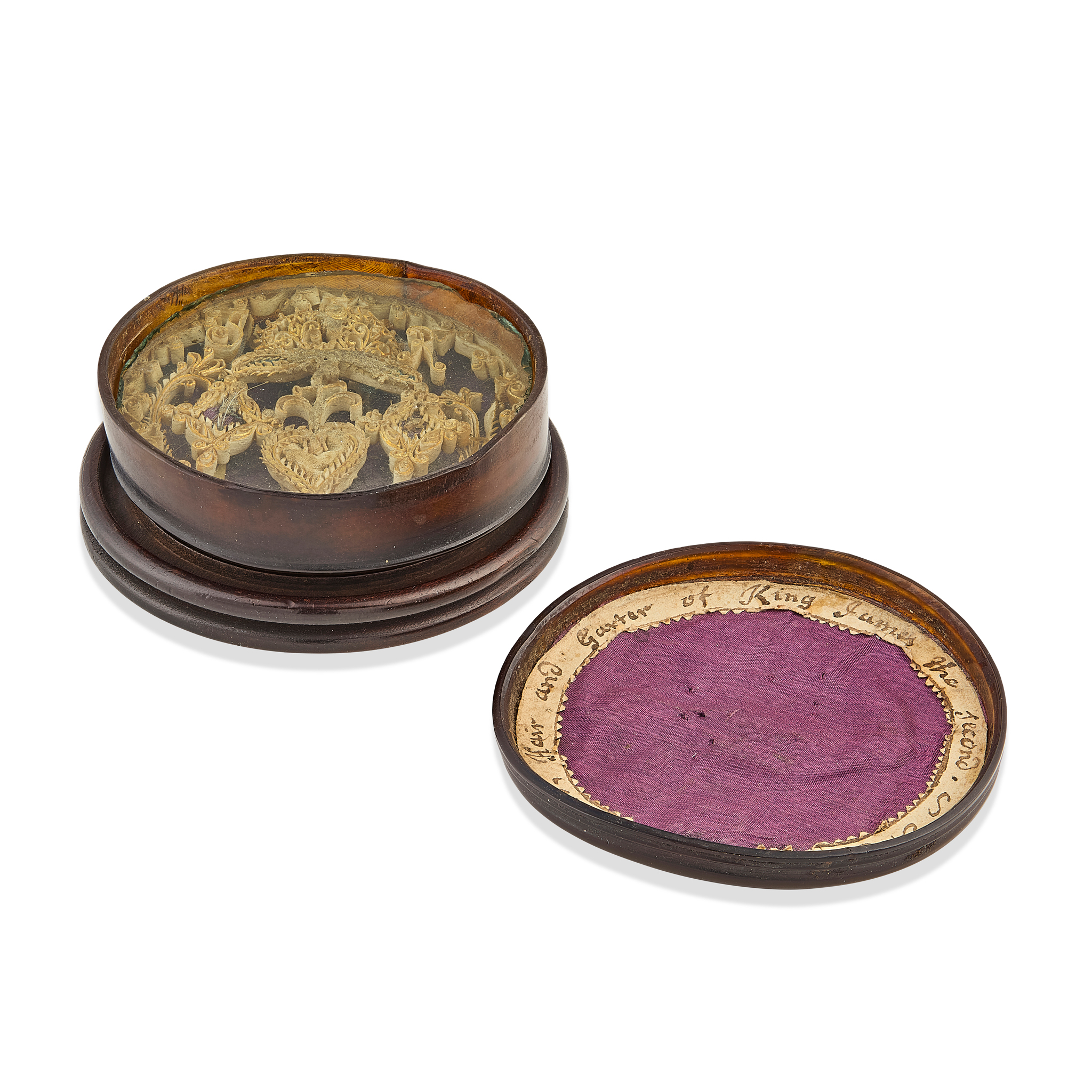
A JAMES II STUART MONARCH RELIQUARY

Auction: Day Two | Thursday 20 August from 10am | Lots 199 - 555
Description
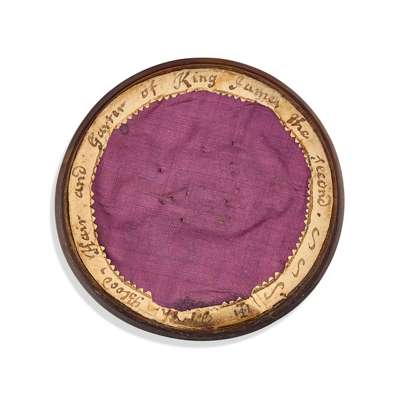
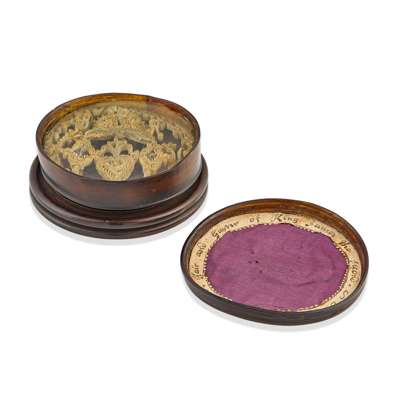
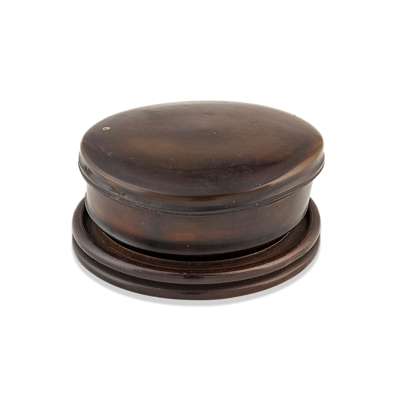
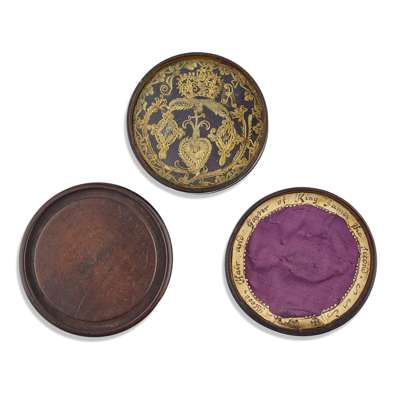
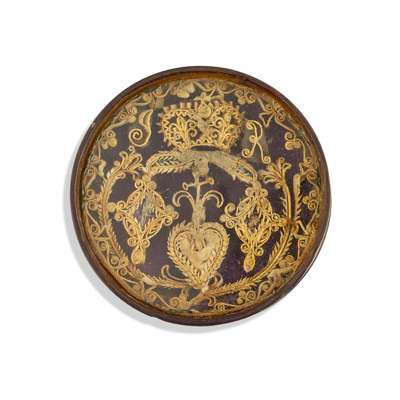
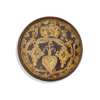
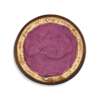
The tortoiseshell reliquary, containing a glazed panel set with gilt-edged paper scroll-work, the cypher of James II and crown above a heart flanked to either side with a lozenge, in a border of scroll detail to a purple silk mount, the interior of the lid applied with purple silk, the border with a handwritten note ‘Blood, Hair and Garter of King James the second … ***’, the turned wooden base with applied sticker, numbered 167
Dimensions
6cm diameter (widest)
Footnote
James II (1633–1701), (of England and Ireland) and James VII (of Scotland), the grandson of James VI of Scotland and I of England—the first monarch to unite the crowns of England, Scotland and Ireland—was the last Roman Catholic king to reign over England, Scotland, and Ireland. His reign lasted from 1685 until his overthrow during the Glorious Revolution of 1688, an event that permanently altered the British monarchy and established Protestant succession.
James succeeded his elder brother, Charles II, in 1685 after Charles died without legitimate heirs. Although James had secretly converted to Roman Catholicism while living in exile in France during the English Civil War, many hoped the succession would eventually pass to his Protestant daughter, Mary, and her husband, William of Orange. However, the birth of James Francis Edward Stuart to James and his second wife, Mary of Modena, in June 1688 transformed the political landscape. The infant prince, later known as "The Old Pretender," represented the prospect of a continuing Catholic dynasty, provoking widespread alarm among England's Protestant political elite.
James' life was shaped by conflict long before he became king. During the English Civil War, he fled into exile alongside the royal family following the execution of his father, Charles I. After the Restoration of the monarchy in 1660, James returned to England and served with distinction as Lord High Admiral, commanding the Royal Navy until 1673. His military experience and years spent in continental Europe profoundly influenced both his political outlook and his religious convictions.
Although his reign lasted only three years, James continued the traditions and ceremonial honours of the Crown, including appointments to the prestigious Order of the Garter. Following the Glorious Revolution of 1688, James fled to France under the protection of his cousin, King Louis XIV. There he established a court in exile at the Château de Saint-Germain-en-Laye, remaining steadfast in his claim to the thrones of England, Scotland and Ireland. Although several attempts were made to restore him—including his unsuccessful campaign in Ireland, which ended with defeat at the Battle of the Boyne in 1690—James never regained his kingdoms. He spent the remainder of his life in religious devotion and the affairs of the Jacobite court, dying in exile at Saint-Germain-en-Laye on 16 September 1701. His death did not end the Stuart claim, however; it passed to his son, James Francis Edward Stuart, the "Old Pretender," who continued to lead the Jacobite cause for many years thereafter.
Founded in 1348 by King Edward III, the Order of the Garter is the oldest and most senior order of chivalry in Britain. Membership is limited to the Sovereign, members of the Royal Family, and twenty-four Companion Knights, who are personally selected by the monarch in recognition of exceptional public service or national achievement.
During James II's reign, seven men were invested as Knights Companion of the Order of the Garter:
The riband of the Order of the Garter has traditionally been worn in a rich, vibrant blue, seen in the iconic portrait held in the National Portrait Gallery accession number NPG 666. It is possible that the dyes used in this example have degraded over time, resulting in the more purplish tones visible today. Contemporary portraits and surviving examples confirm that the original colour would have been a striking deep blue, consistent with the Order's long-established ceremonial dress.
Following the failure of the Jacobite rebellions, many royal and Jacobite relics were carefully preserved by loyal families, often passing quietly through successive generations. As no auction records or exhibition history are known for this riband, it is likely that it has remained in private family ownership since its manufacture, preserved by descent rather than entering the public market. Such uninterrupted provenance is characteristic of many surviving Jacobite reliquaries and adds significantly to the historical interest of the piece.