Lot 2
JOHN WILLIAM GODWARD R.B.A. (BRITISH 1861-1922)
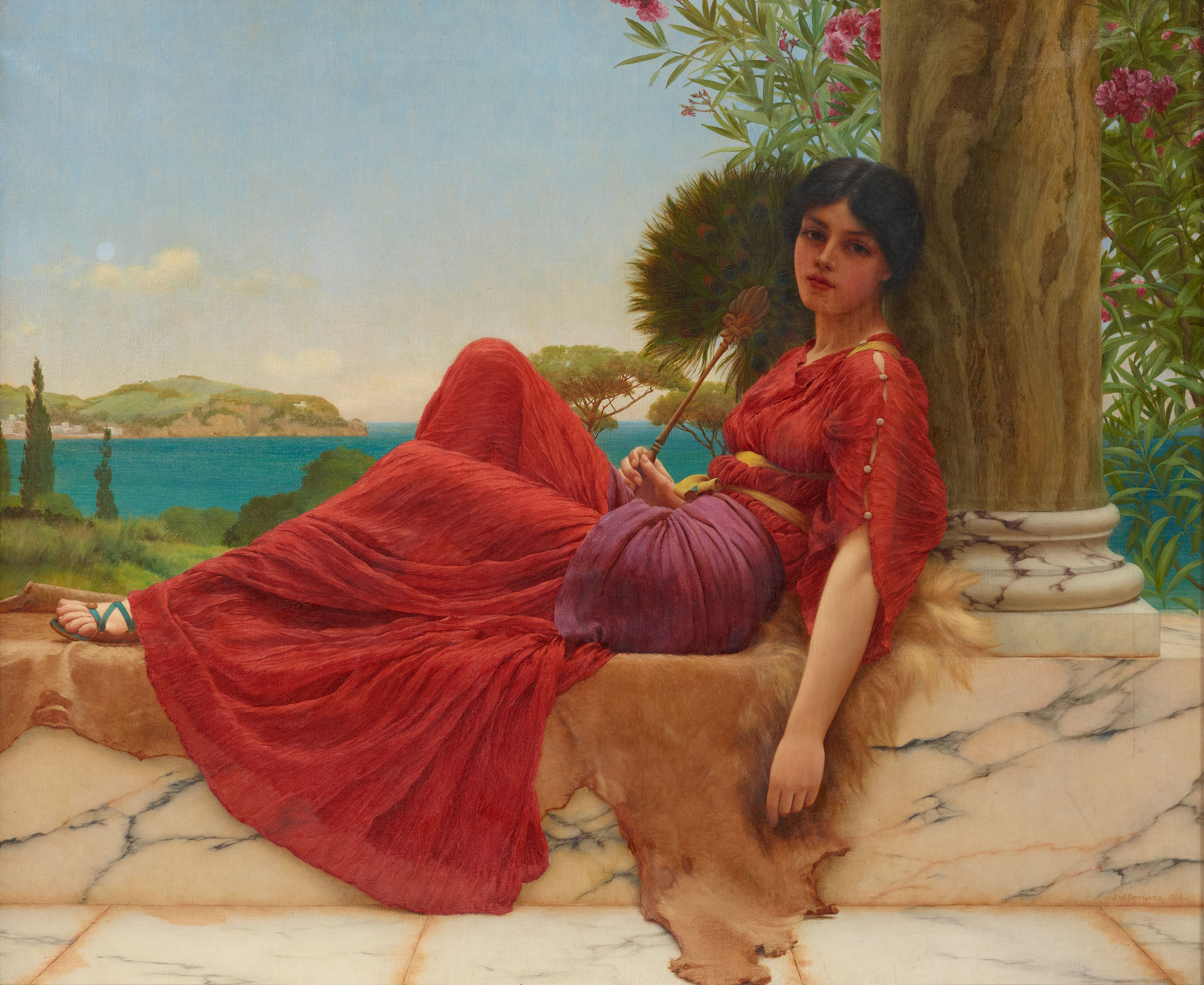
LEANING AGAINST A COLUMN



Poetry & Myth: Romantic Art in the Victorian Age
Auction: 02 July 2026 from 14:00 BST
Description
Signed and dated 1901, oil on canvas
Dimensions
60cm x 72cm (23.5in x 28.5in)
Provenance
Sold by the artist to Thomas McLean, London, 26 September 1901;
Private collection, Los Cabos, Mexico;
Sotheby’s, London, 15 December 2016
Footnote
John William Godward’s Leaning Against a Column belongs to the final flowering of Victorian classicism, a world poised delicately between devotion to beauty and the encroaching rise of modernity. Few painters embodied this late Neo-Classical vision more completely than Godward. As art historian Vern Swanson observed, he rivalled Alma-Tadema in his rendering of marble and flowers, while achieving a mastery of drapery comparable to Frederic Leighton. In this painting, those qualities converge to create an atmosphere of stillness, sensuality, and idealised escape.
Set upon a marble terrace overlooking the sea, the composition presents a solitary young woman suspended in a moment of languid reverie. Reclining against a column atop a lion skin, she gazes outward with calm intimacy, as though acknowledging the unseen presence of the viewer. Behind her, oleander blossoms frame an expanse of azure water and distant sky. The scene feels untouched by time or hardship: a dream of eternal summer where beauty, warmth, and silence prevail.
What distinguishes Godward’s work is not merely its technical precision, but the emotional world that he constructs. Marble surfaces gleam with cool perfection beside warm flesh tones and delicate fabrics; feathers, flowers, and stone are rendered with astonishing sensitivity to texture. Yet these details never overwhelm the composition. Instead, they work in harmony to sustain an atmosphere of luxurious tranquillity. Godward transforms material accuracy into sensory experience, inviting the viewer into a world governed entirely by aesthetic pleasure.
Godward returned obsessively to the imagined world of ancient Greece and Rome throughout his career. His studios in London were filled with marble fragments, antique textiles, classical sculptures, and carefully collected objects that allowed him to recreate the illusion of antiquity with remarkable conviction. He selected models whose features he considered suitably “classical.” Around 1900, one particular model emerged repeatedly in his paintings, becoming something of a muse. Her striking dark hair and luminous complexion appear in works such as Midday, Idleness, and Dolce far Niente. In Leaning Against a Column, clothed in vivid crimson against pale marble, she embodies the ideal Godward pursued for decades: serene, sensual, and timeless.
Yet beneath the calm perfection of these paintings lay a more troubled reality. Godward’s devotion to classical painting increasingly isolated him from the rapidly changing artistic world around him. As modernism gained prominence, the meticulous realism and idealised beauty he cherished came to be dismissed as outdated. His personal life was equally strained. His family reportedly disapproved of his artistic ambitions and later severed ties with him after he moved to Italy with one of his models. Following his death by suicide in 1922, much of his personal archive was destroyed, leaving only fragments of his life behind.
There is a poignant irony in this contrast between artist and artwork. Godward’s paintings reveal little of the sadness or alienation that shadowed his later years. Instead, they remain steadfastly committed to harmony, refinement, and beauty. In an era increasingly fascinated by fragmentation and experimentation, he continued to paint worlds of calm sunlight, polished marble, and contemplative figures. His art became an act of resistance against modern disillusionment.
Today, the appeal of Godward’s work has returned with renewed force. What once seemed old-fashioned now appears almost radical in its unapologetic pursuit of beauty. Leaning Against a Column endures not because it reflects reality, but because it offers an escape from it, a carefully composed vision of stillness and grace. Fashion may shift and artistic movements may rise and fall, but the quiet power of craftsmanship, balance, and atmosphere remains. In Godward’s world, beauty is not fleeting; it is eternal.