

Lot 38
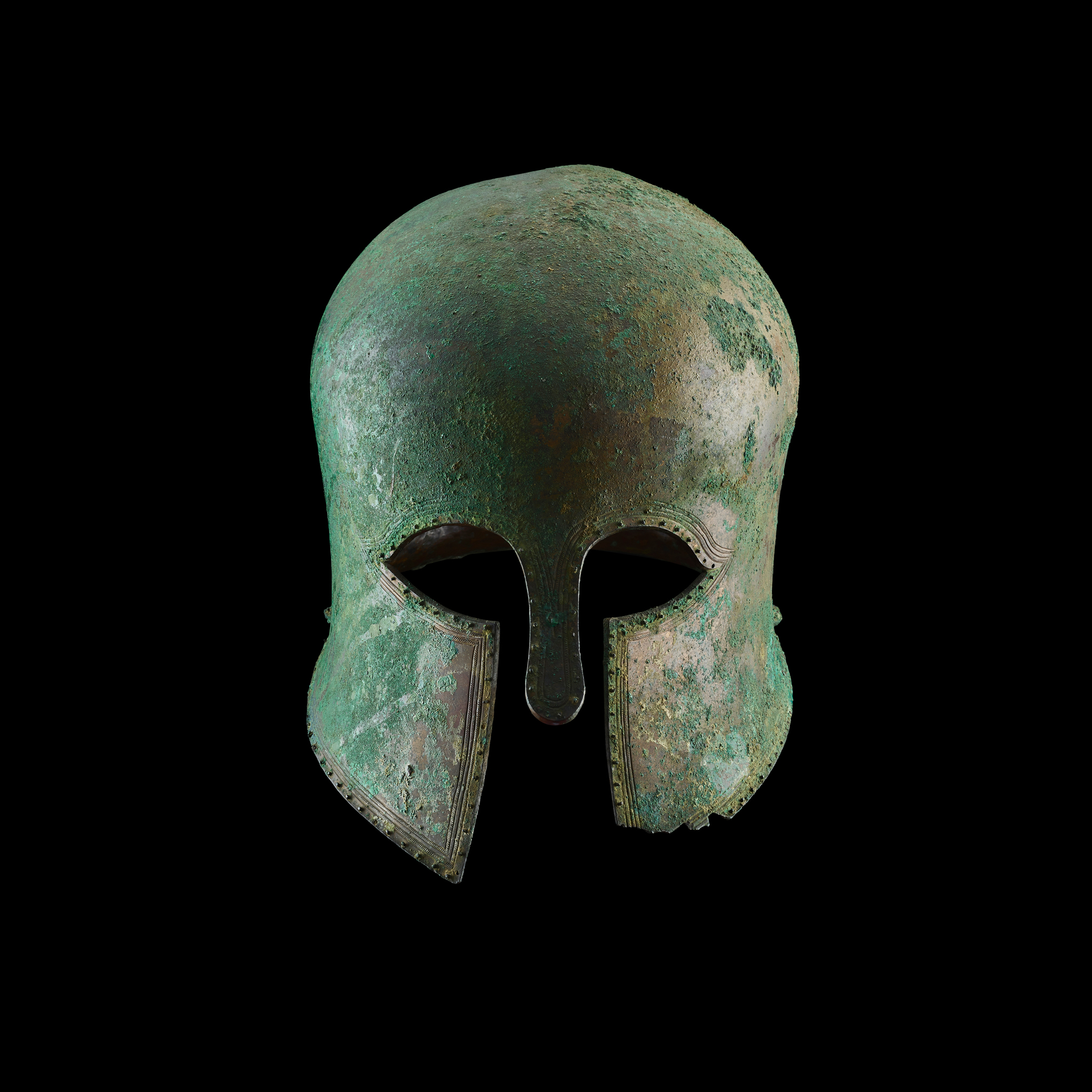
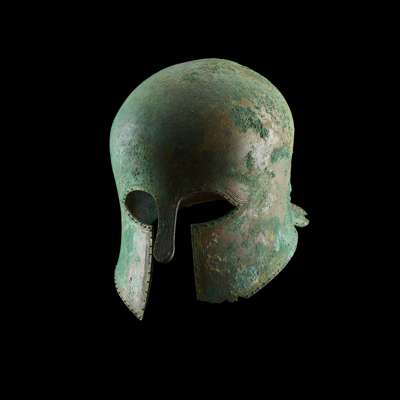
EXCEPTIONAL ANCIENT GREEK HELMET OF CORINTHIAN TYPE
GREECE, LATE ARCHAIC PERIOD, C. 525 - 475 B.C.













Auction: 28 May 2026 from 13:00 BST
Description
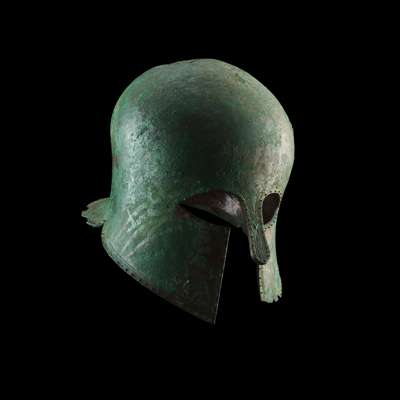
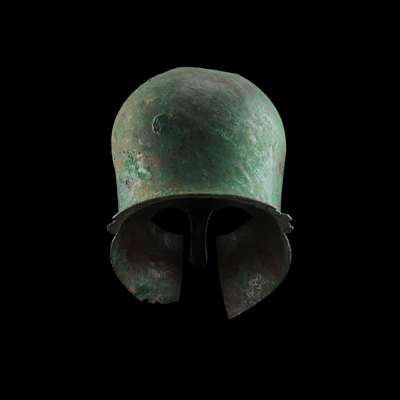
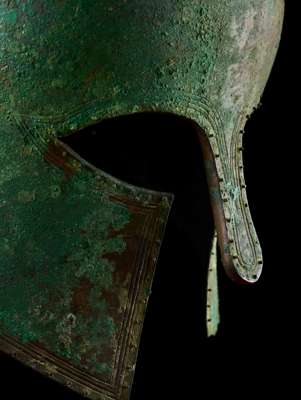
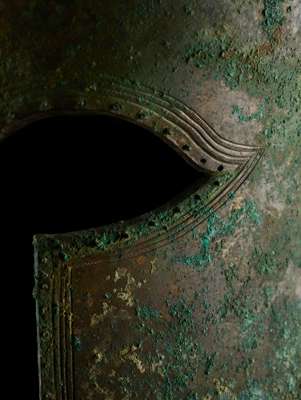
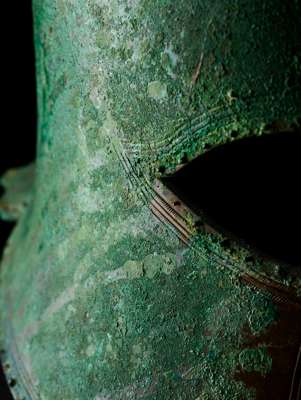
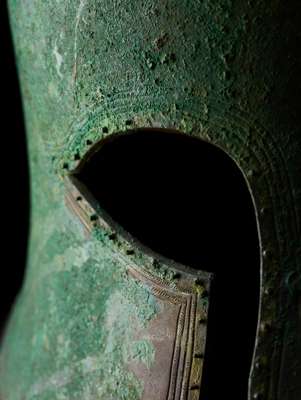
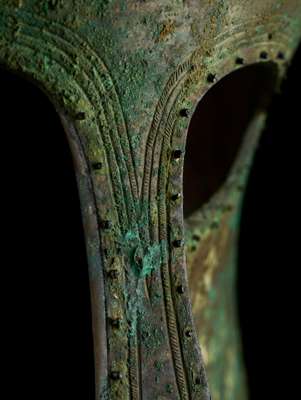
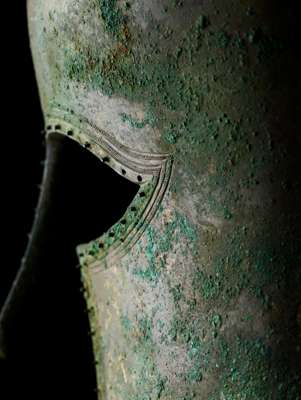
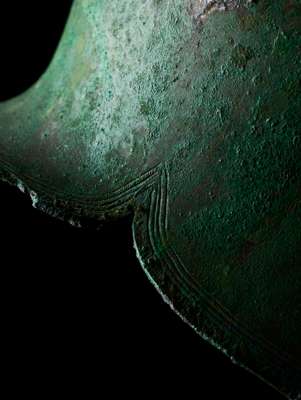
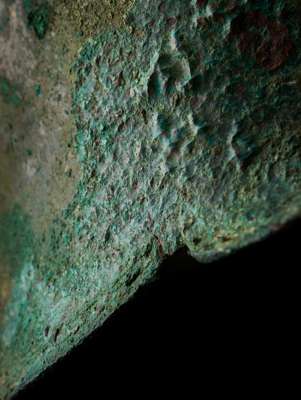
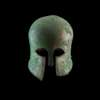
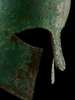
hammered from a single piece of bronze, with a domed helm, flaring nose and cheek guards, almond-shaped eyes, and perforations along edges for attachment, sweeping lines executed in light relief run from the top of the nose guard and along the borders of the eyes, rich patination, raised on a bespoke mount
Dimensions
28.2cm tall
Provenance
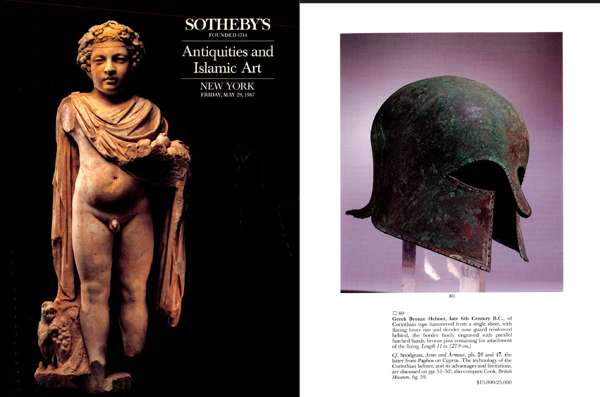
Private collection, London, United Kingdom, acquired Sotheby's, New York, Antiquities and Islamic Art, May 29th 1987, lot 80, sold for $85,000
Footnote
The present helmet is an exceptional example of the iconic Corinthian type, distinguished both by its remarkable state of preservation and by the absence of modern restoration. Among the finest and most aesthetically compelling examples to appear on the market, it embodies the technical sophistication and sculptural refinement associated with the Corinthian helmet at the height of its development. Its elegant proportions, carefully modelled features, and outstanding condition together make it a particularly important survival of ancient Greek armour.
The Corinthian helmet is among the most distinctive and iconic forms of ancient Greek armour, and it remains one of the most immediately recognisable survivals of the classical world. Its enduring appeal lies in its almost anthropomorphic presence, that evokes a powerful sense of connection with the ancient warrior. With a substantial corpus of surviving examples, modern scholarship has been able to trace subtle regional and chronological variations, revealing how its form evolved across different workshops and periods of production.
The helmet is defined by its enveloping design, typically characterised by deep almond shaped eye openings, a prominent nose guard that tapers gently towards its tip, and integral cheek pieces that extend downward in pointed or rounded forms. This configuration reflects its development during the late seventh and early sixth centuries B.C., when Greek armorers increasingly prioritised full protection within the context of hoplite warfare. Constructed from a single sheet of bronze hammered into shape, it represents a significant technical advancement over earlier composite forms, reducing points of weakness and offering a more unified protective surface.
In military use, the Corinthian helmet was designed to maximise survivability in close order combat. It reduced facial exposure to a narrow T shaped opening, protecting the wearer from slashing and thrusting weapons while maintaining structural strength through its continuous metal form. Although highly effective in the press of battle, its enclosed structure would have limited peripheral vision and hearing, factors that likely contributed to its gradual replacement in favour of more open designs during the later Classical period.
The present example is carefully worked, with a high domed crown that flows into a subtly flared neck guard, creating a harmonious and continuous profile. A faint medial ridge rises across the skull, enhancing both structural integrity and visual definition, while the eye openings are crisply delineated and carefully proportioned. The nose guard is robust yet elegantly integrated into the overall form, maintaining both strength and visual coherence. Along the lower edge, a series of perforations indicates the former presence of a textile or leather lining, now lost, which would have improved comfort and fit.
It dates to the period 525 to 475 BCE, a time spanning the late Archaic and early Classical eras of Greek history, when the Corinthian helmet reached its apogee of design and was closely associated with the peak of hoplite warfare. This was the period in which the Greek city states faced major conflicts with the Persian Empire, most notably the battles of Marathon (490 B.C.) and Thermopylae (480 B.C.), events that came to define the military and cultural identity of the Classical Greek world. At Marathon, Athenian hoplites achieved a decisive victory through disciplined phalanx tactics, while at Thermopylae a small allied force led by Spartans famously resisted a vastly larger Persian army in a narrow pass.
The Corinthian helmet, has come to symbolise the idealised Greek warrior, and its association with defining moments such as Marathon and Thermopylae ensured its lasting cultural resonance. Even after its decline as a common battlefield form, it continued to appear in art and later cultural memory as an emblem of the age.