

Lot 338
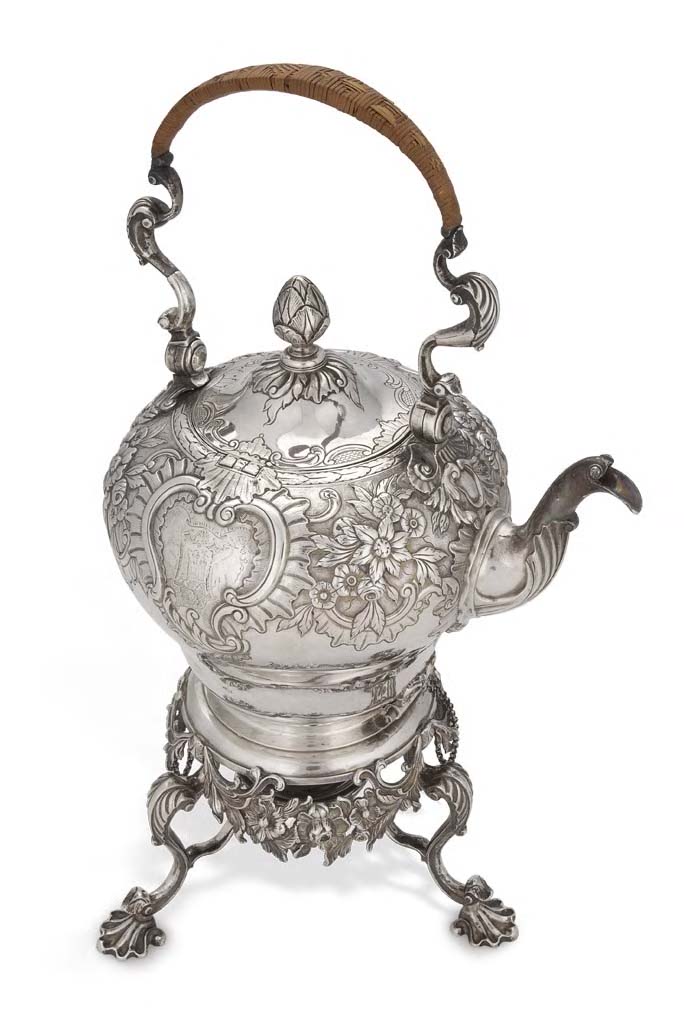
A scarce George III Scottish tea kettle on stand with burner,
Auction: 25 May 2006 at 12:00 BST
Description
with marks for Edinburgh 1753, maker William Gilchrist, Assay Master Hugh Gordon, of inverted pear form, the handle with basket weave covering, the lid with leaf clasped finial, the upper body with chased floral decoration, engraved with C-scrolls and foliate detail to the lid, with one blank C-scroll cartouche and another engraved with an armorial and mottos; the stand of circular form on three foliate clasped C-scroll legs, with drapes of foliage between.
Dimensions
Overall height 31cm, weight 73oz
Footnote
Provenance: Stirling Maxwell Collection, Pollok House
The Armorials are for The City of Edinburgh.
William Gilchrist, apprentice to James Tait, goldsmith in Edinburgh, petitioned for entry by way of an essay of his work into the Incorporation of Goldsmiths on 26 February 1736. He was asked to make, in the shop of Edward Lothian, a "tea kittle [sic] and lamp and a plain gold ring". [Edinburgh Goldsmiths' Minutes, I, f.137r.]
His essay masters for these items were Dougall Ged and William Marshall. This work was carried out to the necessary standard and Gilchrist was admitted a Freeman of the Incorporation on 12 May 1736.
Little is known about Gilchrist's early work until he was elected to be Deacon of the Incorporation on 16 September 1752. He continued in that office until September 1754, serving the usual two consecutive years.
While Gilchrist was an active member of the Incorporation from his admission in 1736, and still a voting member in 1772, there is little work known by him. From the minute books of the Incorporation it appears that from the start of his working life, he was in some financial difficulty and struggled to set up in business. In all probability he was working for another master rather than running a shop of his own for most of that time.
The possibility of this kettle having been commissioned by the town council as a Leith race prize looks likely, as it would be unusual to have the City Arms engraved on it for any other reason. Gilchrist was deacon at the time it was made and he had a seat on the council. Furthermore, it was normal prcatice for the deacon of the time to get commissions from the council.
In the Town Council minutes for 1754 it is noted that the Council
"further resolved that for the encouragement of the town of Leith and the gentlemen concerned in the races the town will give a plate of thirty pound value to be run for on the sands of Leith".
Additionally, a regular advert for the Leith races, in 1754, again mentions the race prize, although without specific mention to the item,
"on Tuesday the 17th of September, next will be run for the sands of Leith, the best of three heats four miles each heat, a plate of thirty pounds value given by the city of Edinburgh…"
While these references do not mention the actual item evidence suggests that this lot may in fact be one of the race prizes. As the value was to be of thirty pounds sterling, and silver at the time would have been approximately 5/6d per ounce, the weight of this item would make it's original worth approximately £20/7-. While this is somewhat below the thirty pounds sterling once a provision for decoration and engraving is made it would be much closer to thirty pounds. While all this adds up only to interesting conjecture it does appear to be a cohesive argument.
There is only a small body of Gilchrist's work on record and this is one of the largest and most important pieces to have survived. It also appears to be the only recorded example made when he was Deacon of the Incorporation. Other important items include the 1752 Leith race price of a gold two-handled cup and cover made in 1752, which is now in the Metropolitan Museum of Art, New York.
Literature:
The Empire Exhibition - May to October 1938, item 16 - text page 3, illustrated plate 9
Scottish Gold and Silver Work, revised edition I Findlay & H Steuart Fothringham illustrated plate 84, text page 158
With thanks to Mr. H Steuart Fothringham and the Edinburgh Incorporation of Goldsmiths for their help in cataloguing this lot