

Lot 177
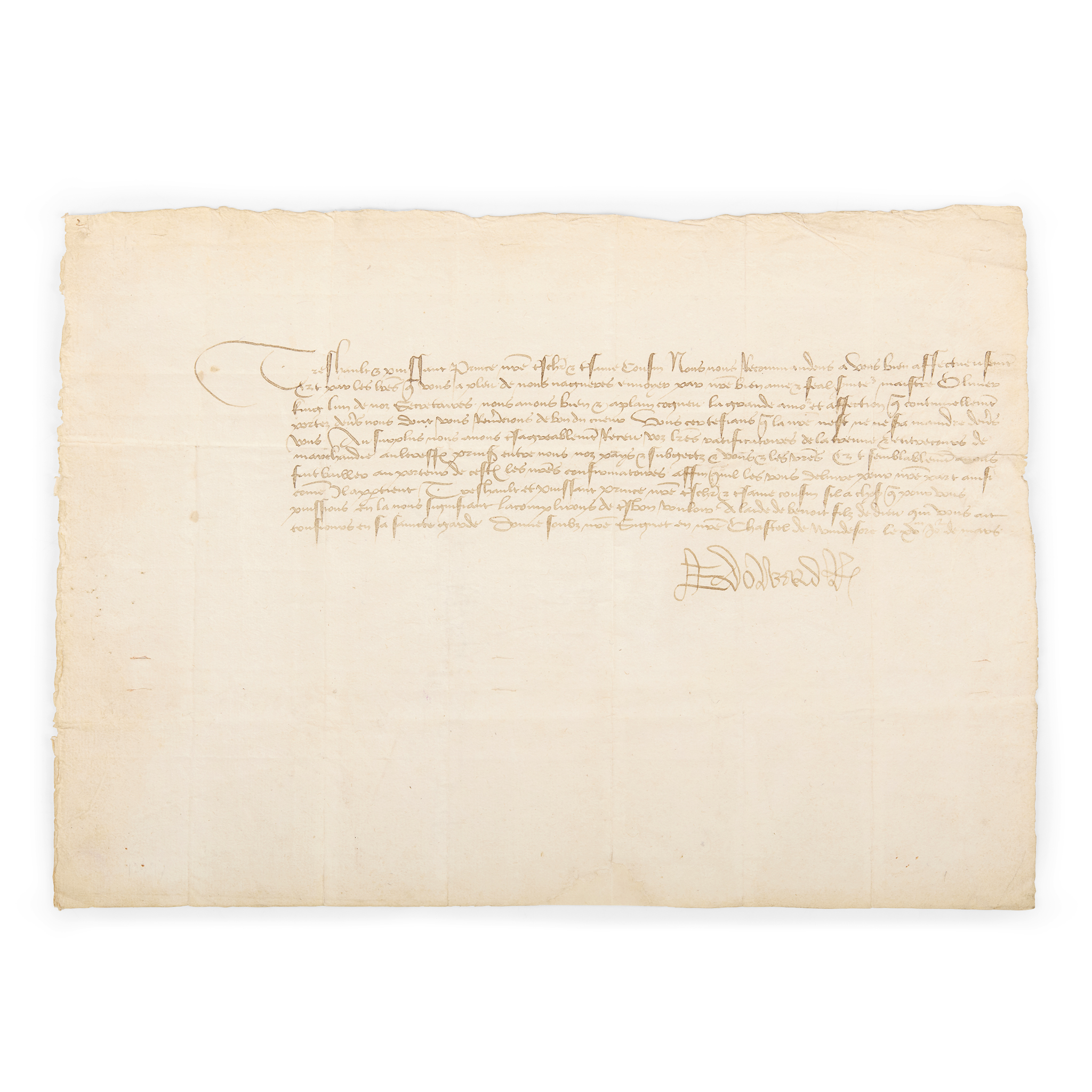
Edward IV (1442-1483), King of England & Lord of Ireland
Letter signed to François II, Duke of Brittany



Auction: Books & Manuscripts | Wed 25 February from 10am | Lots 63 to 255
Description
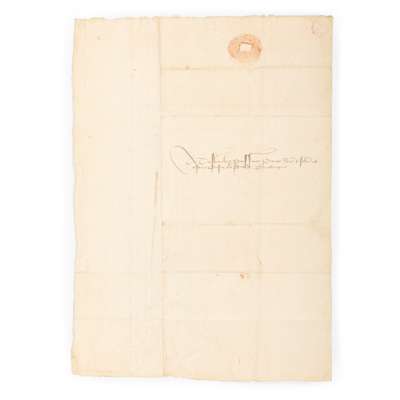
Windsor Castle ('chastre de Windesore'), 15th March [1476].
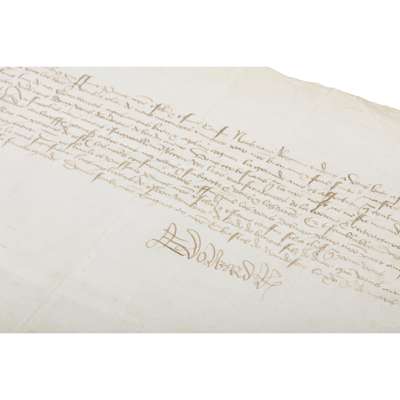
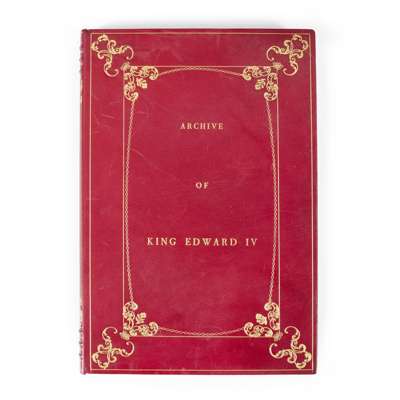
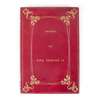
In French, confirming the truce and commercial treaty agreed between England and Brittany by acknowledgement of the receipt of the relevant letters of ratification ('les lettres ratificatoires de la treuve et entrecours de marchandie … permise entre nous noz pays et subjetz’) brought by Oliver King (q.v.), ‘one of our secretaries’ ('lun de nos secretaires'), and by the return Edward's own letters of confirmation via the carrier, 24 x 33.5cm, the body of the letter comprising 10 lines, written in an elegant secretary hand probably by Oliver King, signed by Edward IV using the French form of his full name (‘Edouard R’) at foot, addressed on verso in the same hand to the ‘Tres hault et puissant prince … le Duc de Bretaigne’, crowned fleur-de-lys watermark including monogram ‘JH’, old folds, dispatch slits, remains of red wax seal, a few minute holes, small area of paper restoration to foot. Housed in a fine gilt red morocco solander box and red cloth chemise
Footnote
Edward IV concludes an important treaty with the Duke of Brittany, consolidating his ascendancy over his continental rivals while furthering his covert agenda against his Lancastrian enemy Henry Tudor, the future Henry VII, who would elude Edward’s grasp and, less than a decade later, bring about the final defeat of Edward’s house of York and the end of the Wars of the Roses.
In the summer of 1475 Edward crossed to France to fight Louis XI and dispatched his French-language secretary Oliver King (d.1503), the future bishop of Bath and Wells and probable scribe of the present letter, to open diplomatic negotiations with François II of Brittany. By August Edward and Louis agreed the treaty of Picquigny, by which Edward extracted from the French king a major financial settlement on which he swiftly capitalised by means of the thirty-year truce and treaty of amity and commerce agreed with François a few months later.
In treating with François, Edward was in fact pursuing the twin objectives of commercial opportunity and dynastic security. In 1471, following Edward’s recapture of the English crown after the temporary restoration of the Lancastrian Henry VI, the young Henry Tudor had fled to Brittany and been granted asylum. Writing in the early Tudor period, Polydore Vergil described how, following the triumph of Picquigny, Edward ‘determynd … to slycyte Francisse duke of Bryteyne, with gyfte, promise, and prayer, to betray that young erle into his handes’ (English History, ed. Sir Henry Ellis, 1844, p. 164). Under Edward's diplomatic pressure, the grant of asylum ‘turned into house arrest in a succession of castles and palaces … Late in 1476 François agreed to surrender Henry to Edward's envoys, but at St Malo Henry's embarkation was delayed by illness until François countermanded his orders; in the ensuing confusion Henry took sanctuary and Edward's men returned empty-handed’ (ODNB).
Edward IV was the last Yorkist monarch to hold the throne with any kind of security, and his early death in 1483 led quickly to the final battle between the houses of York and Lancaster. Henry Tudor’s victory over Richard III, Edward’s brother, at Bosworth in 1485, and his neutralisation of the Yorkist claim via his ensuing marriage to Elizabeth of York, Edward's daughter, marked the triumph of the house of Lancaster, but was also a form of posthumous justice for Edward and his two sons, Edward V and Prince Richard, the tragic ‘Princes in the Tower’.
Documents signed by Edward IV are very rare, and when encountered usually bear only his initials: when writing to a fellow potentate, it was presumably deemed appropriate for the king to sign his name in full.