

Lot 159
![Minerva Press - [Meeke, Elizabeth]](https://media.app.artisio.co/media/104cbde6-0d38-43cb-9e0f-bb721ef57bcf/inventory/8e1f1249-b57a-4835-a636-7a5ef58f1221/847942a7-9d63-493f-aa3f-5b971a153b37/0001_qKZlxE_original.jpg)
Minerva Press - [Meeke, Elizabeth]
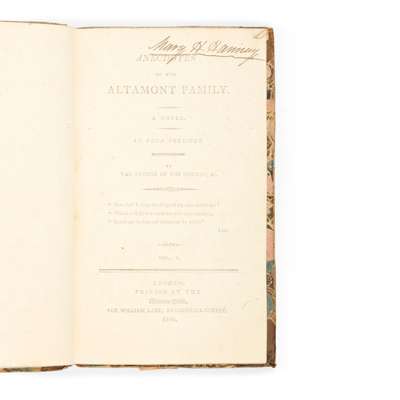
Anecdotes of the Altamont Family

Auction: Books & Manuscripts | Wed 25 February from 10am | Lots 63 to 255
Description
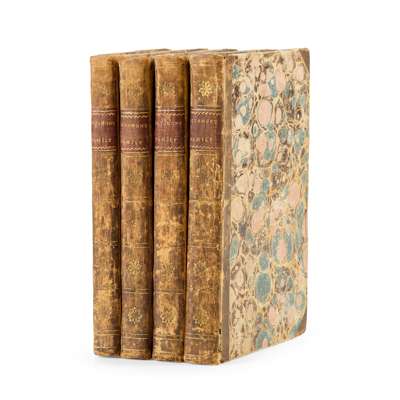
A Novel. In Four Volumes. By the Author of the Sicilian. London: printed at the Minerva Press, for William Lane, 1800. First edition, 4 volumes, 12mo (17.5 x 10cm), [4] 250 [2], [4] 266 [2], [4] 306 [2], [2] 365 [2] pp., contemporary half calf, smooth spines gilt in compartments, red morocco labels, marbled sides, blue sprinkled edges, half-titles to volumes 1-3, final advertisement leaf to each volume, contemporary ownership inscriptions to title-pages, volume 1 with old staining to pp. 137-8, volume 2 D4 with lower fore corner excised not affecting text, volume 3 with closed tear in H3, staining to fore margin of last gathering, a few trivial marks elsewhere [ESTC T89386] (4)
Footnote
Extremely rare work by one of the most enigmatic novelists of the Romantic period, whose identity eluded scholarship for two centuries until the 2010s, when she was proven conclusively to be Elizabeth Meeke (1761-1826), the scandalous stepsister of Fanny Burney, authorities including the original Dictionary of National Biography, Montague Summers in his Gothic Bibliography, and the ESTC all having conflated her with Mary Meeke, the wife of a Staffordshire vicar, on the basis of her usual nom-de-plume of ‘Mrs Meeke’.
Elizabeth Meeke published a total of 30 novels and translations in almost as many years, all with the Minerva Press. ‘Over three decades, she fashioned works that met the protean tastes of her reading public, incorporating sentimental melodrama, gothic suspense, and fashionable high life in equal proportions … Meeke’s productivity and responsiveness notwithstanding, her erasure from literary posterity tells a far from straightforward story about women’s writing' (Mandal). The enduring uncertainty surrounding her identity is an obvious reason for the critical neglect of such a productive and successful figure whose social connections placed her at the heart of late Georgian literary society.
See further: Anthony Mandal, ‘Mrs. Meeke and Minerva: The Mystery of the Marketplace’, Eighteenth-Century Life 42 (2), 2018, pp. 131-151.