

Lot 68
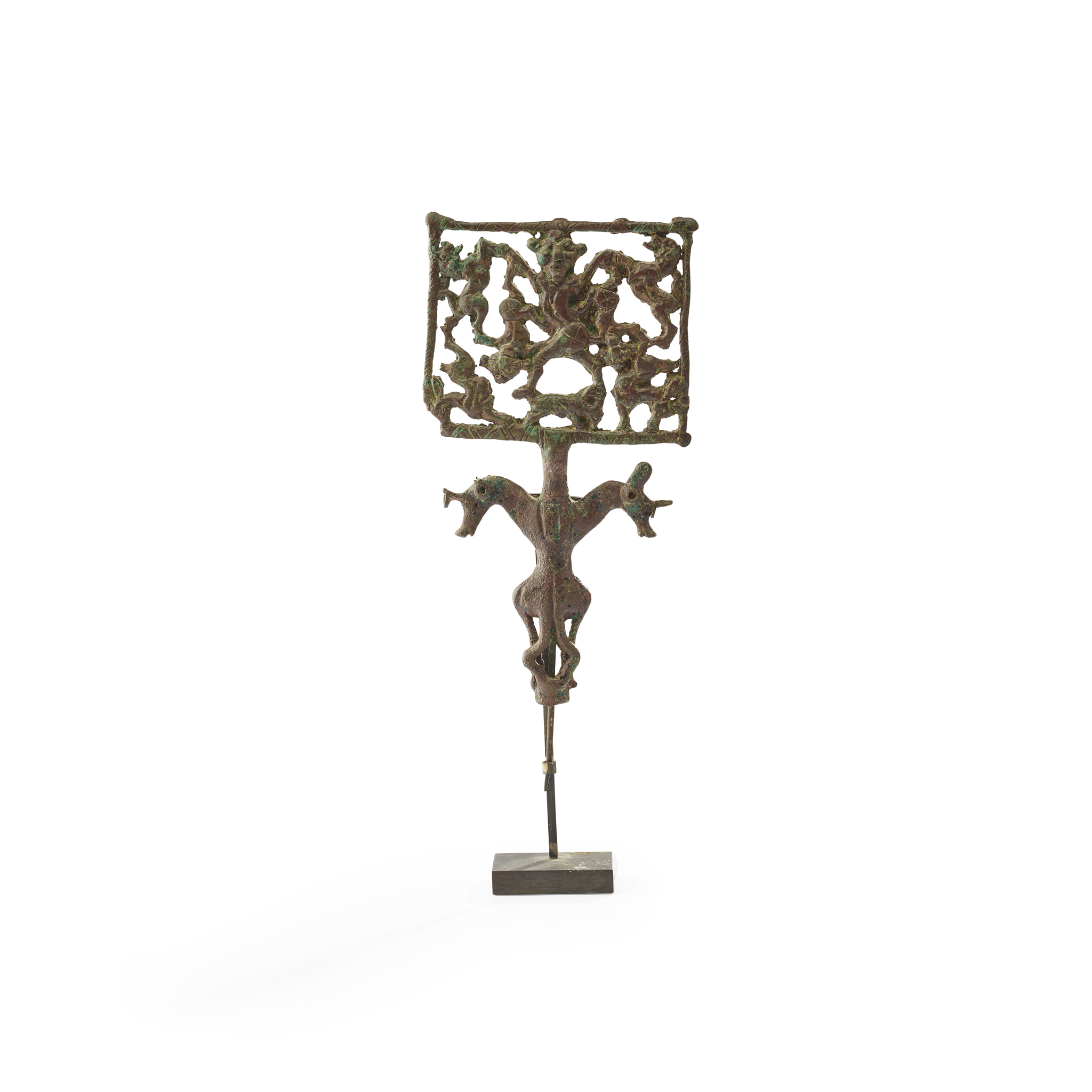
LURISTAN BRONZE PIN WITH OPENWORK PLAQUE
WESTERN ASIA, 800 – 600 B.C.
Antiquities and African & Oceanic Art
Auction: Antiquities - 31 July 2024 at 2pm
Description
cast bronze, the pin topped with a large square openwork plaque in the style of the “master of animals”, in a kinetic scene the central figure is shown standing atop an ibex, with arms raised, grasping the front legs of two wild lions to keep them at bay, two further hybrid creatures hang from his forearms whilst a pair of ibex jump down towards the base, the shaft adorned with a pair of horses, each standing atop a central plinth and facing outwards, raised on a bespoke mount
Dimensions
19.4cm tall
Provenance
Provenance:
The Paul Strickland collection of Lorestan art, acquired from the below 12th November 1982, accompanied by a copy of the original invoice
Mansour Gallery, 46 Davies Street, London, United Kingdom
Footnote
Some scholars think that elaborate pins such as the present example were votive offerings, while others suggest the more practical purpose of being used to fasten clothing. The motif depicted here of an anthropomorphic figure standing between and grasping two confronted animals is a particularly ancient one. Known as The Master of Animals, it likely represented a deity or talismanic figure with dominion over nature. The Master of Animals appeared throughout the ancient Near East and Egypt for thousands of years, with its roots sitting deep in prehistory. The earliest known example appears on a terracotta stamp seal excavated in southern Mesopotamia dated to c. 4000 B.C.