Poul Kjærholm was one of the leading figures of twentieth-century Danish design, celebrated for his disciplined use of steel, leather and glass. His work occupies a distinct position within the canon of Scandinavian modernism, combining industrial materials with a refined sense of proportion and restraint.
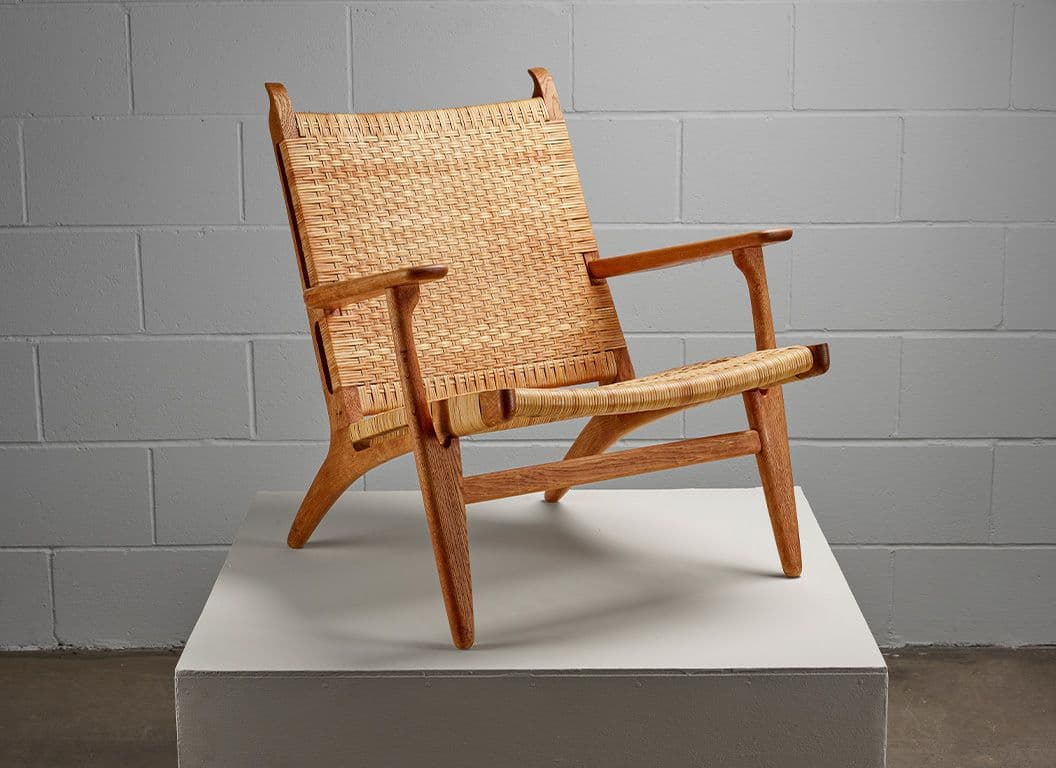
Born in Østervrå, Denmark, in 1929, Kjærholm trained as a cabinetmaker before studying furniture design at the Danish School of Arts and Crafts in Copenhagen. There he worked under the influential designer Hans Wegner, whose emphasis on craftsmanship and structural clarity left a lasting impression. Unlike many of his contemporaries, however, Kjærholm turned away from wood as his primary material, favouring steel for its precision and expressive potential.
Kjærholm regarded steel not as a purely industrial medium but as a material capable of warmth and subtlety when handled with care. His furniture is characterised by clean lines, carefully calculated proportions and a restrained elegance. Rather than imposing design for its own sake, he allowed construction and material to define form.
Among his most recognised designs are the PK22 lounge chair, the PK80 daybed, and the PK61 and PK63 tables, many produced by the Danish manufacturer E. Kold Christensen and later by Fritz Hansen. These pieces exemplify his approach: minimal yet tactile, modern yet rooted in craft tradition.
Kjærholm exhibited widely during his lifetime, including at the Milan Triennale, where he received international recognition. His work is held in major museum collections, including the Museum of Modern Art in New York and the Victoria and Albert Museum in London.
Image by Cristina Bejarano, CC BY 2.0 via Wikimedia Commons