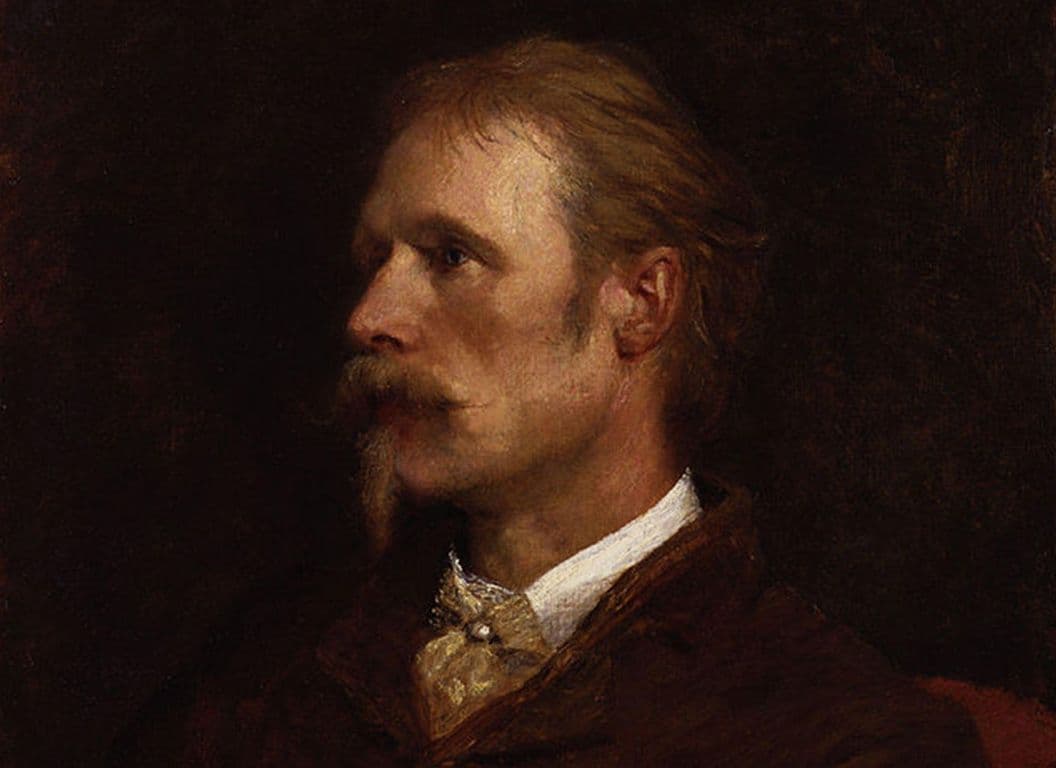
Born in Kent in 1884, Henry George Murphy, known as Harry, had an early first encounter with design and craftsmanship. Aged 10 he walked past an exhibition of the Arts and Crafts Society of London and, showing curiosity, was introduced to jeweller and silversmith Henry Wilson, illustrator Walter Crane and founder of the Arts & Crafts movement William Morris.
Murphy became Wilson’s protegee, from the age of fifteen undertaking a six-year apprenticeship at his Kensington workshop, an education complimented by enrolling at the Central School of Arts and Crafts. On completion of his studies, Murphy continued teaching at this institution and at the Royal College of Art. Further, he honed his skills as a craftsman in Wilson’s workshop, focusing on goldsmithing, enamel and jewellery. Murphy’s interest in Gothic and Renaissance style and use of enamel and niello mirrored Wilson’s, leading to his designs often being misattributed to his mentor.
In 1910 Murphy left Wilson’s studio and in 1912 travelled to Berlin where he was foreman in the workshop of Emil Lettré. This partnership was short lived due to Murphy’s homesickness and the recalcitrant nature of his employer. The following year, Murphy founded his west London workshop and married his fiancée of four years, Jessie Church. World War I meant a hiatus in his typical output, as he initially produced metal and enamel service badges for the military, before enlisting and shutting his workshop in 1915.
Following the conclusion of the war, Murphy recommenced teaching at the Central School of Arts and Crafts alongside other piecemeal studio work. In 1924 he produced the Crown Jewels for Queen Mary’s Doll’s House, including the Imperial State Crown at just 3cm high. It was also during this period that he received the most high-profile commission of his career, a tiara for the Princess Royal. This impressive piece was described at the 1966 auction of Princess Mary’s jewellery as ‘A Gem, Enamel and Gold Head Ornament, composed of five graduated gold and enamel Gothic arches supported on similarly decorated pillars each enclosing a stylized tree set with sapphires and small diamond collets'. The stylised trees were representations of the ‘Tree of Jesse’, a metaphor for the ancestors of Christ. This was a recurrent motif in Murphy’s work, and a nod to his wife Jessie.
It was in this vein that in 1928 he named his new workshop Falcon Studios (a jess being the strap attached to the leg of a falcon). The stamped Falcon mark can be found on much of Murphy’s work from this period and recognises the instrumental role Jessie played in supervising the Studios’ shop and office. Opening on Marylebone High Street in an old chemist’s shop, Murphy’s enterprise flourished. Falcon Studios’ initial success was unfortunately hampered by the 1929 Wall Street Crash, the negative effect of which impacted both the business’s fortunes and Murphy’s health. Despite illness, Murphy never lost his enthusiasm for his work or his verve for teaching. By 1932 however financial circumstances had improved and Murphy was also awarded Head of Silversmithing at the Central School of Arts and Crafts.
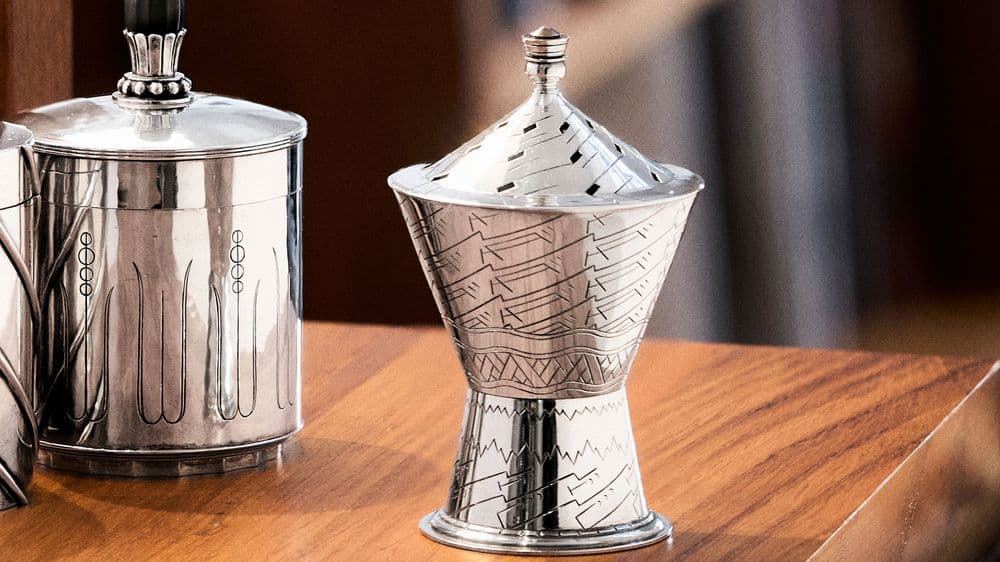
Murphy’s hitherto Renaissance and Gothic style began to include Art Deco, Egyptian and Oriental elements from the late 1920s. This is manifest in his clean, geometric lines and zig-zag patterns. Murphy also admired Nordic makers like Georg Jensen, as is evidenced by his inclusion of cabochons.
The conclusion of the decade saw Murphy declared a Freeman of the City of London and the Art Workers Guild, called to the Court of Assistants of the Goldsmiths’ Company and a recipient of the Diploma of Royal Designer of Industry, a highly regarded figure at the pinnacle of his profession. In 1939 however, Murphy’s health worsened significantly and he died on 10th July.
Passing away on the eve of the Second World War, the aesthetic of his work unfashionable at its close, H. G. Murphy languished almost entirely forgotten in the canon of design history. In 2005 however, admirers Paul Atterbury and John Benjamin organised an exhibition at Goldsmith’s Hall in London, presenting his work alongside an array of archival material and original designs. It is from their work that most of the writing on Murphy in subsequent years draws.
Their exhibition, At the Sign of the Falcon: H.G. Murphy – Art Deco Silversmith and Jeweller, initiated renewed interest in Murphy and began to redress the neglect of the previous century.