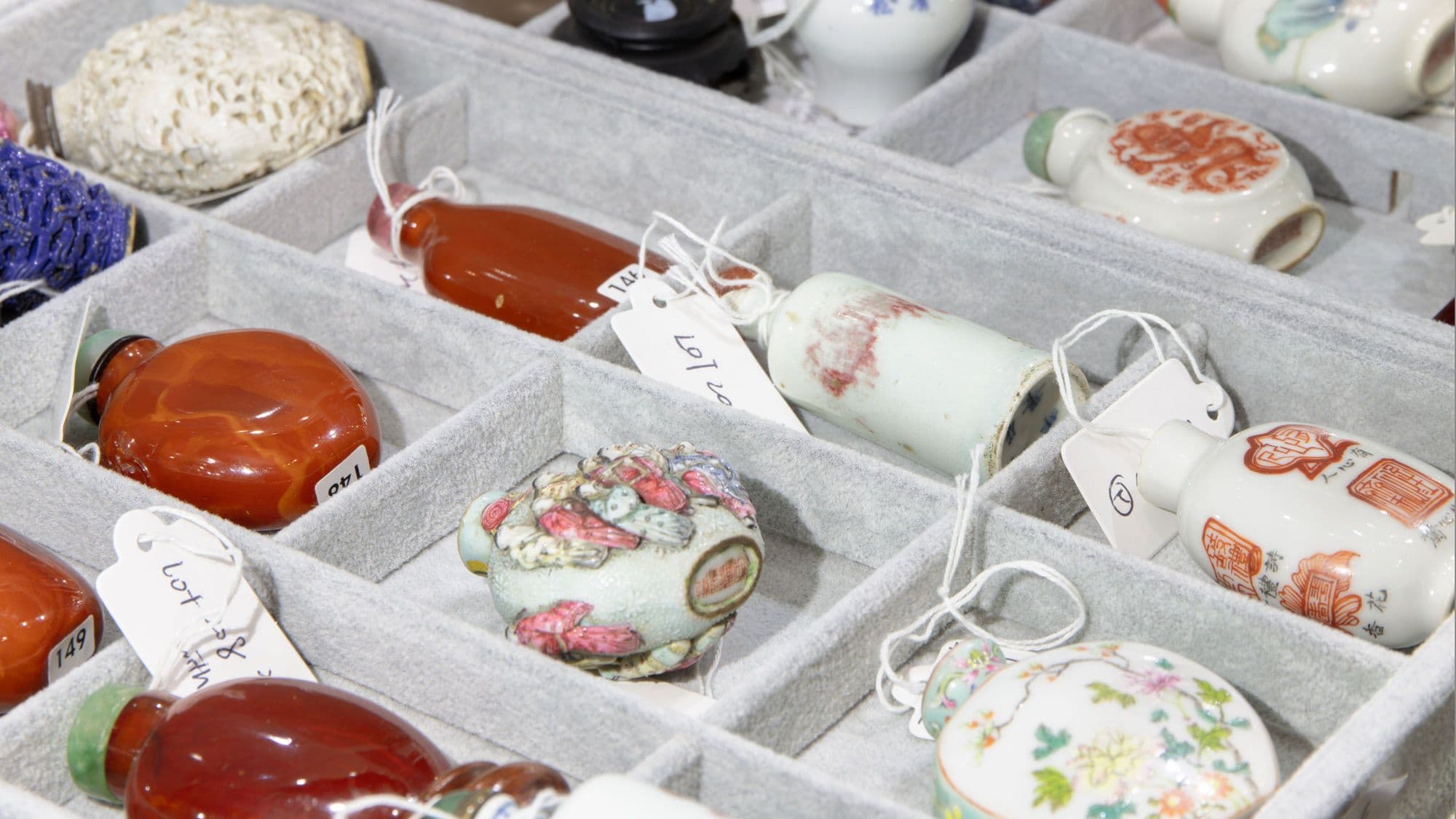
Small enough to fit in the palm of a hand, Chinese snuff bottles were once fashionable personal accessories. Popular during the Qing dynasty (1644–1912), they were designed to hold powdered tobacco, known as snuff, which was inhaled through the nose.
Over time, these practical containers became highly decorative objects. Crafted from porcelain, jade, glass, agate and other materials, some were painted with elaborate scenes, poetry and calligraphy. Today, Chinese snuff bottles are collected for their craftsmanship, historical significance and remarkable variety.
What Is a Chinese Snuff Bottle?
A Chinese snuff bottle is a small, portable container traditionally used to store powdered tobacco. Most have a narrow neck, a fitted stopper and a small spoon attached to the stopper for removing the snuff.
Introduced during the Qing dynasty, snuff bottles became popular among members of the imperial court and wider Chinese society. Their compact size made them convenient to carry, while their decoration offered opportunities to display wealth, taste and artistic appreciation.
Got Something to Sell?
Find out how much your Asian art could be worth at auction with a free valuation.
Why Did Chinese People Use Snuff Bottles?
Tobacco arrived in China through international trade during the late Ming and early Qing periods. While smoking tobacco became widespread, powdered tobacco, or snuff, developed its own social associations. Snuff was carried in small, tightly sealed bottles rather than the boxes commonly used in Europe. The fitted stopper helped protect the powdered contents from moisture.
During the Qing dynasty, snuff-taking became particularly fashionable at court and among wealthy households. Bottles could be exchanged as gifts, admired for their materials and craftsmanship or carried as personal accessories. As their popularity increased, the bottles themselves became objects of artistic importance, often far more elaborate than their original function required.
What Were Chinese Snuff Bottles Made From?
Chinese snuff bottles were produced in a remarkable range of materials, each offering different possibilities for decoration.
Material
Characteristics
Porcelain
Painted decoration, including blue-and-white and famille rose designs
Glass
Coloured, carved, overlay or inside-painted decoration
Jade
Carved stone valued for its colour, texture and workmanship
Agate
Natural variations in the stone incorporated into carved designs
Enamel
Detailed painted or cloisonné decoration
Lacquer
Carved surfaces featuring figures, landscapes and decorative patterns
The choice of material could reflect the owner's preferences, the availability of specialist craftsmen and the artistic fashions of the period.
Why Were Some Snuff Bottles Painted on the Inside?
One of the most remarkable developments in Chinese snuff bottle decoration was inside-painting. Rather than decorating the exterior, artists painted directly onto the inner surface of glass or crystal bottles using specially shaped brushes inserted through the narrow neck. This demanding technique transformed a small functional container into a miniature canvas.
The paintings could feature landscapes, animals, figures and scenes from Chinese literature. Some incorporated calligraphy and poetry, allowing the artist to combine visual imagery with literary references.
Poetry and Painting on a Single Bottle
A particularly interesting example is a glass snuff bottle dated 1909 and associated with the family workshop of Ma Shaoxuan. One side depicts two cats at play, while the reverse bears a 32-character poem by the celebrated Song dynasty poet Su Dongpo. The combination of playful imagery and classical poetry demonstrates how snuff bottles could reflect the literary interests and artistic tastes of their owners.
Other examples illustrate stories from Strange Tales from a Chinese Studio (Liaozhai Zhiyi), the celebrated collection of supernatural tales by Pu Songling. These miniature paintings brought familiar characters and narratives into an object small enough to carry in a pocket.
Yes. Although snuff-taking is no longer a widespread social practice, Chinese snuff bottles remain an established collecting category. Collectors may specialise in particular materials, periods, decorative techniques or artists. Some focus on Qing dynasty porcelain and jade bottles, while others favour carved glass, agate or inside-painted examples.
When assessing a Chinese snuff bottle, specialists consider its age, materials, craftsmanship, condition, provenance and attribution. Original stoppers, inscriptions and the quality of decoration can also contribute to an understanding of an individual bottle.
Chinese Incense Vessels at Auction
Chinese incense vessels are an established collecting category within Asian decorative art. Examples range from early bronze censers and Buddhist ritual objects to Ming and Qing dynasty metalwork, ceramics and cloisonné enamel.
When examining an incense vessel, specialists consider its form, material, decoration, condition and provenance. These features can help establish its period, intended function and artistic significance.
Lyon & Turnbull's Asian Art department regularly handles Chinese bronzes, incense burners, ceramics and other works of art.
If you own a Chinese incense vessel and would like to know more about its potential auction value, our specialists offer complimentary and confidential valuations.
Lyon & Turnbull's Asian Art specialists regularly handle Chinese snuff bottles and other works of art, including porcelain, jade, glass and decorative objects from the Qing dynasty.
Whether you own a single bottle or a larger collection, our specialists can provide advice on identification and potential auction value.
Frequently Asked Questions About Chinese Snuff Bottles
Chinese snuff bottles were designed to contain powdered tobacco, known as snuff. A small spoon, usually attached to the stopper, was used to remove the powder.
Snuff bottles became popular during the Qing dynasty (1644–1912), particularly from the seventeenth century onwards. They continued to be produced and collected after the dynasty ended.
Their compact size made them convenient personal accessories. They were designed to carry small quantities of powdered tobacco and could be kept in a pocket or sleeve.
No. Chinese snuff bottles were made from many different materials, including jade, agate, porcelain, glass, enamel and lacquer. Some were carved, others painted and some relied on the natural appearance of their materials.
Value depends on several factors, including age, rarity, material, quality of craftsmanship, condition, provenance and artist attribution. A specialist assessment can help establish its potential auction value.