Boshanlu: The Chinese Hill Censer
Identifying feature: A mountain-shaped, pierced cover.
The bronze hill censer, known as boshanlu (博山爐), is a form particularly associated with the Han dynasty. Its distinctive cover represents a mountainous landscape, traditionally associated with Mount Penglai, the mythical home of immortals. As incense burns inside the vessel, smoke emerges through the openings and drifts around the raised peaks.
This combination of practical design and symbolic imagery makes the boshanlu one of the most recognisable forms of early Chinese incense burner.
Xinglu: The Long-Handled Walking Censer
Identifying feature: An elongated handle attached to the incense vessel.
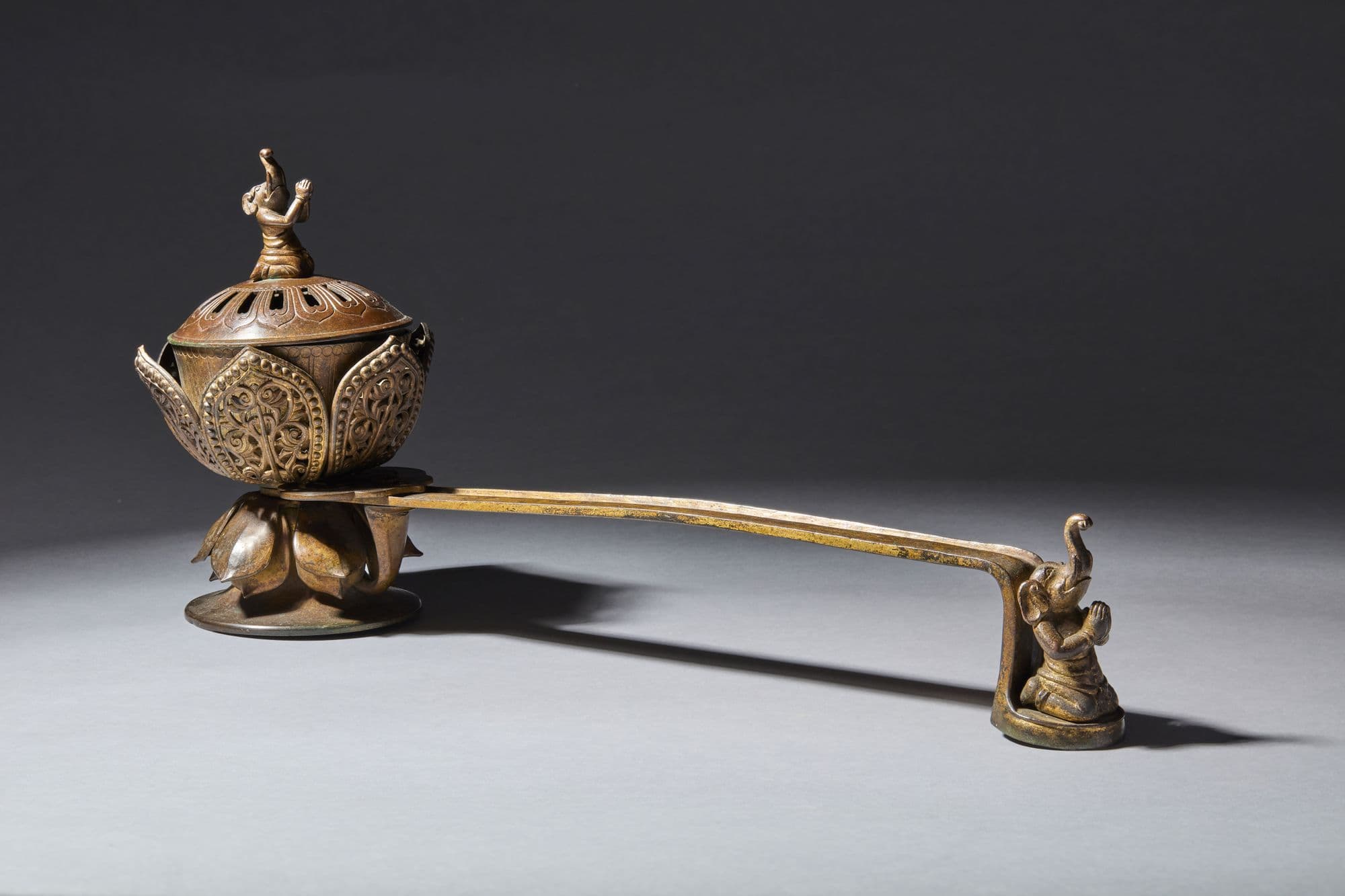
The xinglu (行爐), or walking censer, was used during Buddhist processions.
Unlike a stationary incense burner, its long handle allowed the vessel to be carried by worshippers during religious ceremonies, including the practice of circumambulating a Buddha image.
Some surviving examples incorporate elaborate religious imagery. A rare gilt-bronze long-handled censer featuring Vināyaka-Ganesha, for example, demonstrates the interaction between Indian religious iconography and East Asian Buddhist art. Vināyaka-Ganesha is an elephant-headed deity associated with wisdom and the removal of obstacles. His appearance on a Chinese Buddhist ritual object reflects the transmission and adaptation of religious imagery across Asia.
Xiangping: The Chinese Incense-Tool Vase
Identifying feature: A narrow, upright vessel designed to hold incense implements.
The xiangping (香瓶) was used to hold the tools associated with preparing and handling incense.
These could include tongs, small shovels and incense sticks. Unlike a censer, the vase was not principally intended as a vessel in which to burn incense. During the Ming dynasty, incense-tool vases could be highly decorative objects in their own right.
One notable example is a gilt-bronze vase with silver-inlaid sea beasts leaping above waves, bearing an attribution to the Ming metalworker Hu Wenming. Its detailed decoration demonstrates how a practical studio accessory could also display considerable artistic craftsmanship.
Chinese Incense Boxes
Identifying feature: A small covered container with a closely fitting lid.
Chinese incense boxes were designed to store aromatic materials, including incense cakes, pellets and powders. Their closely fitting lids helped protect the contents and preserve their fragrance.
Incense boxes were made from a variety of materials, including bronze, cloisonné enamel, jade and hardwood. Some were decorated with floral patterns, auspicious symbols or other motifs associated with Chinese decorative art.
It is important to distinguish an incense box from a censer: the former was intended primarily for storage, while the latter was used for burning incense.
How Were These Vessels Used Together?
By the Ming dynasty, an arrangement known as the Three Incense Utensils, or luping sanshi (爐瓶三事), had become associated with the Chinese scholar's studio.
It comprised three complementary objects:
- Incense burner: the vessel in which incense was burned.
- Incense-tool vase: used to hold the implements required for preparing and handling incense.
- Incense box: used to store the aromatic materials.
Together, these objects formed a practical arrangement for incense appreciation, while their materials and decoration reflected the taste of their owners.
For a fuller account of the historical development of these objects, read A History of Incense Burners and Censers.