

Lot 7
![[INCENSE CULTURE] RARE GILT-BRONZE 'VINĀYAKA-GANESHA' LONG-HANDLED CENSER](https://media.app.artisio.co/media/104cbde6-0d38-43cb-9e0f-bb721ef57bcf/inventory/1904cdd4-6d32-4914-bf82-a4b073eeb9f7/4b0dc179-4712-48e3-bc54-c6d7241b031f/00001_UxrNjA_original.jpeg)
[INCENSE CULTURE] RARE GILT-BRONZE 'VINĀYAKA-GANESHA' LONG-HANDLED CENSER
9TH-13TH CENTURY


Auction: 06 November 2026 from 10:00 GMT
Description
九至十三世紀 銅鎏金蓮花形唐草紋行爐 帶毗那夜迦-象鼻天鎮飾
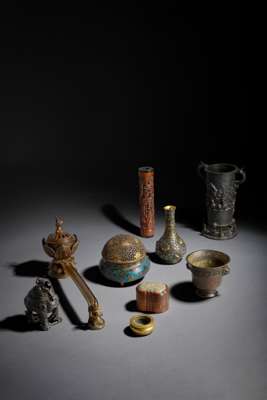
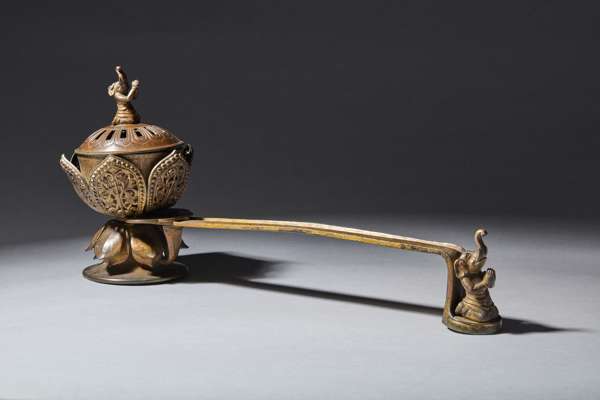
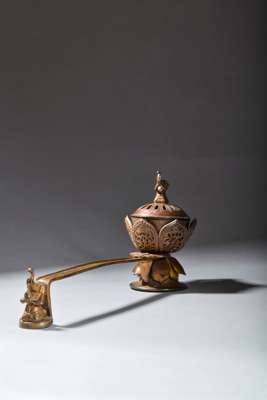
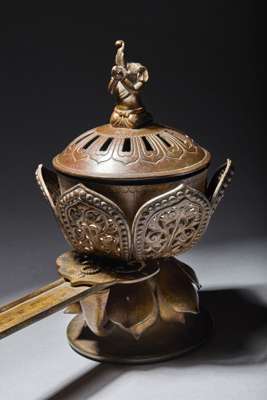
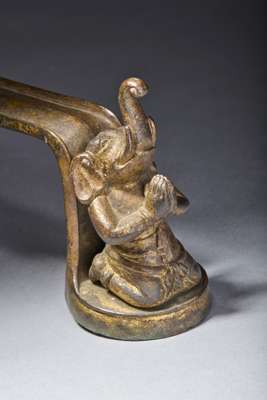
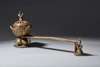
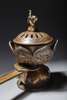
the finely cast incense bowl in the form of a blossoming lotus with each petal decorated with tendrils in openwork within a beaded border, set on a petalled base and fitted with a handle reminiscent of a ruyi sceptre, the long strap handle angling down at the end to accommodate a kneeling elephant-head Vināyaka-Ganesha as weight ornament, the deity exquisitely cast in anjali mudra and the curling snout highly raised, the pierced cover surmounted with another Vināyaka-Ganesha as finial
Dimensions
34cm wide; 1100g
Provenance
Private Taiwanese collection;
Formerly in a private Japanese collection
台灣私人收藏;
日本私人舊藏
Footnote
This extremely unusual censer is exceptional not only in its long-handled form, but also the Vināyaka-Ganesha weight ornament on the cover and the end of the handle.
This type of long-handled censer is also known as a walking censer, magpie-tail censer or hand-held burner. The custom of offering incense to Buddhist deities using long-handled censers appears in Gandharan stone sculpture as early as the 2nd century. In China, it first appeared during the Northern and Southern Dynasties period and was commonly used in major Buddhist ceremonies as a Buddhist offering vessel. Its use originated from a Buddhist practice known as ‘incense procession’ (xingxiang), in which worshippers carried a censer and circumambulated around a Buddha image as part of a devotional ritual. As the censer was designed to be carried while walking, it became known as a xinglu, or walking censer.
During the Tang dynasty, bronze casting incorporated and further developed techniques such as welding and openwork carving, giving rise to a wide variety of vessel forms. Early examples of this type traditionally featured a lion-shaped terminal, and were made using casting or forging techniques, sometimes in gilt bronze. Gilding was also applied to bronze vessels, enhancing their decorative refinement. The present example exemplifies the high level of craftsmanship achieved in the production of Buddhist ritual implements during this period. Long-handled censers were common during the Tang China, and then introduced to Japan. Soon after, Japanese bronze casters began producing long-handled censers modelled after the Tang-dynasty prototype.
Censers of this type are frequently depicted in Dunhuang murals and silk paintings. One notable example appears in Barbarian Royalty Worshiping the Buddha, a silk painting in ink and colour attributed to Zhao Guangfu of the Song dynasty, in the collection of the Cleveland Museum of Art, museum number: 1957.358. The painting depicts the story of foreign kings paying homage to the Buddha. The leading nobleman is shown carrying a long-handled censer with a lotus-shaped bowl, closely resembling the form of the present example.
Compare a related Tang dynasty gilt-bronze censer in the British Museum, museum number: 1936,1118.183. Also see a Tang dynasty bronze handled censer in the Sakamoto Gorō collection and then sold at Sotheby’s New York, 13 September 2016, lot 14. Both examples decorated with a finely cast seated lion weight at the end of the handle. Also see a gilt bronze censer with closely comparable Tang-style foliage decoration in openwork on the lotus-petal bowl, dated to the Yuan dynasty, sold at Beijing Poly, 7th June 2016, lot 8397. Two further Japanese examples of gilt bronze censers with lion weight: one in the Tokyo National Museum, dated to the Nara period of 8th century, museum no: N-282; one further example dated to the 13th century was sold at Bonhams New York, 25 March 2010, lot 2127.
The image of Vināyaka originated in ancient India in the 2nd century AD. Also known as Ganesha, he is the elephant-headed deity of wisdom and creation, the son of Shiva and the snow mountain goddess Pārvatī. Revered for his power to remove obstacles, he became widely worshipped. Introduced into China through Esoteric Buddhism during the Tang dynasty, Vināyaka was interpreted in Esoteric Buddhist tradition as the Deity of Obstacles and adopted into Buddhism as a Dharma protector. His image became widespread in Buddhist bronze sculpture in Tibet and Mongolia. As a guardian deity who protects the Buddhist Dharma, Vināyaka also appears in mural paintings. Surviving depictions can be found in the Mogao Caves at Dunhuang, including on the west wall of Cave 285, dating to the Western Wei dynasty, the east wall of Cave 244, dating to the Sui dynasty, and the north wall of the passageway in Cave 404.
The image of Vināyaka can also be seen on the Tang dynasty gilt-bronze censer with an elephant-head finial, preserved in the Famen Temple Museum (inventory no. FD4:018), which was interred in the crypt in the fifteenth year of the Xiantong reign (874 AD). This gilt-bronze incense burner is a characteristic example of incense implements associated with Tang-dynasty Esoteric Buddhism. The openwork lid is surmounted by a figure of Vināyaka kneeling upon an upturned lotus bud. The placement of Vināyaka atop the burner symbolises the power of burning incense to overcome obstacles and expel evil spirits. This censer found in the Famen Temple was the only known bronze censer discovered to date featuring an image of Vināyaka associated with Esoteric Buddhism, and the present long-handled censer is the other rare example. For comparison, see a Tang-dynasty gilt-bronze seated figure of Vināyaka in the collection of the Cleveland Museum of Art, museum no. 1959.253.
這件極為罕見的香爐,其獨特之處不僅在於長柄形制,更在於爐蓋及柄端之毗那夜迦-象鼻天鎮飾。
此式長柄香爐,亦稱行爐,又名鵲尾爐或手爐。以長柄香爐供養佛教神祇之習俗,早於公元二世紀已見於犍陀羅石雕。在中國最早見於南北朝時期,常於佛教大典中使用,作為佛供養器,始於佛教中有一種修持,叫做「行香」,即手捧香爐沿佛像繞行,是禮佛儀式的一種。因為此爐是走著使用的,故稱之為「行爐」。
唐代銅器繼承、引進了鑄造、焊接、鏤空技術,形狀有多種,古式之形狀尾端作獅子形,有鑄製、鍛製或青銅鍍金製等,鎏金亦在銅器上運用,製作更為精美。一如本品,顯示了其當時高超的佛教用器製作水平。長柄香爐於唐代中國甚為普遍,其後傳入日本。不久之後,日本青銅鑄造工匠便開始模仿唐代原型製作長柄香爐。
此類行爐形象在敦煌壁畫、絹畫中多有表現。美國克利夫蘭藝術博物館藏的宋代趙光輔絹本設色《番王禮佛圖》(館藏號1957.358),描繪少數民族番王朝拜佛像的故事。其中領頭的貴族則是用蓮花斗長柄行爐,形制與本品相似。
參考一件唐代鎏金銅香爐,現藏於大英博物館,館藏號:1936,1118.183。另見一件唐代銅柄香爐,曾為坂本五郎收藏,後於2016年9月13日在紐約蘇富比拍賣,拍品14。此兩例之柄端均飾有精美鑄造之蹲獅鎮。另可比較一件鎏金銅香爐,其蓮瓣爐身之唐式鏤空裝飾與本品相近,定年為元代,於2016年6月7日在北京保利拍賣,拍品8397。另有兩件日本鎏金銅香爐例,亦飾有獅鎮:一件藏於東京國立博物館,定年為八世紀奈良時代,館藏號:N-282;另一例定年為十三世紀,於2010年3月25日在紐約邦瀚斯拍賣,拍品2127。
毗那夜迦(Vināyaka)形象發源於公元2 世紀的古印度,又稱伽內什(Ganesa),是象頭人身的智慧神與創世神,是濕婆與雪山女神帕瓦羅蒂的兒子,因其能為世人消解障礙而廣受供奉,經唐代密宗傳入,密教毗那夜迦譯為障礙神,佛教引為護法神,在西藏與蒙古地區的佛教銅像中流傳甚廣。毗那夜迦作為護持佛法的護法神還出現在一些壁畫中,如敦煌莫高窟中西魏285 窟西壁、隋代244 窟東壁、404 窟甬道北壁中均遺留有毗那夜迦像。
毗那夜迦像亦可見於法門寺博物館藏的唐代鎏金象首金剛銅熏爐(編號FD4:018),唐咸通十五年(874AD)埋入地宮。這件鎏金象首金剛銅熏爐為典型唐密教香具,鏤空爐蓋頂飾跪於仰蓮蕾上造像為毗那夜迦像。毗那夜迦像飾於熏爐頂蓋,寓意燃香可破除障礙、祛除邪魔。這件法門寺地宮同熏爐是迄今發現的唯一一尊帶有密教毗那夜迦像的銅熏爐,而本品長柄爐則為另一罕例。另參考一件唐代鎏金銅毗那夜迦坐像,現藏於克利夫蘭藝術博物館,館藏號:1959.253。