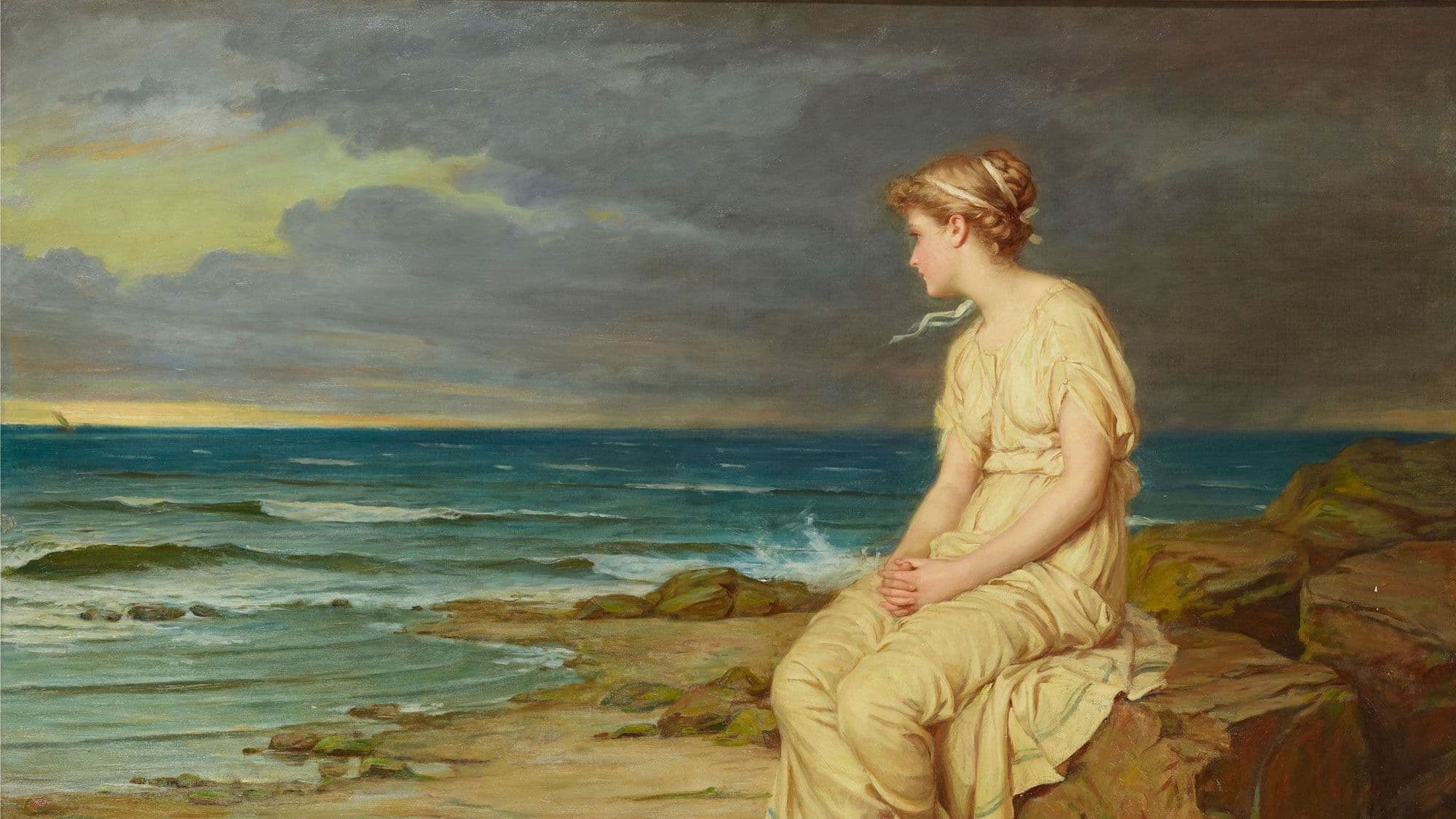
The painting also demonstrates the strong influence of Neo-Classicism upon Waterhouse’s early style. Miranda is dressed not in seventeenth-century costume appropriate to Shakespeare’s heroine, but rather in Grecian drapery resembling a classical chiton or toga. This stylistic decision aligns with the pervading fashion for Neo-Classicism amongst London artists at the time.
At the same time, the work introduces themes that would remain central throughout Waterhouse’s artistic production. Water, femininity, melancholy, and magic converge in Miranda in ways that anticipate later masterpieces such as The Lady of Shalott and his celebrated depictions of Ophelia. The sea functions not merely as a backdrop but as a psychological and symbolic presence. Miranda’s fixed gaze toward the distant vessel suggests both longing and apprehension, while the calm surface of the waves contrasts with the latent violence of Prospero’s approaching storm. This tension between serenity and impending catastrophe imbues the composition with emotional complexity.
The rediscovery of Miranda has therefore altered scholarly understanding of Waterhouse’s artistic development. Prior to its reappearance, the painting was known only through a reversed black-and-white reproduction published in Anthony Hobson’s 1980 monograph. Seeing the work in colour revealed the sophistication of Waterhouse’s early handling of luminous sea tones, atmospheric light, and subtle modelling of form. The painting demonstrates that by the age of twenty-six Waterhouse had already begun to cultivate the poetic sensibility and technical refinement associated with his later Pre-Raphaelite masterpieces. Furthermore, the possibility that the model was the artist’s sister Jessie, who also appeared in Whispered Words exhibited the same year, adds a personal dimension to the work’s introspective character.
Waterhouse would revisit the subject of Miranda in 1916 and 1917, producing dramatically different interpretations shaped by the emotional climate of the First World War. Those later paintings depict the storm and shipwreck with heightened drama and anguish, contrasting sharply with the calm restraint of the 1875 canvas. Seen in retrospect, the early Miranda emerges not merely as a youthful experiment but as the foundation of one of Waterhouse’s most enduring imaginative themes.