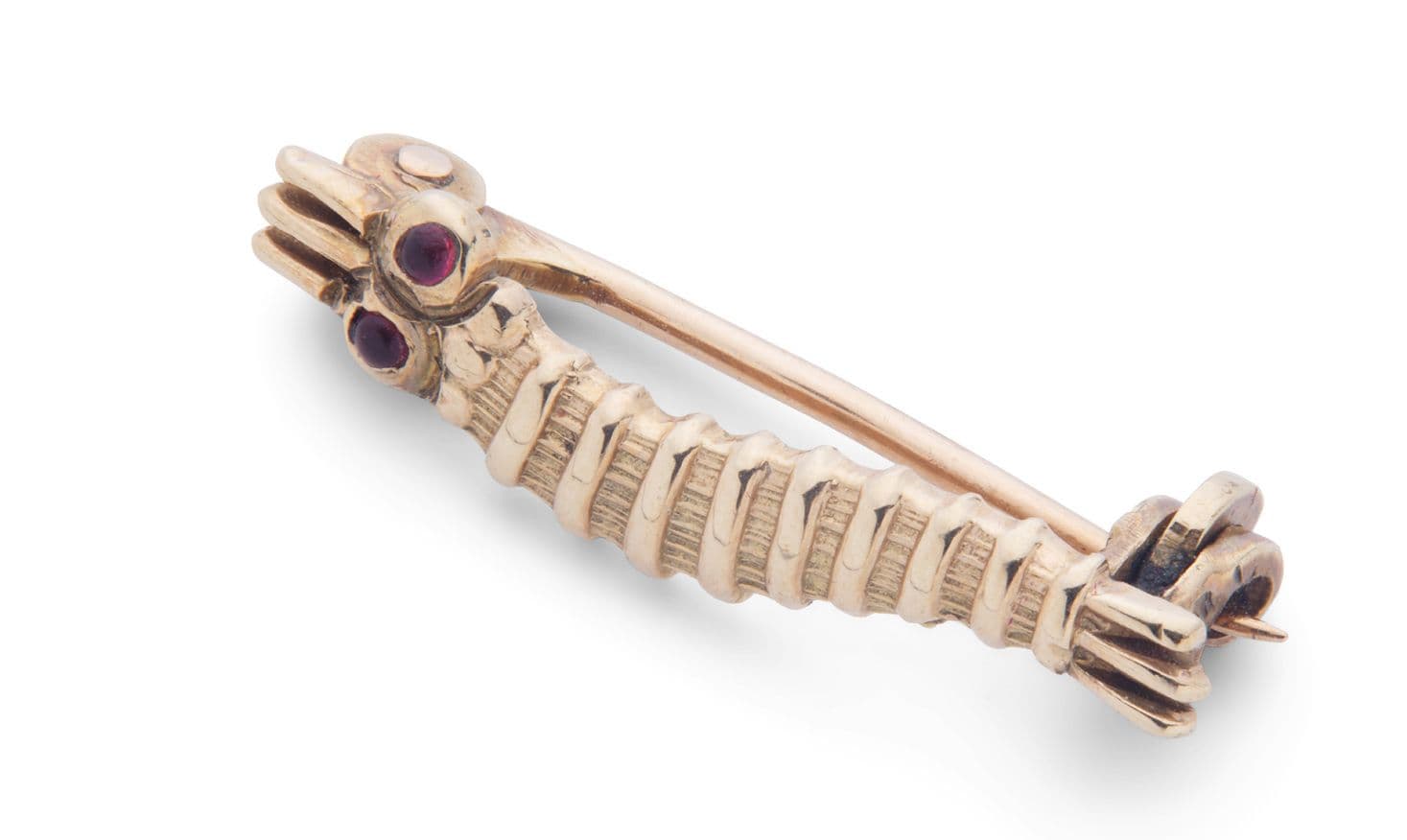
The Caterpillar Club continues today and includes such notable members as Charles Lindbergh, General Jimmy Doolittle as well as Senator and astronaut John Glenn. While official club membership numbers are only a fraction of the total number eligible, it is estimated that at least 100,000 people have had their lives saved by IRVIN parachutes.
Based on our research, lot 483, appears to be the caterpillar brooch awarded to Sergeant John Thomas Halliday who served in the RAFVR, or the Royal Air Force Volunteer Reserve; this was a civilian aircrew reserve formed in 1936 and were used extensively during the Second World War.
Sergeant Halliday’s admittance into the Caterpillar Club could stem from an incident that took place on the 12th into the 13th of July, 1944. At that time, Halliday was serving as a Flight Engineer in 103 Squadron of RAF Bomber Command, stationed at RAF Elsham Wolds in North Lincolnshire. Within the area, this was one of the first and most important RAF Stations during the Second World War.
On the 12th of July, Halliday was one of a seven-person crew carrying out their ninth operation: a night attack on the marshalling yards at Revigny in eastern France. Upon return from the operation within their Avro Lancaster III, the crew encountered rain and low cloud at their own air base and were diverted to RAF Carnaby, an emergency landing strip on the east coast of England that gave crippled bombers the chance for a safe landing. However, the Lancaster was also running low on fuel, and the crew were ordered to bale out. The aircraft was abandoned over Bridlington and subsequently crashed at Langtoft. Thankfully, all members of the crew were reported safe.
Later that year, after carrying out a successful attack on a V1 launching site at La Nieppe, the Lancaster PB363 which Sergeant Halliday was aboard, was shot down by flak and Halliday was captured as a prisoner of war along with other remaining survivors. He would be held at Stalag Luft L7 Bankau near Krueuzburg in Upper Silesia, Poland.