Where Have Roman Dodecahedrons Been Found?
The geographical distribution of Roman dodecahedrons is one of the most important clues to their possible purpose. Although they are described as Roman objects, the majority have been discovered in the northern and western provinces of the Empire, rather than in Rome or Italy itself.
Finds have been recorded in Britain, France, Belgium, Germany, the Netherlands and parts of Central Europe, including Hungary. This concentration has led to the alternative description Gallo-Roman dodecahedron, reflecting their particular association with the Roman provinces of Gaul and neighbouring regions.
Their distribution raises an intriguing possibility: rather than representing a practice shared across the entire Roman Empire, dodecahedrons may have belonged to traditions specific to particular provincial communities. These regions were places of considerable cultural interaction, where Roman customs existed alongside older local beliefs, artistic traditions and technologies.
Could the dodecahedron represent a practice that emerged from this meeting of cultures? The surviving evidence cannot yet provide a definitive answer, but its geographical pattern remains central to archaeological investigation.
The Norton Disney Roman Dodecahedron
One of the most significant discoveries in recent years occurred in 2023, when a remarkably complete Roman dodecahedron was excavated near Norton Disney in Lincolnshire, England.
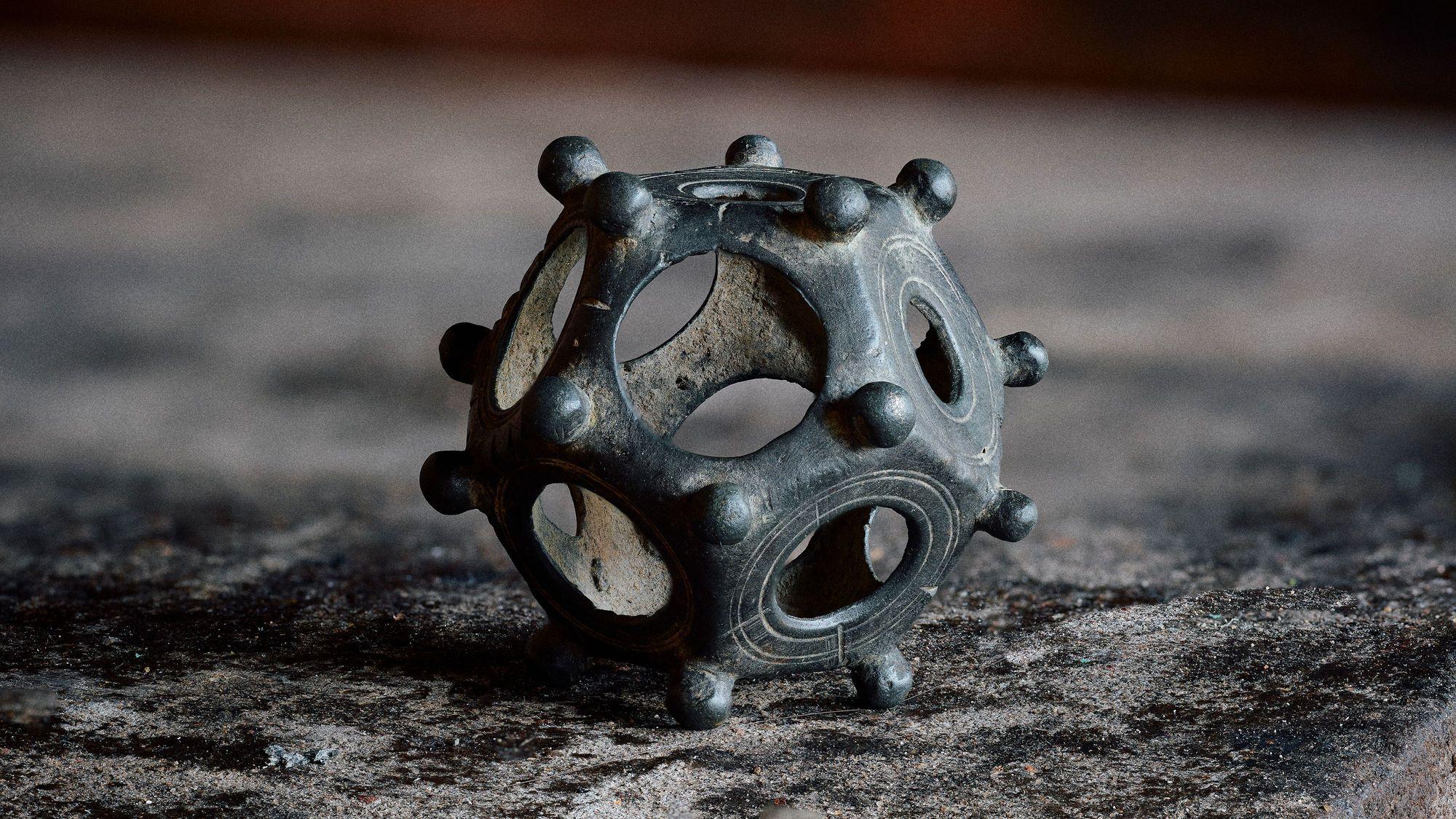
Found by the Norton Disney History and Archaeology Group during an archaeological excavation, the copper-alloy object dates to the later Roman period and measures approximately 8cm in height.
Unlike many earlier examples discovered without detailed archaeological records, the Norton Disney dodecahedron was recovered in a documented archaeological context.
Its discovery close to a Roman villa and the Fosse Way, an important Roman road, has provided researchers with an opportunity to investigate the wider setting in which one of these objects was deposited. The find has attracted considerable interest, yet it has not resolved the fundamental mystery. Even with modern archaeological techniques and an unusually well-preserved example, the object's original function remains elusive.
How Were Roman Dodecahedrons Made?
Whatever their intended purpose, Roman dodecahedrons reveal considerable technical skill. Producing a hollow metal object with twelve pentagonal faces, precisely arranged openings and projecting corner knobs required an accomplished understanding of metal casting.
The objects were generally cast in copper alloy, with some examples displaying additional decorative details, including concentric circles surrounding the perforations. Their construction is particularly fascinating because of the effort required to create them. If dodecahedrons were ordinary practical tools, why were they produced in such elaborate forms? And if they were ceremonial objects, what significance did their precise geometric design hold?
The quality of their manufacture suggests that they were more than casually assembled objects, but craftsmanship alone cannot establish whether their value was practical, symbolic or both.
What Can Roman Dodecahedrons Tell Us About the Ancient World?
The Roman dodecahedron provides a valuable reminder that our knowledge of antiquity remains incomplete. It is easy to imagine the Roman Empire as a thoroughly documented civilisation. Its emperors, military campaigns, engineering achievements and artistic traditions have been studied for centuries. Yet the survival of more than a hundred objects whose function remains unknown demonstrates how much of everyday ancient experience has been lost. Objects made from durable materials such as bronze may survive for millennia, while the knowledge, traditions and instructions associated with their use disappear. The Roman dodecahedron sits precisely at this intersection between the surviving material world and the lost experiences of the people who inhabited it.
It also illustrates why archaeological context is so important. Understanding where an object was found, what surrounded it and how it was deposited can sometimes reveal more than the object itself.
For collectors and enthusiasts of ancient art, this uncertainty is part of the fascination. A Roman dodecahedron is not simply an example of ancient metalwork, but a tangible connection to a question that has remained unanswered for nearly two thousand years.
The Mystery of the Roman Dodecahedron
Among the great achievements of the Roman Empire, few objects present quite the same puzzle as the dodecahedron. As demonstrated by the example examined by Lyon & Turnbull's Antiquities specialist, its complexity and unusual construction invite immediate curiosity.
There are three particularly fascinating aspects to these objects:
- The craftsmanship: The precise casting of twelve faces, circular openings and projecting knobs demonstrates considerable technical ability.
- The geographical distribution: Their concentration in the northern Roman provinces suggests that regional customs may be significant to understanding their purpose.
- The absence of explanation: Despite the extensive surviving records of Roman civilisation, no known written account identifies how these objects were used.
These characteristics make the Roman dodecahedron an exceptional subject for archaeological study and a reminder of the discoveries that may still await us.