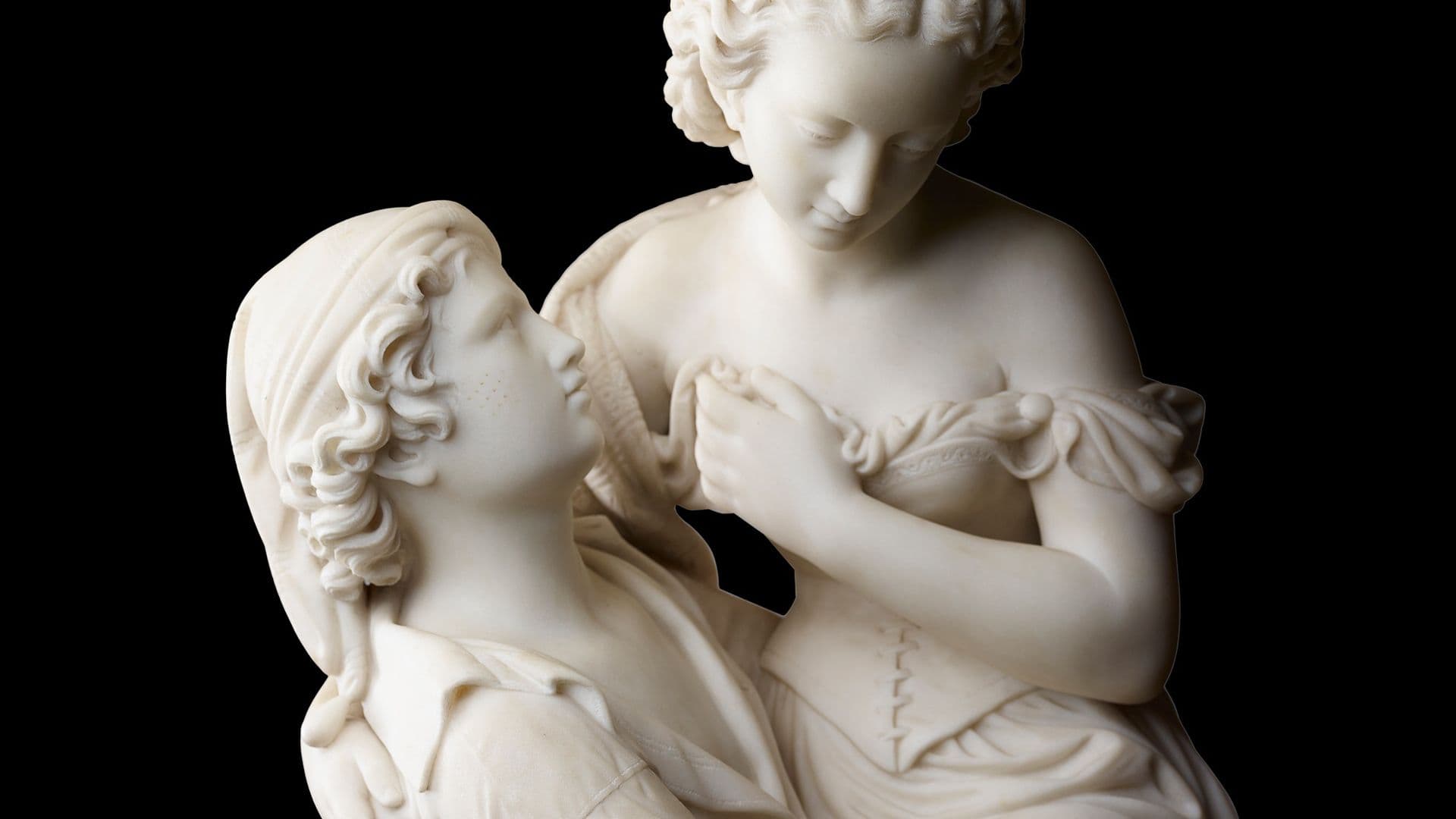
Carved from white Carrara marble, Giuseppe Lazzerini’s Paul and Virginia captures a tender moment from one of the most widely read romantic stories of the late 18th century.
Rather than depicting the tragedy that brings Jacques-Henri Bernardin de Saint-Pierre’s novel to its close, Lazzerini chose an earlier scene: Paul helping Virginia cross a river in the landscape of Mauritius. His careful treatment of their expressions and gestures transforms the literary episode into a study of affection, trust and youthful devotion.
Who Was Giuseppe Lazzerini?
Giuseppe Lazzerini was born in Carrara in 1831 and belonged to a long-established family of sculptors and marble workers. Carrara’s celebrated white marble had been prized by artists since antiquity, and the city developed an international reputation for workshops capable of producing technically accomplished sculpture.
Lazzerini entered the Accademia di Belle Arti di Carrara in 1848, studying under the sculptor Ferdinando Pelliccia. In 1853, his marble relief Patroclus Slaying Sarpedon earned him a scholarship to Rome, where he joined the studio of Pietro Tenerani, one of the leading Italian sculptors of the period.
Tenerani’s work combined the clarity and refinement of Neoclassical sculpture with a greater interest in human emotion. This influence can be seen in Lazzerini’s smooth marble surfaces, balanced compositions and sensitive treatment of literary and allegorical subjects.
Lazzerini later returned to Carrara, where he worked in and eventually supervised the family studio. He produced his own sculptures while also contributing to the wider output of a workshop whose history extended across several generations.