What Happens When You Move Around a Paolo Scheggi Painting?
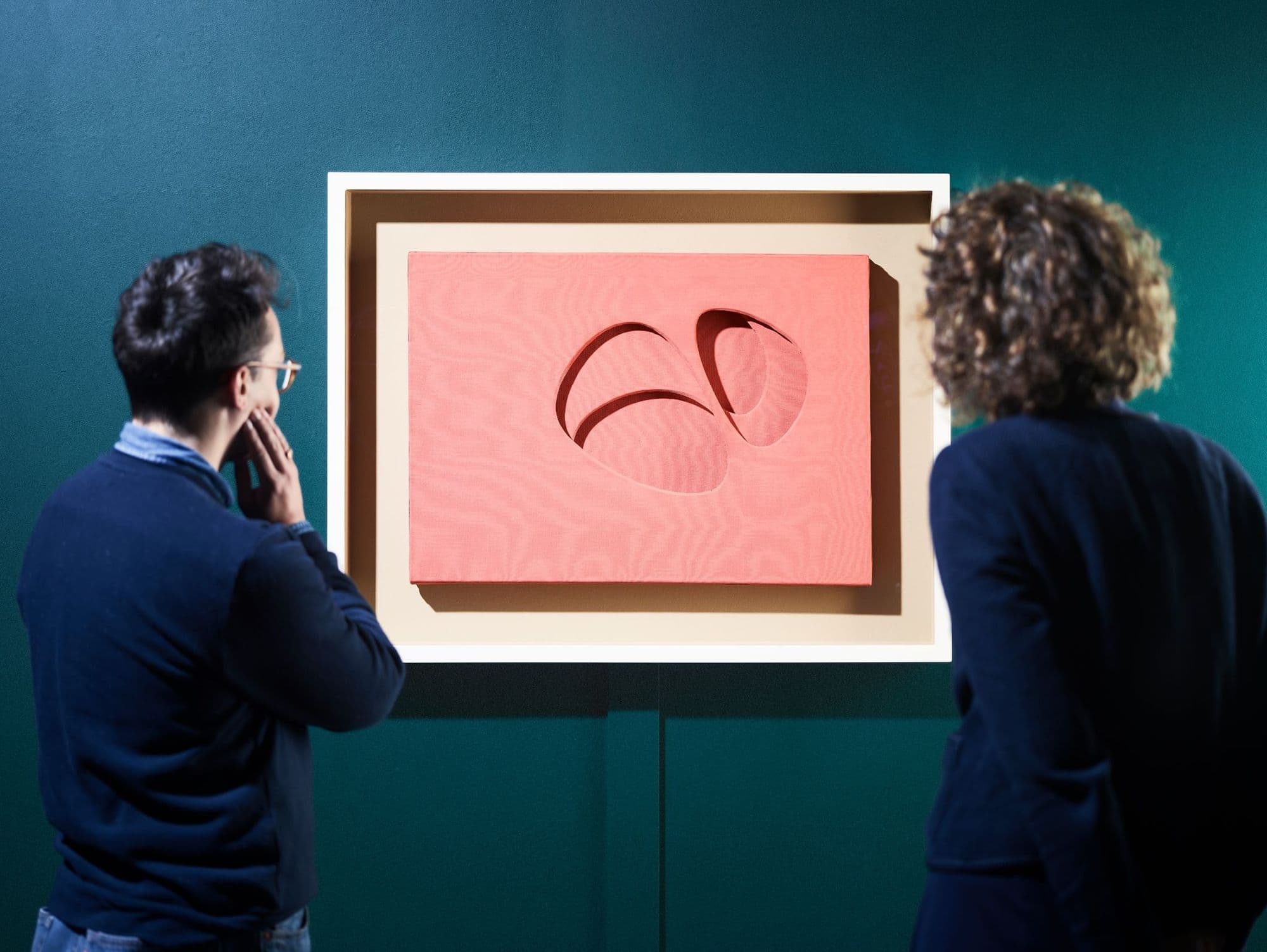
Most paintings are intended to be viewed primarily from the front. Scheggi's works ask something different of their audience. As the viewer moves, the openings in the layered canvases reveal different portions of the surfaces behind them. Shadows change position and the apparent depth of each opening becomes more pronounced. The work itself remains stationary, but our experience of it is continually changing.
“You have that immediate impression, but actually you need to look around and see in between spaces, to really delve in, look behind, make the shadows move yourself” Simon explains.
This is why he sees a relationship between Scheggi's paintings and kinetic art, a form of art concerned with movement. Strictly speaking, Zone Riflesse is not a mechanically moving kinetic sculpture. Its movement is perceptual, created by the changing relationship between the artwork, the light and the person looking at it. In this sense, the viewer becomes part of the experience.
Breaking the Fourth Wall: Painting Beyond the Canvas
Scheggi was an important figure within the Italian avant-garde centred on Milan during the 1960s, alongside artists including Lucio Fontana and Enrico Castellani. These artists challenged the traditional boundaries of painting, questioning whether the canvas should remain a flat, self-contained surface.
Simon offers an interesting comparison with cinema, “For me, Spatialism is a little bit like breaking the fourth wall in film.”
In theatre and film, breaking the fourth wall draws attention to the relationship between the audience and what is happening before them. Something comparable happens when an artist cuts into a canvas.
A painted surface traditionally encourages us to look at an image or imagine a space represented within it. By cutting, piercing or layering that surface, artists such as Fontana and Scheggi draw attention to the physical object itself while simultaneously opening up spaces beyond its apparent boundaries. The canvas is no longer simply a window onto another world. It becomes part of the world occupied by the viewer.
For Scheggi, these openings were not merely decorative shapes. They were a means of changing how painting could be experienced.
Why Is the Colour of Zone Riflesse So Important?
One of the most striking characteristics of Scheggi's Zone Riflesse of 1963 is its colour. The work is painted in a distinctive shade of pink, although describing it simply as pink hardly does it justice.
“It's very flat, it's very pink, but it's not pink-pink. It's kind of halfway between orange and brown” Simon observes.
The colour is particularly difficult to capture in photographs. Depending on the lighting and the way it is reproduced, its warmth and subtle tonal character can be lost. This matters because colour plays an important role in how we experience the work.
Much Minimalist and Conceptual art employs primary colours, black or white to emphasise structure and form. Scheggi's choice of this unusual pink creates a different effect. Rather than making the construction feel purely geometric or austere, it introduces a softer, warmer atmosphere. The colour also interacts with the shadows cast between the layers of canvas. As light enters the openings, subtle variations of tone become visible, adding to the sense of depth. What initially appears to be a uniform surface is therefore considerably more complex.
Light, Shadow and the Illusion of Movement
The relationship between light and shadow is central to understanding Scheggi's work. Each opening reveals not only another surface but also the shadow cast upon it by the canvas above. These shadows help establish the distance between the layers, making the construction feel deeper than its relatively shallow physical dimensions might suggest.
As the viewer changes position, the visible relationships between openings, surfaces and shadows shift. This creates a sense of movement without the need for moving parts. It is an important distinction. Scheggi does not simply depict movement within a painting. He creates a work in which the viewer's own movement changes what can be seen. The painting is therefore experienced over time, rather than understood through a single fixed image.