What Are Old Cut Diamonds?
The term old cut diamond doesn't describe one single diamond cut. Instead, it is commonly used for a family of historic cutting styles produced before diamond cutting became standardised. Early diamond cutters were working without the sophisticated equipment, computer modelling and understanding of light performance available today. They also had another priority: preserving as much valuable diamond rough as possible.
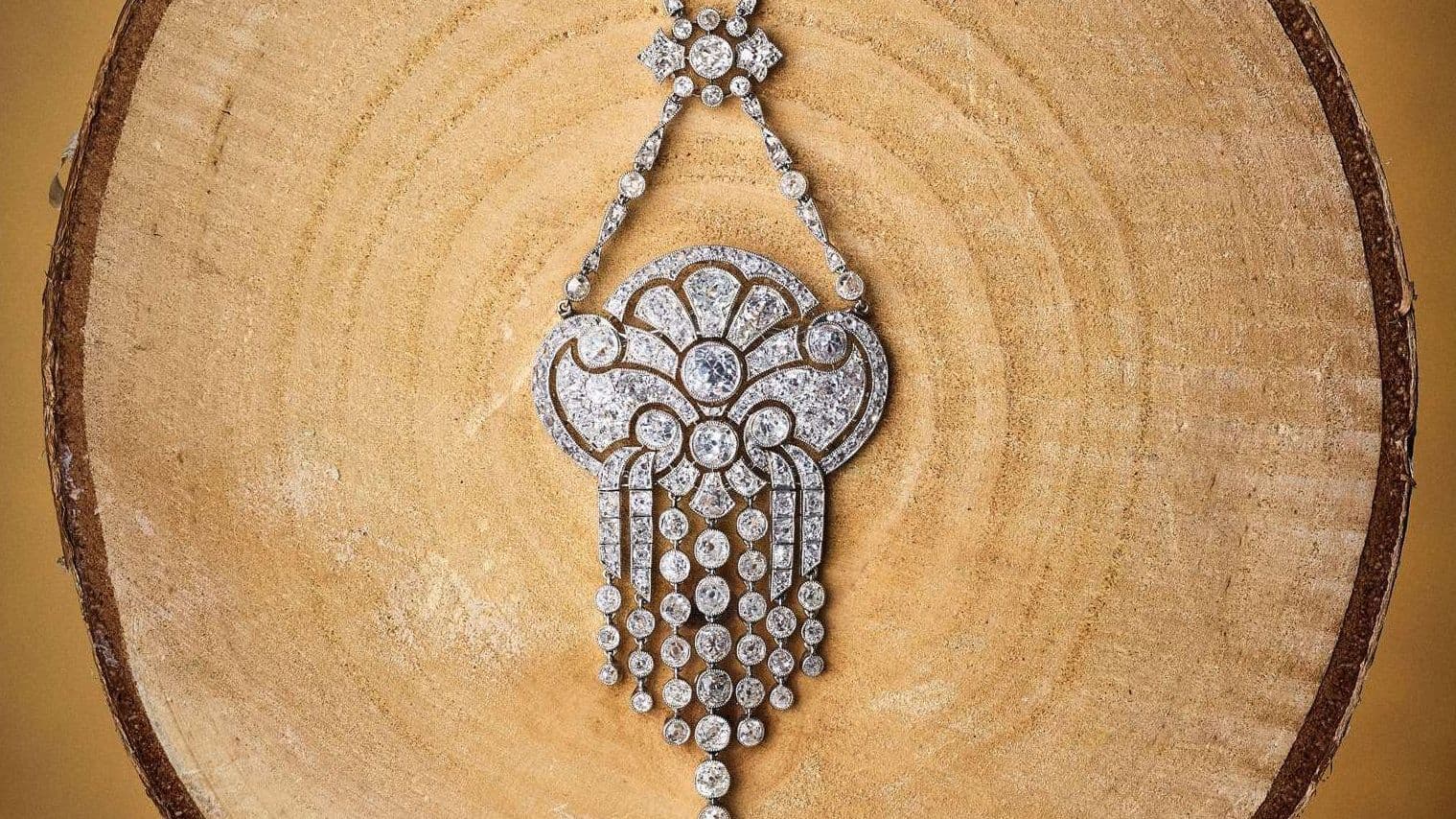
As a result, an antique diamond often retains the individual proportions dictated by the original rough stone. One may be slightly elongated, another almost square, while another might have noticeably uneven facets. Those variations aren't necessarily faults. In an antique jewel, they can be an important part of its character and history.
What Is an Old Mine Cut Diamond?
The Old Mine cut is one of the most recognisable historic diamond cuts. Usually cushion-shaped rather than perfectly round, Old Mine cut diamonds tend to have a high crown, relatively small table, deep pavilion and an open culet. Viewed from above, that culet can sometimes be seen as a small facet or apparent 'hole' at the centre of the stone.
Because Old Mine diamonds were fashioned by hand, their outlines can vary considerably. Some are squarer, some more rectangular and others approach a rounded cushion shape. Their larger facets tend to produce broad flashes of light rather than the more rapid sparkle associated with a modern brilliant.
How can you recognise an Old Mine cut?
Look for a combination of:
- A cushion or irregular outline
- A relatively small table
- High crown
- Deep proportions
- Large facets
- A visible open culet
- Individual, sometimes asymmetric proportions
No single feature is enough to identify a diamond conclusively, particularly when the stone remains mounted in a ring.
What Is an Old European Cut Diamond?
The Old European cut represents an important stage in the development of the round brilliant diamond. It became prominent during the late 19th and early 20th centuries as advances in diamond-cutting technology made it possible to create increasingly round and symmetrical stones.
Old European cut diamonds are generally rounder than Old Mine cuts, but they retain many characteristics associated with antique diamonds: a relatively small table, high crown, larger facets and a visible culet. They therefore sit fascinatingly between the hand-fashioned character of earlier diamonds and the increasingly precise geometry that would eventually lead to the modern Round Brilliant.
Old Mine Cut vs Old European Cut: What's the Difference?
The most immediately apparent difference is usually shape. An Old Mine cut tends towards a cushion-shaped or irregular outline, while an Old European cut is generally round. The Old European cut also tends to demonstrate greater symmetry, reflecting developments in diamond-cutting machinery and technique around the turn of the 20th century.
There is, however, no neat date on which cutters stopped producing one and began producing the other. Jewellery evolved gradually, techniques overlapped and older diamonds were frequently reset into newer jewels. This is why specialists look at the entire piece rather than using the diamond cut alone to date a ring.
What Is a Round Brilliant-Cut Diamond?
The modern Round Brilliant cut developed from centuries of experimentation with diamond faceting. Its proportions and facet arrangement are designed specifically to control the way light enters and leaves the diamond, producing high levels of brilliance, fire and scintillation.
The modern standard Round Brilliant has 57 or 58 facets depending on whether the culet is counted, arranged with much greater consistency than would normally be found in an antique hand-cut stone.
Its outline is circular, its symmetry is considerably more precise and the culet generally comes to a point rather than forming the obvious flat facet often seen in old cuts. This doesn't make a modern brilliant inherently 'better' than an old cut. They represent different approaches to cutting a diamond and create different visual effects.
Do Old Cut Diamonds Sparkle Differently?
Yes, and this is one of their great attractions. Modern brilliant cuts are engineered to return large amounts of light to the viewer, producing the lively combination of white light, coloured fire and scintillation generally associated with modern diamonds.
Old cuts can behave differently. Their high crowns, small tables and larger facets can create broader, slower flashes of light, particularly as the jewel moves. The effect can feel warmer and less uniform than that of a precisely cut modern diamond.
Historically, these diamonds would also have been seen in very different lighting conditions. Candlelight, gaslight and early electric lighting interact with a diamond quite differently from the bright environments in which we usually encounter jewellery today.
Why Do Old Cut Diamonds Have a Hole in the Middle?
What appears to be a small hole is usually the culet. The culet is the facet at the very bottom of a diamond. On many Old Mine and Old European cut diamonds it was deliberately polished flat rather than brought to the sharp point usually found on a modern Round Brilliant.
When viewed through the table of the diamond, a large open culet can therefore be visible as a small shape at its centre. It is not a missing piece of diamond or necessarily evidence of damage. In the right context, it can actually be one of the clues that a specialist uses when assessing an old cut stone.
Are Old Cut Diamonds More Valuable?
Not automatically. Age alone doesn't make a diamond valuable. As with other diamonds, carat weight, colour, clarity, condition and overall appearance all influence value.
With antique diamonds, however, specialists may also consider factors that don't translate neatly onto a modern grading report. The attractiveness of the cut, its proportions and individuality, the quality and period of the setting, rarity, provenance and whether the stone appears original to the jewel can all contribute to collector interest. An antique ring by an important maker can also occupy a very different market from an unsigned example containing a superficially similar diamond.
Can Old Cut Diamonds Be GIA Certified?
Yes. Antique diamonds can be submitted to independent gemmological laboratories for grading, although terminology on a laboratory report may differ from the terminology used by jewellery historians, dealers and auction specialists.
A report can provide important information about characteristics including carat weight, colour and clarity. It shouldn't, however, be treated as a substitute for examining the jewel itself. For an antique diamond ring, the diamond is only part of the story.
Have Antique Diamonds Been Recut?
Some have. Diamonds have always been valuable, portable materials, and jewellery has frequently been altered as fashions changed. Stones could be removed from damaged or unfashionable settings, reset into newer jewellery or recut to alter their appearance.
Recutting an old diamond may improve aspects such as symmetry or remove damage, but it also removes material and can erase some of the historic characteristics collectors value. For this reason, an apparently untouched old cut diamond in an original period setting can be particularly interesting.
Can an Old Cut Diamond Be in a Modern Ring?
Absolutely. A historic diamond may have been reset many decades after it was originally cut. Equally, contemporary jewellers sometimes deliberately use antique diamonds because of their distinctive appearance.
The reverse is also possible: an antique ring may have had its original stone replaced with a later diamond. Diamond cut should therefore never be used on its own to date a ring. Specialists will consider the setting, construction, metal, hallmarks, style, wear and any available provenance alongside the characteristics of the stone.
A Specialist's Eye: What to Look for in an Old Cut Diamond Ring
When examining an antique diamond ring, some of the most useful clues are not necessarily the most obvious. Look at the outline of the diamond. Hand-cut stones rarely have the mechanical regularity of modern diamonds.
Look through the table for a visible culet, and examine the relationship between the smaller table, high crown and deeper body of the stone. Then look beyond the diamond. The construction of the setting, the way the stone is mounted, the metal used and evidence of alteration can all help establish whether the elements of the ring belong together.
Most importantly, don't dismiss irregularity automatically. With an old cut diamond, a little imperfection in symmetry can be part of what makes the stone distinctive.
Old Cut Diamond Rings at Auction
Old cut diamonds regularly appear at auction in jewellery dating from the Georgian, Victorian, Edwardian and early 20th-century periods.
Some remain within their original settings, while others have lived several lives, moving from one jewel to another as fashions and families changed.
For collectors, this creates an area of the diamond market where gemmology, jewellery history and craftsmanship intersect. Two diamonds of similar weight and grade can have markedly different appearances, histories and appeal.
At Lyon & Turnbull, our jewellery specialists assess antique and modern diamond rings individually, considering the diamonds alongside their settings, condition, age, maker and provenance where known.