How Are Pearls Formed?
A pearl is one of the few materials used in jewellery today which, like coral, is produced by a living organism rather than by geological forces deep in the earth.
Pearls are produced by certain molluscs, including freshwater mussels and saltwater oysters. When an irritant becomes lodged within the mollusc, layers of nacre can form around it. Over time these layers build up to create a pearl.
The size, colour and shape of a pearl can be influenced by the mollusc in which it grows, its environment and the length of time over which it develops.
What Is the Difference Between Natural and Cultured Pearls?
There are two broad categories of pearl: natural pearls and cultured pearls.
Natural pearls form without deliberate human intervention. Historically, finding them required enormous effort. Pearl divers collected large numbers of molluscs, yet only a tiny proportion might contain pearls of sufficient quality for jewellery.
This rarity was one reason natural pearls commanded extraordinary prices.
Cultured pearls are also genuine pearls produced by molluscs, but their formation is deliberately initiated by people. The development of commercial pearl cultivation transformed the availability of pearl jewellery during the 20th century.
Today, most pearls encountered in jewellery are cultured, while fine natural pearls remain considerably rarer.
Why Were Natural Pearls So Valuable?
Before pearl cultivation became commercially viable, obtaining a fine natural pearl depended largely upon chance.
Divers might recover enormous quantities of molluscs to find only a handful of desirable pearls. Matching enough natural pearls in size, colour, shape and lustre to create an entire necklace was more difficult still.
This helps explain why important natural pearl necklaces became extraordinary displays of wealth.
One famous story concerns Jacques Cartier and the Cartier mansion on Fifth Avenue in New York. In the early 20th century, a double-strand natural pearl necklace played a central role in the transaction through which Cartier acquired the property that became its New York home.
Natural pearls subsequently became particularly prized at auction. In 2011, Christie's sold La Peregrina, the historic pearl later owned by Elizabeth Taylor and incorporated into a Cartier necklace, for more than $11 million.
How Did Cultured Pearls Change Jewellery?
At the turn of the 20th century, developments in pearl cultivation in Japan transformed the market.
Kokichi Mikimoto became one of the figures most closely associated with the commercial development and promotion of cultured pearls. By the 1930s, Japanese pearl farming had grown into a substantial industry capable of producing pearls on a scale that would have been impossible through natural pearl fishing alone.
Cultivation made pearl jewellery accessible to a much wider audience.
It also fundamentally changed the market for natural pearls. Rather than disappearing from collecting, however, fine natural examples became increasingly distinct from the cultured pearls produced for the wider jewellery market.
Natural Pearls vs Cultured Pearls
Natural and cultured pearls are both produced by molluscs and both consist largely of nacre. The important distinction is how their formation begins.
A natural pearl develops without deliberate human intervention, whereas the formation of a cultured pearl is initiated as part of the cultivation process.
For important pearl jewellery, determining whether pearls are natural or cultured can therefore have a significant effect on value.
Laboratory testing may be required for particularly important examples, as the distinction cannot always be established reliably simply by looking at a pearl.
What Makes a Pearl Valuable?
There is no single characteristic that determines the value of a pearl.
Specialists consider a combination of factors including:
- whether the pearl is natural or cultured
- size
- shape
- colour
- lustre
- surface quality
- the quality and thickness of the nacre
- matching within a necklace or suite
- condition
- provenance
- the setting and associated gemstones
For natural pearl jewellery in particular, rarity and successful matching can be extremely important. Creating a graduated necklace of natural pearls with complementary colour, shape and lustre could require the accumulation of individual pearls over many years.
What Are Scottish Freshwater Pearls?
Scotland has a particularly important history of freshwater pearls.
Scottish freshwater pearls are produced by the freshwater pearl mussel, Margaritifera margaritifera, and their use in jewellery stretches back centuries.
Scottish pearls vary considerably in appearance and can have enormous character. Their history also connects them closely with Scottish jewellery and goldsmithing.
The freshwater pearl mussel is now legally protected in Scotland, and taking, killing, injuring or disturbing the mussels is prohibited. As a result, historic Scottish pearl jewellery has a significance that goes beyond the appearance of the pearls themselves.
Older pieces can provide evidence of a jewellery tradition that can no longer be practised in the same way today.
Pearls in Antique and Vintage Jewellery
Pearls appear throughout the history of jewellery and their use can tell us a great deal about the period in which a piece was made.
Natural pearls feature prominently in Georgian, Victorian and Edwardian jewellery, including necklaces, earrings, brooches and rings. Their soft lustre also made them particularly suited to mourning and sentimental jewellery.
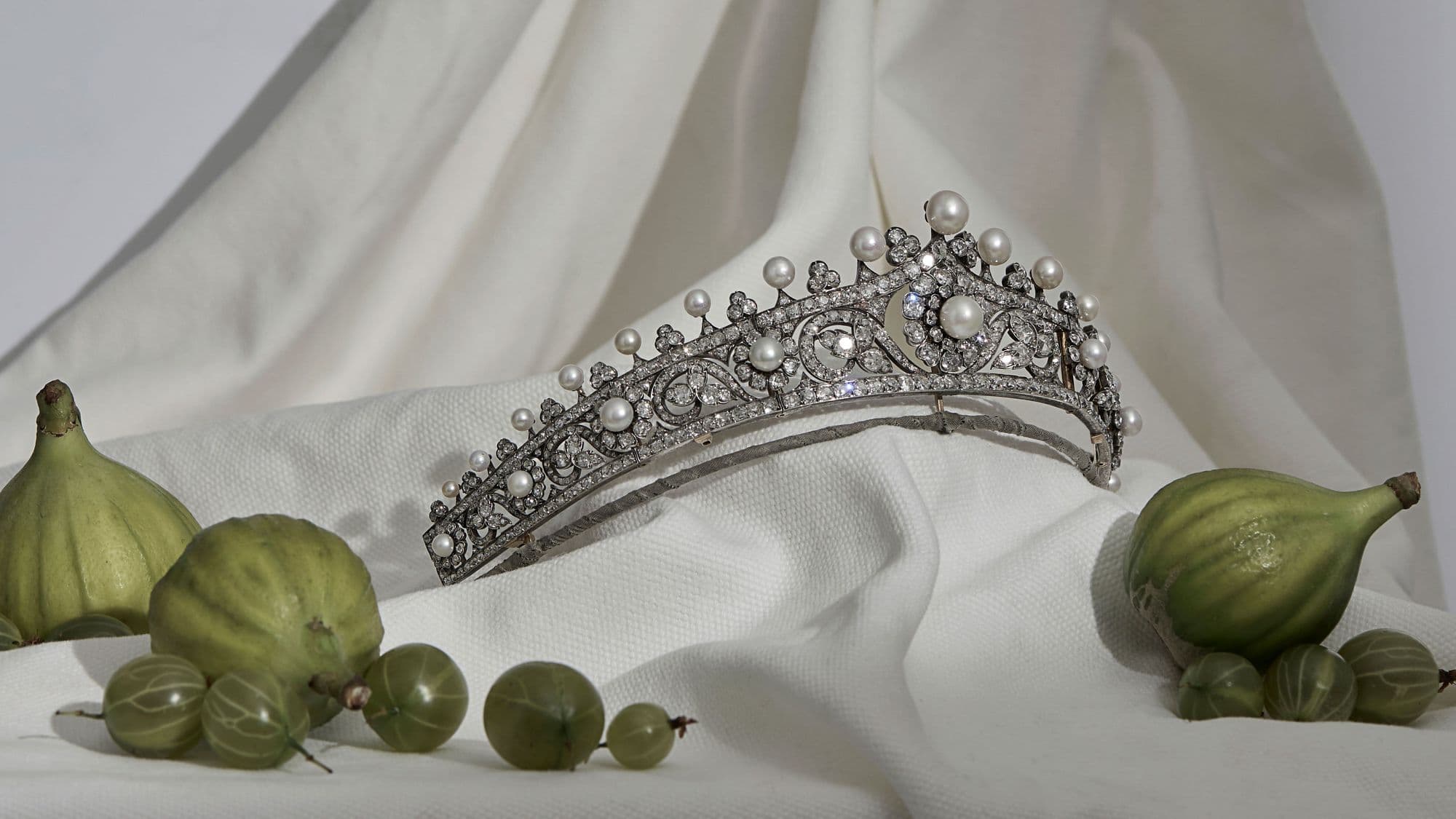
During the late 19th and early 20th centuries, pearls were frequently paired with diamonds, particularly in delicate Edwardian and Belle Époque designs.
The arrival of cultured pearls opened another chapter, making pearl necklaces and jewellery increasingly fashionable throughout the 20th century.
Today, collectors can therefore encounter everything from rare natural pearl jewels to Scottish freshwater pearls and vintage cultured pearl necklaces at auction.