
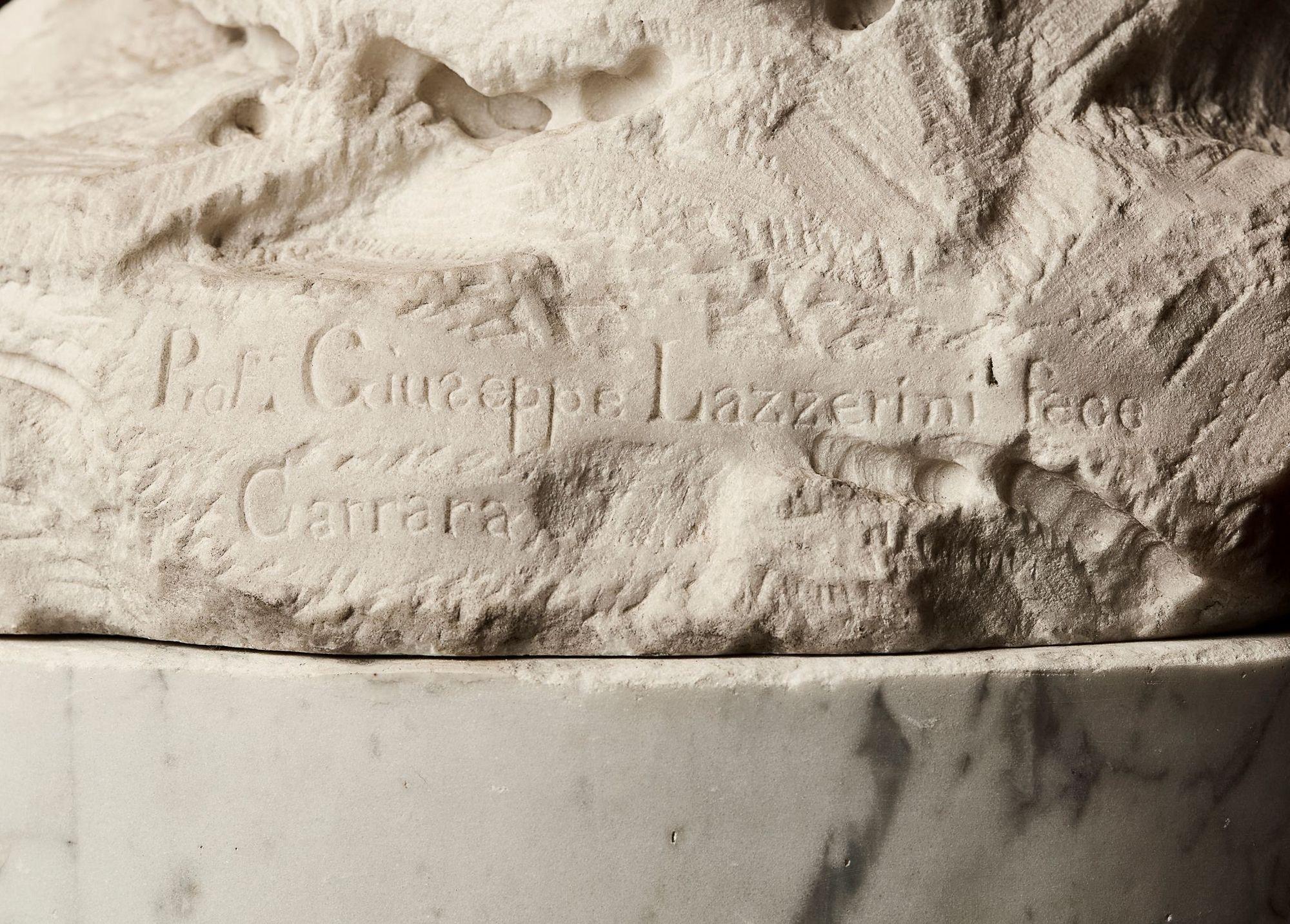
Guiseppe Lazzerini descended from a family of Italian sculptors in Carrara, and in 1848 entered the Carrara Accademia di Belle Arti under the direction of Ferdinando Pelliccia. While there he won the Rome scholarship which sent him to work in the studio of Pietro Tenerani, where he completed a statue of St. Sebastien followed by Hagar and Ishmael. Lazzerini returned to Carrara to work in the family studio where he produced a wide range of his own works as well as works of other sculptors. His sculpture demonstrated the strong influence of Tenerani, which he in turned passed on to students of the Carrara Academy for which he was the director from 1889-1893.
Five Centuries
Love, Loss and the Romantic Imagination: Lazzerini’s Paul et Virginie
6 November 2026
Douglas Girton
Its central themes are innocent love, separation, social inequality and the loss of paradise. Nature provides both an apparent refuge from social convention and a power beyond human control. The movement from pastoral tranquillity to the sublime terror of a shipwreck is particularly important to its wider artistic context, where a landscape that first offers harmony becomes overwhelming and destructive. This tension between the beautiful and the sublime connects the novel with the developing Romantic fascination with storms, dramatic scenery and the vulnerability of human life.
An international success, the novel helped establish a literary language in which landscape reflects and intensifies human feeling. Its lyrical descriptions of nature helped shape the writing associated with Chateaubriand and later Romantic authors, giving the natural world an emotional significance beyond its role as a setting. The story’s combination of tenderness, idealised simplicity, and tragedy also exemplifies the culture of sensibility by inviting readers to respond sympathetically to suffering while questioning the social distinctions that frustrate personal happiness.
Lazzerini's sculpture Paul et Virginie is based on the popular romance novel by Jacques-Henri Bernadin de Saint-Pierre, first published in 1788. The novel occupies a transitional position between the eighteenth-century cult of sensibility and the emerging Romanticism of the early 19th century. Set in the years before the French Revolution, it tells the story of the idyllic childhoods of the title characters and the fate of a child of nature corrupted by the artificial sentimentality of the French upper classes in the late eighteenth century. Born and raised on the island of Mauritius, Paul and Virginia are childhood sweethearts who are separated when Virginia is sent to Paris at the behest of a wealthy aunt, with the promise of an inheritance and education. While there she is miserably treated and unhappy, and is pressured to marry a nobleman but refuses, vowing to return to Paul and her simpler, more authentic life. On her return journey the ship enters a hurricane within sight of the island and is wrecked just off the coast. Paul tries in vain to swim out and rescue her, but fails, and Virginia is tragically drowned within sight of the home to which she desperately wanted to return.
Lazzerini chose as his subject an earlier moment in the story when the two young lovers lose their way in a remote part of the island and are confronted by a river which Paul helps Virginia to cross. The story draws on Rousseau’s ideal of natural goodness, contrasting an apparently innocent island existence with the corrupting influence of European society. Rather than a fully Romantic novel in the nineteenth-century sense, it is a precursor. Its emotional intensity, distant setting and lyrical treatment of landscape anticipate the movement’s preference for feeling, imagination, and individual experience.

Its influence extended well beyond literature into paintings, prints, opera and the decorative arts. Scenes from the story appeared on clocks, plates, wallpaper, and snuffboxes, translating the sentimental narrative into objects for the domestic interior. Specific examples include a white marble and gilt-bronze mantel clock made by Dieudonné Kinable around 1795, and a monumental clock by Pierre-Philippe Thomire, dated about 1810–20, in the Musée François Duesberg, Mons, depicting the episode of Paul and Virginie’s return on a palanquin. Joseph Dufour’s manufacture produced a panoramic wallpaper series in 1823; its woodblock-printed grisaille panel La danse des enfants survives in the Musée des Arts Décoratifs, Paris. Printed furnishing textiles likewise brought the narrative into everyday surroundings including toile de Nantes and toile de Jouy fabrics that were turned into bedcovers, curtains, valances, and other soft furnishings, all illustrating the story. These representations made the lovers and their island setting recognisable even beyond the novel’s readership. Paul et Virginie consequently offers a useful link between literary sensibility and Romantic visual culture, showing how themes of emotion, nature and distant places circulated across different art forms.