Check the Dimensions
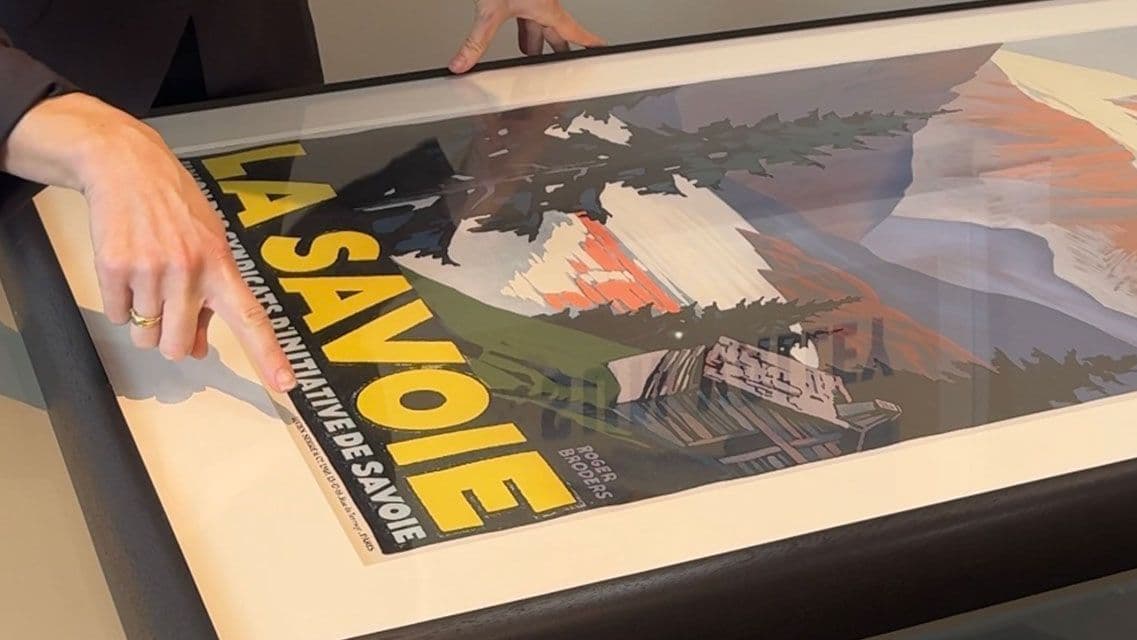
One of the first things to examine is the size of the poster. The Roger Broders example we have used measures approximately 40 x 25 inches, a standard format for early 20th-century travel posters.
This matters because posters were produced to fit specific hoardings and display frames, particularly in railway stations and public spaces. As a result, original posters tend to conform to a small number of consistent dimensions. Deviations from these standard sizes can be an early warning sign.
Look for the Printer’s Mark
Most original posters include a printer’s imprint, usually found along the bottom margin and occasionally at the top.
This imprint identifies:
- Where the poster was printed
- Which printer produced it
- Sometimes, the year of production
In some cases, the date may be absent, as it is here, but the presence of a printer’s mark is still a strong indicator of originality and period production.
Identify the Commissioning Body
Many vintage travel posters were commissioned by transport companies, tourism boards or government bodies. In this example, the PLM logo appears at the top.
PLM stands for Paris–Lyon–Méditerranée, the French railway company that commissioned a large number of iconic travel posters in the early 20th century. Recognising these logos helps confirm both authenticity and original purpose.
Examine the Printing Method
The printing technique is one of the most telling indicators of authenticity.
On close inspection, this poster shows:
- No pixelation or dot pattern
- A matte paper surface
- Flat areas of colour rather than photographic gradients
These characteristics are consistent with stone lithography, the dominant printing method for posters in the 1920s and 1930s. Later reproductions often show modern printing traits such as digital dot patterns, glossy finishes, or inconsistent colour layering.