Rarity, Labour, and Legacy
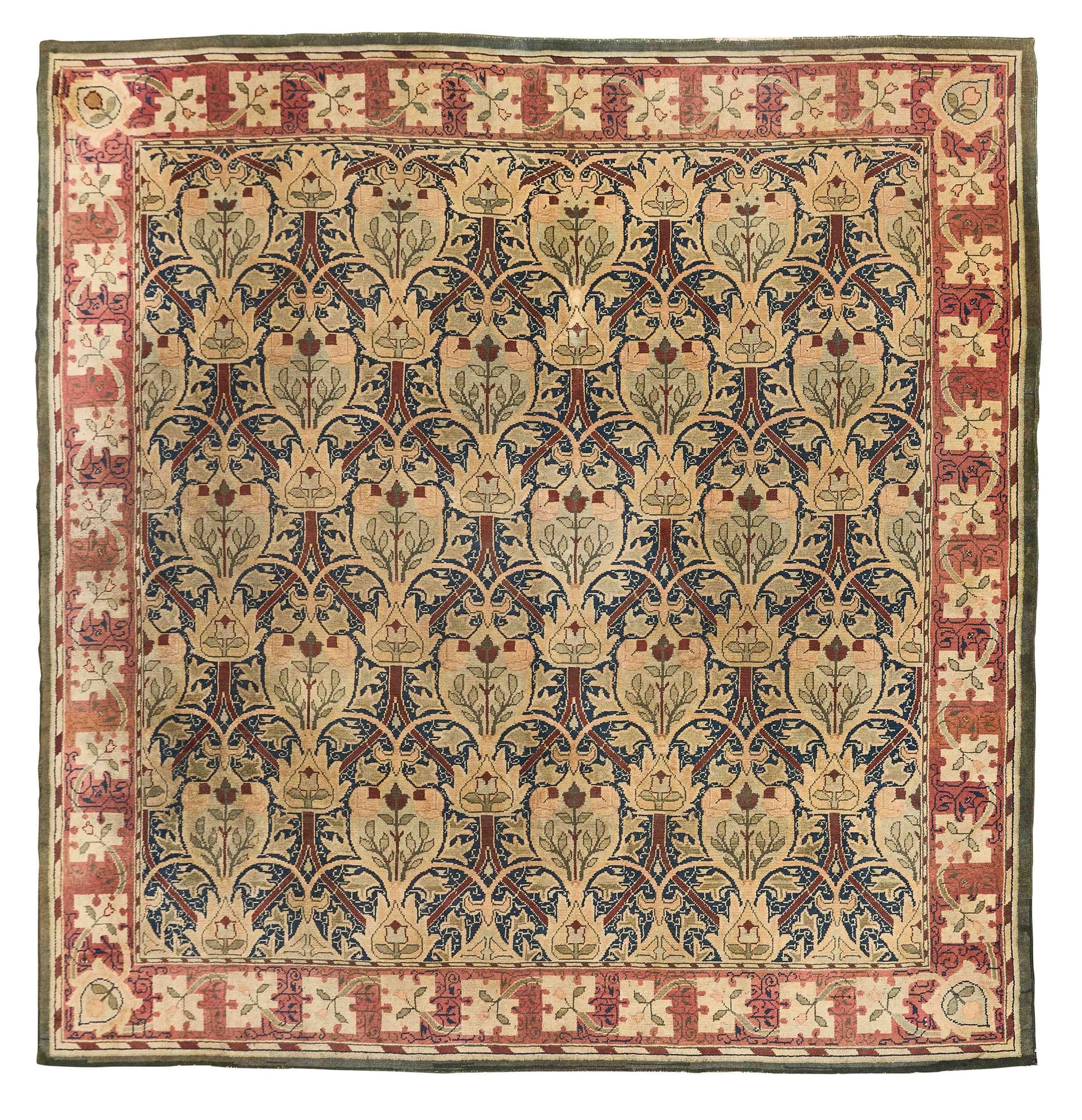
Carpets of this type were among the most expensive and labour-intensive works produced by Morris & Co. Taking days to complete even small sections, they were made only to commission and never held in stock. Their cost and complexity ensured limited production, and today surviving examples are rare, often known by the houses for which they were originally created.
The present carpet is particularly significant in this regard. Its design, associated with major commissions at Bullerswood and Stanmore Hall, appears to be unique, with no other recorded versions.
Yet beyond rarity, its importance lies in what it represents. The Hammersmith carpet encapsulates Morris’s broader project: to restore meaning to making, to align beauty with labour, and to create environments in which art is inseparable from life.
An Enduring Vision
More than a century after its creation, the Hammersmith carpet continues to resonate - not only as a masterpiece of design, but as a statement of values. In an age once again grappling with questions of production, sustainability, and authenticity, Morris’s insistence on craftsmanship and integrity feels strikingly contemporary.
This carpet is not simply a relic of the Arts & Crafts movement. It is a reminder of a radical idea: that the objects we live with should be made with care, designed with thought, and capable of enriching everyday life.
In that sense, its place within the modern interior remains as relevant now as it was in the late 19th century.
Literature
Parry L. Hammersmith Carpets, HALI, October/December 1985, p. 17 and p. 16, pl. 8 where the Bullerswood version of this design is illustrated.
Kirkham P. The Firm: Morris & Company, within Diane Waggoner D. (ed.), The Beauty of Life, William Morris & the Art of Design, (ex. cat.), New York, 2003, p. 54
Parry L. William Morris Textiles, V&A 2013, p. 114
Images of Stanmore Hall taken by Bedford Lemaire in 1891