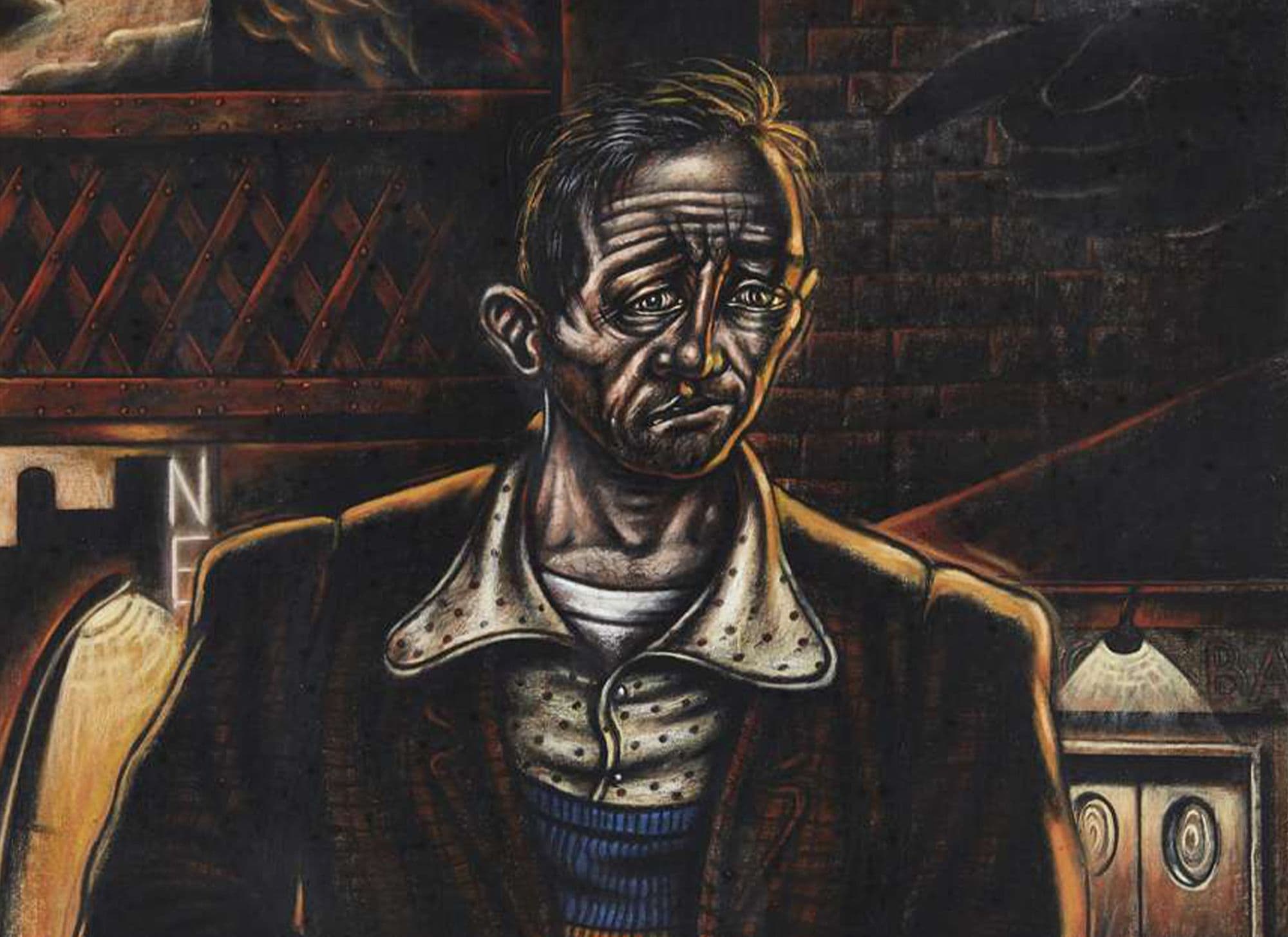
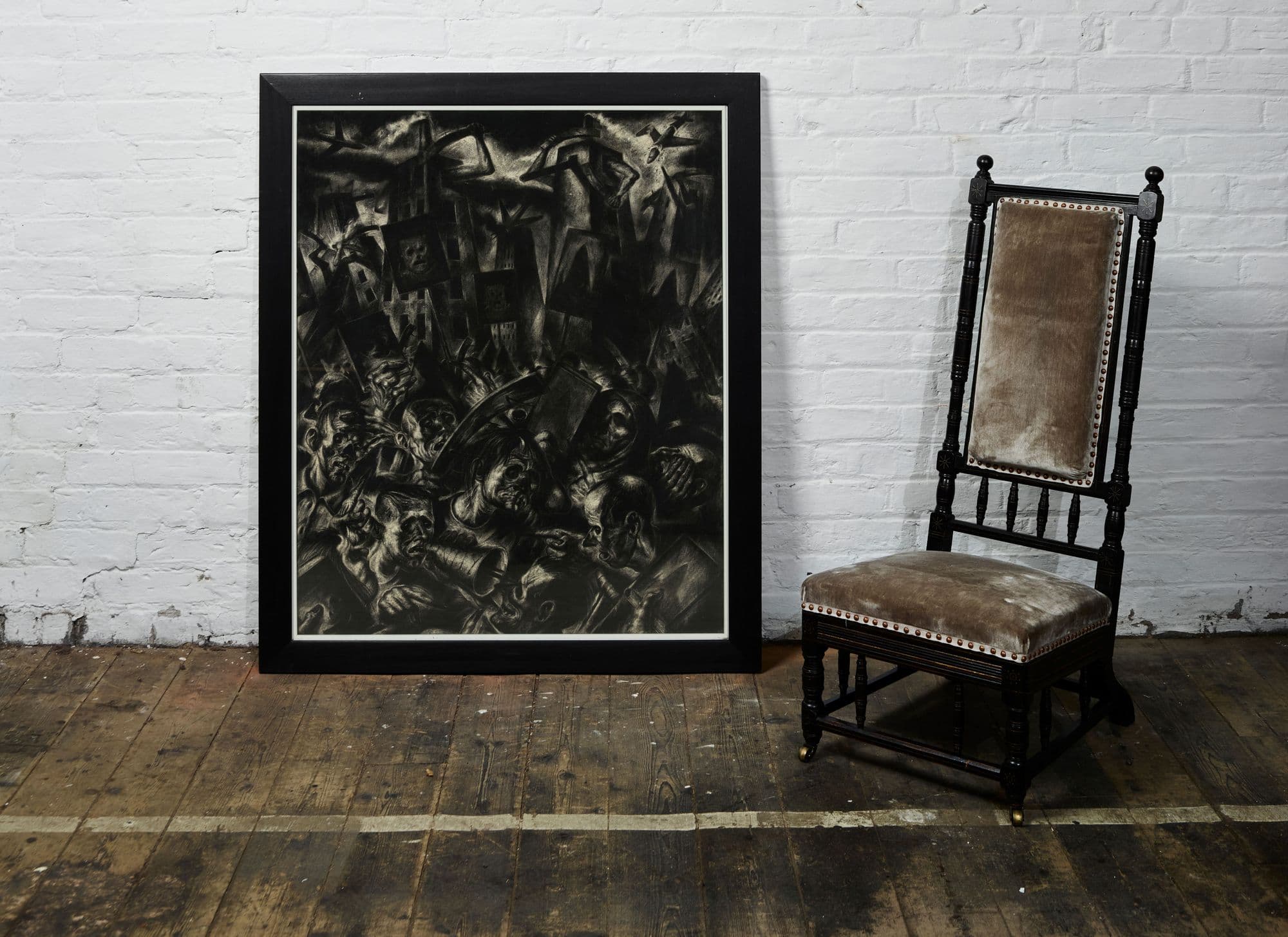
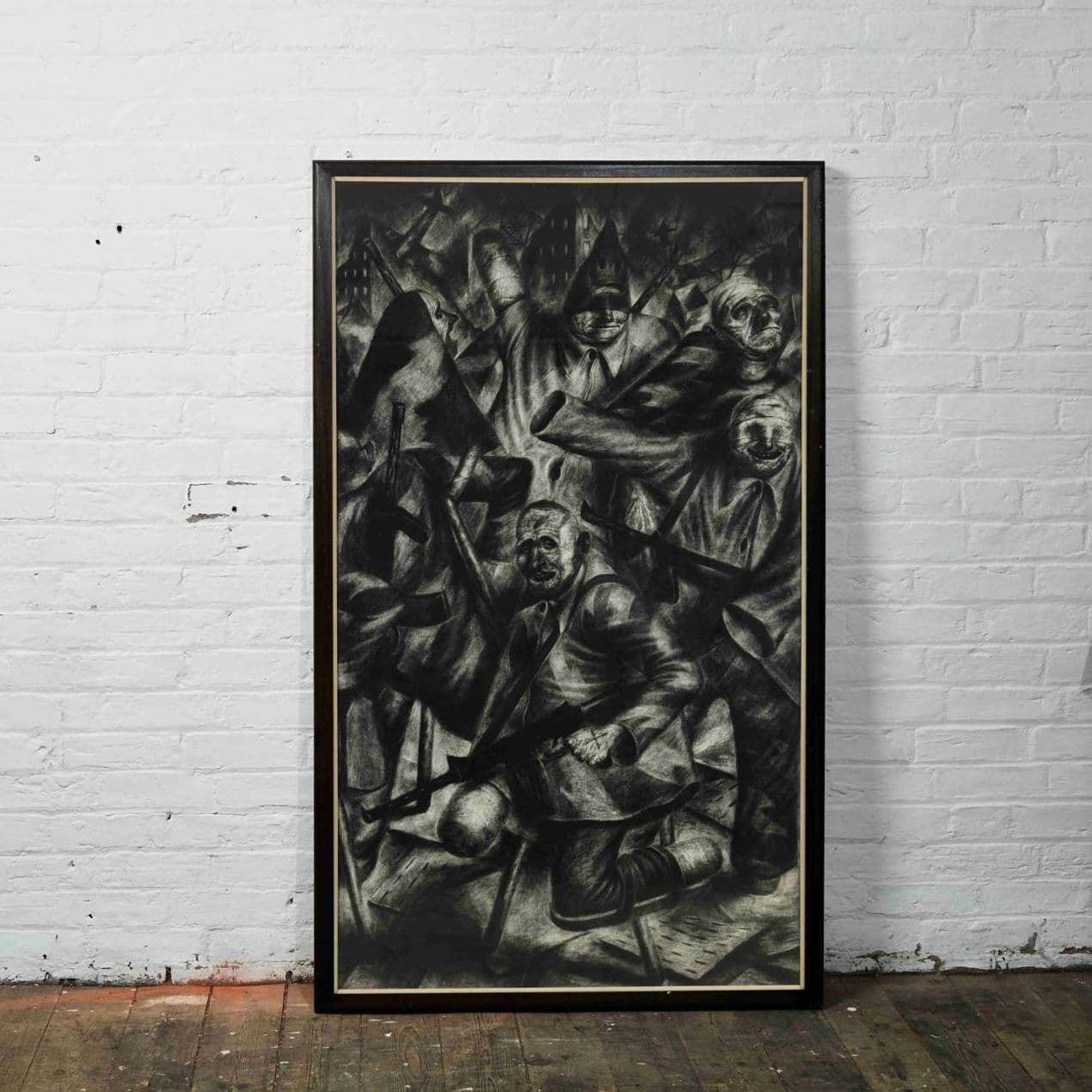
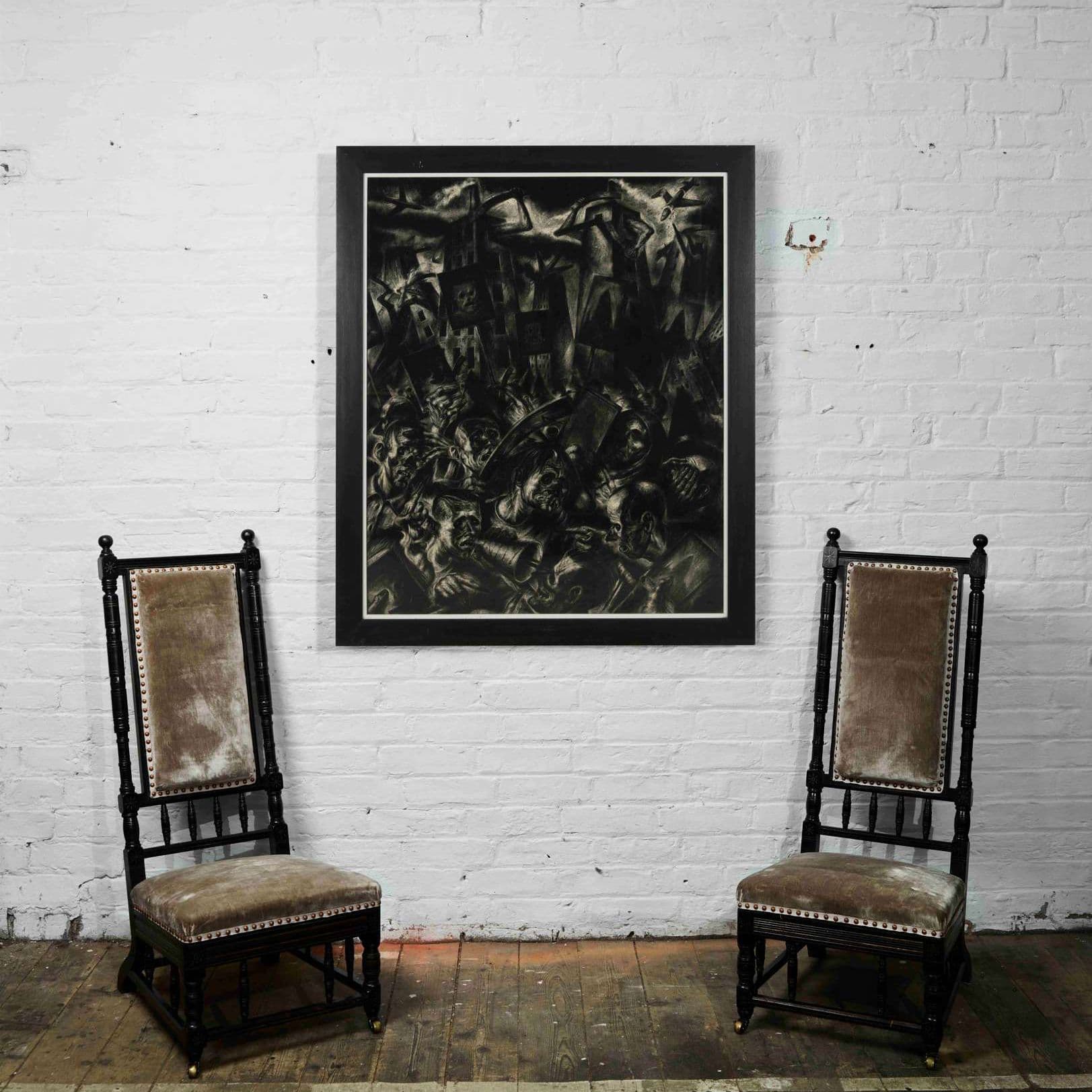
Ken Currie’s The Cripples and The Embattled City are complex, theatrical compositions in which the artist brings a newly honed directorial eye to his fascination with the reverberations of Europe’s turbulent political history.
Fine Art
The Carefully Choreographed Chaos of Ken Currie
3 July 2024
Charlotte Riordan
Ken Currie in 1980s Glasgow
The Embattled City was executed on hand-made paper created by Ken Currie and his friend Keith McIntyre, with whom he shared a studio on East Campbell Street in Glasgow, opposite the Barrowland Ballroom. McIntyre utilised pulped hospital bed sheets as the base material for this paper, lending the gritty image an additional material dimension.
Ken Currie’s early work is celebrated as a remarkable modern interpretation of nineteenth-century history painting, fused with the revolutionary dynamism of pivotal twentieth-century artistic movements. Currie studied at the Glasgow School of Art in the late 1970s and early 1980s. Living in a city in the grip of immense poverty and decay, ruptured by sectarian violence and witnessing the rise of a ‘New Right’, he turned to the figurative tradition to address the sense of existential crisis and undercurrent of brutality he perceived around him.
Currie’s urge to record this zeitgeist produced some of its greatest results when he simultaneously imbued his art with his passion for community engagement.
‘It was only through contact with my tutor, Alexander Moffat, that my work did not descend into the most mindless kind of nihilism… his belief in the centrality of the European figurative tradition provided essential support, putting me, along with other students* in touch with the vital moments of twentieth century painting… and that whole dynamic, revolutionary European culture that flourished between the wars.'
The Artist Comments
Film, Community and a Return to Charcoal
1984 was also the year Currie received a significant grant to make a film called Glasgow 1984 with a group of unemployed young people from the Cranhill Arts Project, using professional equipment.
Currie was intensely engaged with filmmaking at this point, a medium which afforded him the perfect vehicle with which to produce community-engaged art. He had temporarily almost wholly abandoned painting, finding filmmaking both hugely powerful and an all-consuming endurance test.
After the film was finally completed, he felt drawn to return to the looser medium of charcoal, “…retracing my steps stylistically to a time perhaps in my third year at art school”.
Weimar Influences and Political History
In works such as The Cripples and The Embattled City, the parallels with Weimar-era artists such as Beckmann, Grosz, Dix and Kollwitz are clear to see. Visions of destruction, war, annihilation, malformity and insanity are shown unflinchingly.
They are complex, theatrical compositions, a carefully choreographed chaos in which Currie brings his newly honed directorial eye to illustrate his fascination with recording the reverberations of Europe’s turbulent political history, past and present.