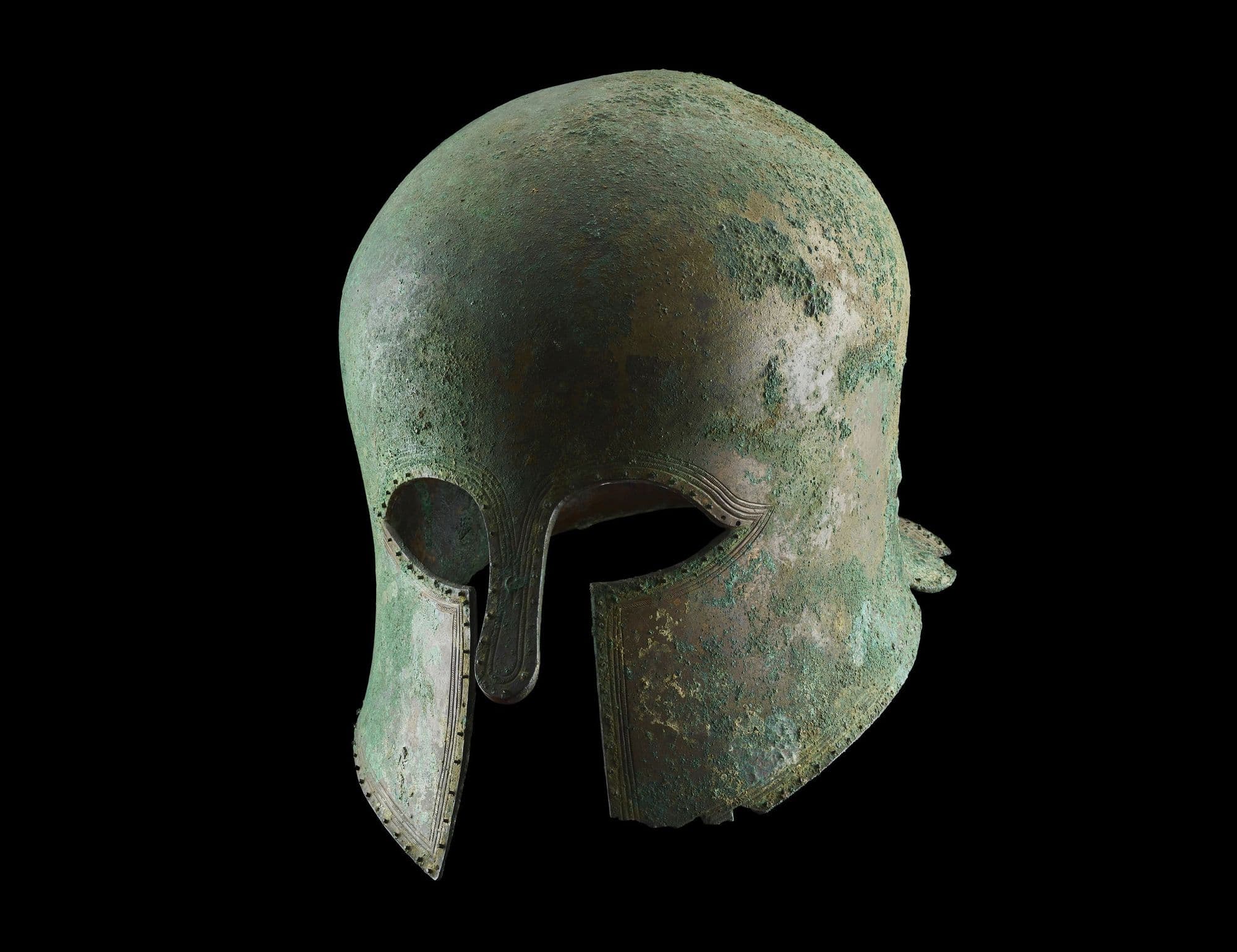
Among the most iconic survivals of the ancient world, the Corinthian helmet remains one of the defining symbols of Classical Greece. The May 2026 edition of Form Through Time featured an exceptional late Archaic example, dating to circa 525 - 475 B.C., that achieved £239,600.
Antiquities
An Iconic Survival of The Ancient World : Exceptional Ancient Greek Corinthian Helmet
8 May 2026
Alex Tweedy
WATCH THE FILM
THE CORINTHIAN
Join Antiquities specialist Alex Tweedy as he takes a closer look at this truly iconic Ancient Greek helmet.
Standing among the finest ancient Greek helmets to appear on the market in recent years this example is remarkable not only for its sculptural beauty and historical significance, but also for its extraordinary state of preservation and absence of modern restoration.
Hammered from a single sheet of bronze, the helmet embodies the technical sophistication of ancient Greek armourers at the height of hoplite warfare. With its elegant almond-shaped eye openings, powerful flaring nose guard, and sweeping relief lines, the piece possesses an almost human presence - a quality that has fascinated collectors, scholars, and museums for generations.
Estimated at £100,000–150,000, this is a museum-quality example of one of the most recognisable forms of ancient Greek armour ever created.
What Is a Corinthian Helmet?
The Corinthian helmet is the most famous type of ancient Greek helmet, closely associated with the rise of the hoplite warrior and the military culture of Archaic and Classical Greece. Developed during the late seventh and early sixth centuries B.C., it became synonymous with elite Greek warfare and appears extensively in ancient sculpture, vase painting, and later Roman art.
Characterised by its enveloping form, the helmet typically features:
- Deep almond-shaped eye openings
- A prominent tapering nose guard
- Integrated cheek pieces
- A continuous bronze surface hammered from a single sheet
Its design was both practical and symbolic. The narrow T-shaped facial opening provided maximum protection during close combat while preserving structural strength across the face and skull. At the same time, the helmet’s striking appearance projected discipline, unity, and martial power.
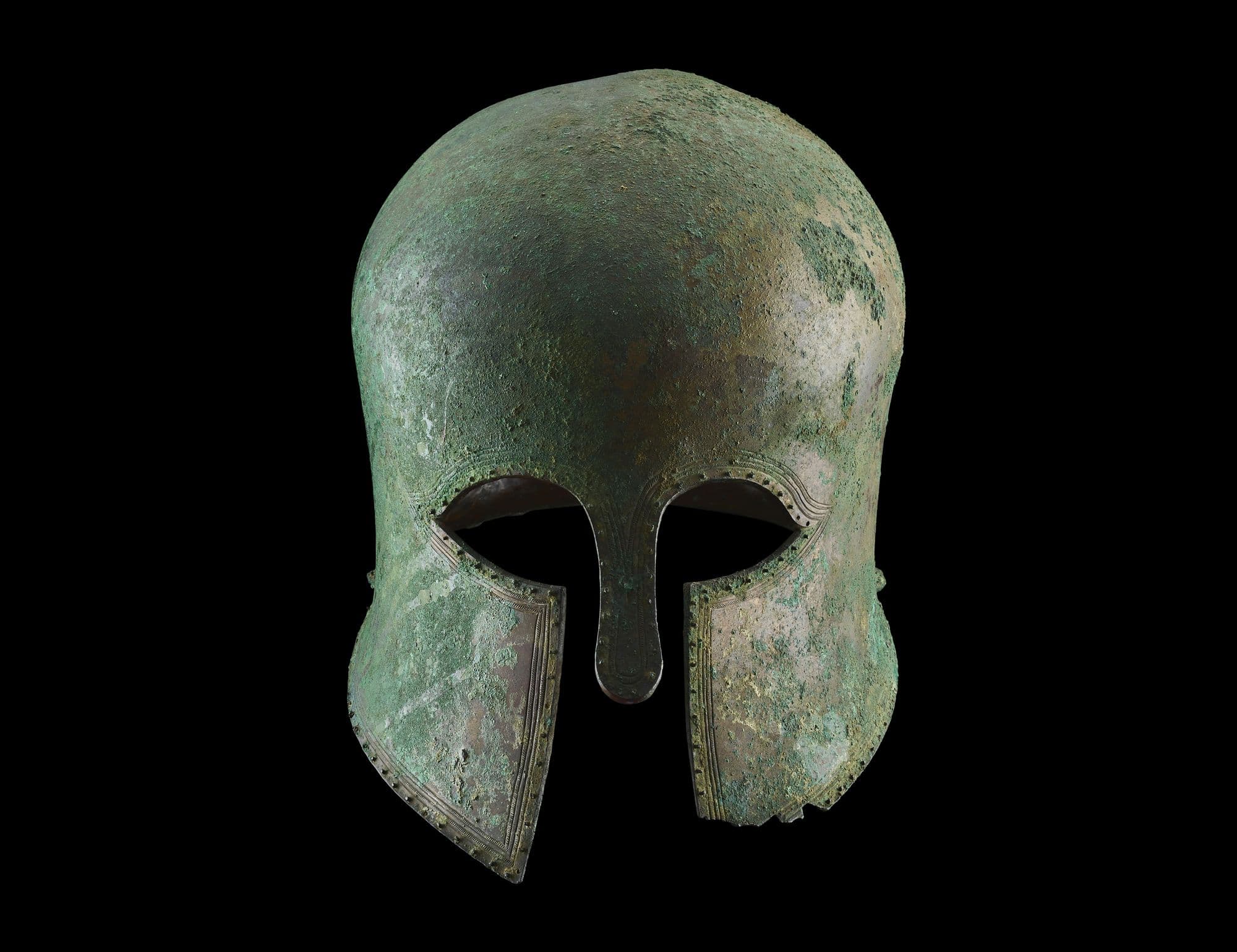
GREECE, LATE ARCHAIC PERIOD, C. 525 - 475 B.C.
EXCEPTIONAL ANCIENT GREEK HELMET OF CORINTHIAN TYPE
hammered from a single piece of bronze, with a domed helm, flaring nose and cheek guards, almond-shaped eyes, and perforations along edges for attachment, sweeping lines executed in light relief run from the top of the nose guard and along the borders of the eyes, rich patination, raised on a bespoke mount
28.2cm tall
SOLD FOR £239,600 (inc premium)
An Exceptional Example from the Late Archaic Period
This helmet represents the Corinthian type at its artistic and functional peak.
The domed crown flows seamlessly into a subtly flared neck guard, creating a harmonious silhouette that demonstrates the sophistication of late Archaic Greek bronze working. Lightly incised relief lines sweep from the top of the nose guard and around the eyes, enhancing the sculptural modelling of the face.
Equally significant is the helmet’s preservation. Ancient Greek bronze helmets often survive with heavy restoration, reconstruction, or surface intervention. By contrast, this example retains rich natural patination and survives without modern restoration, allowing the quality of the original workmanship to remain fully visible.
The perforations along the lower edge once secured a leather or textile lining, now lost, that would have improved fit and comfort for the wearer. Such surviving details provide valuable insight into the practical realities of ancient warfare.
Greek Hoplite Warfare and the Persian Wars
Dating from circa 525 - 475 B.C., this helmet belongs to one of the most transformative periods in Greek history.
This was the era of the Persian Wars, including the legendary battles of Marathon (490 B.C.) and Thermopylae (480 B.C.), conflicts that shaped the political and cultural identity of the Classical Greek world.
Greek hoplites - heavily armed citizen soldiers fighting in tightly organised phalanxes - relied upon armour that balanced protection, endurance, and intimidation. The Corinthian helmet became central to this military system.
At Marathon, Athenian forces used disciplined phalanx tactics to defeat the invading Persian army in one of antiquity’s most celebrated victories. At Thermopylae, Spartan-led Greek defenders made their famous stand against overwhelming Persian numbers, creating a legacy of heroism that still resonates today.
The Corinthian helmet became inseparable from these defining moments. Even after more open helmet forms emerged during the Classical period, the Corinthian type endured in art and cultural memory as the ultimate symbol of the Greek warrior ideal
A Rare Opportunity in the Market for Greek Antiquities
Ancient Greek helmets occupy a unique position within the market for classical antiquities. They combine historical importance, sculptural beauty, rarity, and immediate recognisability in a way few ancient objects can match.
Exceptional ancient Greek armour rarely appears on the market in this condition and quality. The combination of sculptural elegance, historical resonance, and remarkable preservation places this helmet among the most important surviving examples of its type available to collectors today.
As interest in museum-quality Greek antiquities continues to grow internationally, iconic objects with strong visual impact and scholarly significance remain especially desirable. This helmet stands not only as a relic of ancient warfare, but as an enduring symbol of Classical civilisation itself.
For collectors of ancient Greek art, bronze antiquities, or historically significant arms and armour, it represented an extraordinary acquisition opportunity from the golden age of Greek history.