How A. A. Milne Created Winnie-the-Pooh
A. A. Milne was already a moderately successful author when, during a wet family holiday in Wales in 1923, he began writing the poems that would become When We Were Very Young.
Published in November 1924, the book was an immediate success. By Christmas, it had reached its sixth edition, while The Times acclaimed it as the greatest children's book since Lewis Carroll's Alice's Adventures in Wonderland.
Among its poems was Teddy Bear, featuring an unnamed bear who, however hard he tries, grows tubby without exercise. The character would soon become Winnie-the-Pooh, taking his place alongside Christopher Robin and the inhabitants of the Hundred Acre Wood. Milne's collaboration with E. H. Shepard was central to the books' success. Shepard's drawings gave the characters their familiar appearance, combining careful observation with a simplicity that suited Milne's writing. Over the following four years, the pair produced three further books, establishing a literary and artistic partnership that continues to interest collectors of illustrated children's literature.
The Four Original A. A. Milne Books
When We Were Very Young (1924)
Milne's first collection of children's verse introduced the teddy bear who would later become Winnie-the-Pooh. Its immediate popularity marked a turning point in Milne's career and established the partnership with Shepard.
The first edition is particularly important to collectors as the beginning of the Pooh sequence. The signed deluxe edition was limited to just 100 copies, making it exceptionally scarce.
Winnie-the-Pooh (1926)
Published in 1926, Winnie-the-Pooh brought together the stories of Christopher Robin, Pooh, Piglet, Eeyore and their friends.
Shepard's illustrations were integral to the book, establishing the appearance of characters who would become familiar to generations of readers. First editions of Winnie-the-Pooh, particularly copies retaining their original dust jackets, are sought after by collectors. Signed and limited editions are scarcer still.
Now We Are Six (1927)
Milne returned to children's poetry with Now We Are Six, published in 1927. Like When We Were Very Young, the collection was illustrated by Shepard and drew upon the experiences and imagination of childhood.
Although not a collection of Pooh stories, it forms an essential part of the original four-book sequence and is regularly collected alongside the other titles.
The House at Pooh Corner (1928)
Published in 1928, The House at Pooh Corner completed the original sequence and introduced Tigger. The book brought Milne's stories of Christopher Robin and his friends to a close. Its publication marked the end of an extraordinary five-year period in which Milne and Shepard had created four of the best-known books in twentieth-century children's literature.
Signed A. A. Milne and E. H. Shepard Deluxe Editions
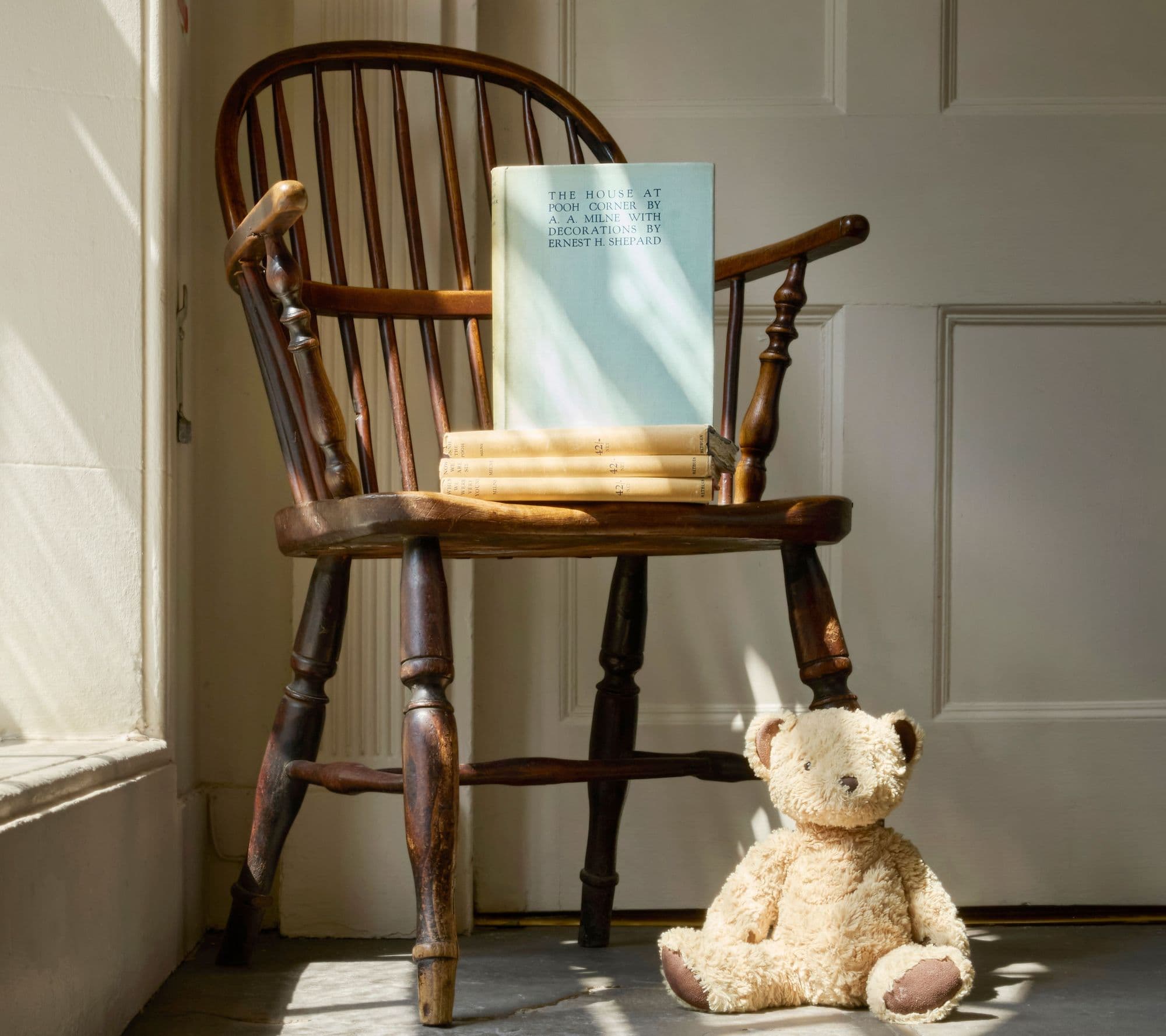
Alongside the standard trade editions, the four Pooh books were also published in limited deluxe editions signed by both Milne and Shepard. These were markedly different from the familiar smaller volumes. Produced in a larger quarto format and printed on fine handmade paper, they allowed Shepard's illustrations to be reproduced with greater detail and clarity.
The editions were strictly limited. Only 100 deluxe copies of When We Were Very Young were produced, with the limitations increasing for subsequent titles to a maximum of 350 copies for The House at Pooh Corner. Their scarcity, together with the signatures of both author and illustrator, makes these editions particularly important within the market for modern first editions and illustrated children's books.
A Complete Collection of Signed Winnie-the-Pooh Books at Auction
In June 2024, Lyon & Turnbull offered four signed deluxe editions of the original Pooh books in its Books & Manuscripts auction. The volumes had been acquired when new by the vendor's family and had never previously been offered for sale. Each was signed by both A. A. Milne and E. H. Shepard, and all four had survived in outstanding condition. The collection included When We Were Very Young, Winnie-the-Pooh, Now We Are Six and The House at Pooh Corner, offered as four individual lots.
Complete groups of these deluxe editions are rarely encountered with such a consistent history of ownership. In this instance, the books had remained together within the same family since publication, preserving not only the original volumes but also their shared provenance. The collection demonstrated the importance of condition, rarity and ownership history when assessing early twentieth-century children's literature.