What Is Lapis Lazuli?
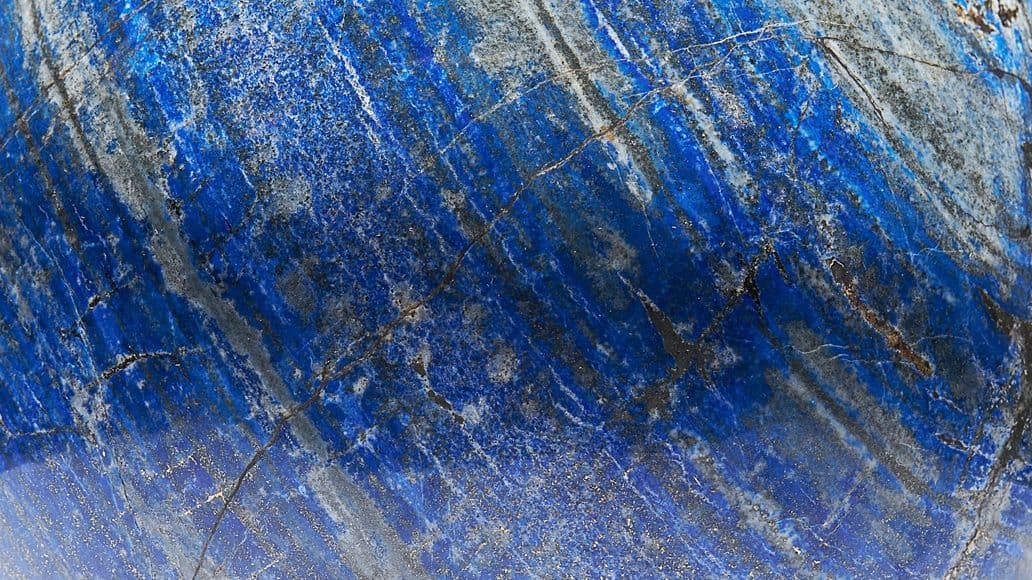
Despite often being described as a gemstone or mineral, lapis lazuli is technically a rock composed of several minerals. Its celebrated blue is principally produced by lazurite. Lapis commonly also contains calcite, which can appear as white areas or veins, and pyrite, responsible for the metallic gold-coloured flecks often associated with the stone. Other minerals can also occur within it.
That composition is important because the balance between these different components can dramatically change the appearance and quality of an individual piece. A block of intensely saturated blue lapis with little visible calcite, for example, presents very differently from paler or heavily veined material.
What Makes Lapis Lazuli Valuable?
There isn't a single universal grade for lapis lazuli. GIA evaluates lapis but does not assign it a standard gem grade. Instead, several characteristics help determine the quality and desirability of individual material.
Colour
Colour is generally the most important quality factor. The most prized lapis tends towards an intense, highly saturated medium-dark blue to violetish blue. Uniformity can also be desirable, particularly where the colour is not interrupted by conspicuous areas of white calcite. This doesn't mean every valuable lapis object must be perfectly uniform. With historic carvings and decorative objects, craftsmanship, scale, age and provenance can become important parts of the assessment too.
Calcite
Calcite occurs naturally within lapis lazuli and appears as white flecks, patches or veins. In material being judged primarily for the quality of the stone, conspicuous white calcite generally reduces desirability because it interrupts the saturated blue colour for which lapis is prized. Its presence does not, however, mean the lapis is fake or necessarily without value.
Pyrite
Those glittering gold-coloured flecks are not gold. They are pyrite, an iron sulphide mineral that occurs naturally within lapis lazuli. Fine, attractively distributed pyrite can add visual interest and does not necessarily reduce value.
Does More Pyrite Mean Better Lapis Lazuli?
No. It is easy to assume that abundant golden flecks make lapis more valuable, but quality is not determined by the quantity of pyrite. Small, well-distributed flecks can be attractive against a strong blue ground. Heavy concentrations, however, may disrupt the colour and can reduce the visual quality of the material. At the highest end, lapis may be prized for an intense, uniform blue with little or no visible pyrite and no conspicuous calcite. So when assessing lapis, blue comes first. Pyrite is part of the picture, not a shortcut to quality.
Where Does the Best Lapis Lazuli Come From?
Lapis lazuli occurs in several parts of the world, but Afghanistan is its most famous historic source. The deposits of Sar-e-Sang in Badakhshan, in the Hindu Kush mountains of north-eastern Afghanistan, have supplied lapis since antiquity. GIA describes Afghanistan as the traditional source of the finest material and records the long history of Sar-e-Sang lapis moving through trade routes into the Middle East, Asia and Europe.
Other sources include Chile, the Lake Baikal region of Siberia, and deposits elsewhere, but Afghan lapis has acquired a particularly important place in both the history and modern appreciation of the material.
For an auction specialist, however, an attribution to Afghanistan shouldn't simply be assumed because a piece is a beautiful dark blue. Where origin materially affects the description or value of an object, supporting evidence matters.
Why Is Afghan Lapis Lazuli So Famous?
Its reputation goes much further back than the modern gemstone trade. Lapis from Afghanistan was transported over enormous distances in the ancient world. Archaeological evidence demonstrates its use by early civilisations thousands of years ago, and the material was prized in Mesopotamia, Egypt and elsewhere. GIA traces human use of lapis back more than 6,500 years. That long-distance trade is part of what makes lapis such an unusual natural material. A blue rock extracted from mountains in Central Asia became one of the ancient world's great luxury commodities. Centuries later, lapis would acquire another identity entirely.
From Lapis Lazuli to Ultramarine
For centuries, finely ground lapis lazuli provided the raw material for natural ultramarine, one of the most celebrated blue pigments in the history of Western art. Producing the pigment required lapis to be ground and processed to separate the valuable blue component from the other minerals in the rock.
Before the development of synthetic ultramarine in the 19th century, high-quality natural ultramarine was exceptionally costly. Its use in paintings therefore carried both visual and material significance. This gives lapis a rather extraordinary double life: collected as a natural stone and deliberately destroyed to create one of history's most prized colours. GIA documents its long artistic use as the source of ultramarine pigment.
Natural Lapis Lazuli, Carvings and Objects
Lapis is opaque and comparatively workable, allowing it to be fashioned in ways that many crystalline gemstones cannot.
It has been used for:
- carved figures and ornaments
- bowls and vessels
- boxes
- beads
- cabochons
- tablets
- inlay
- jewellery
- larger decorative objects
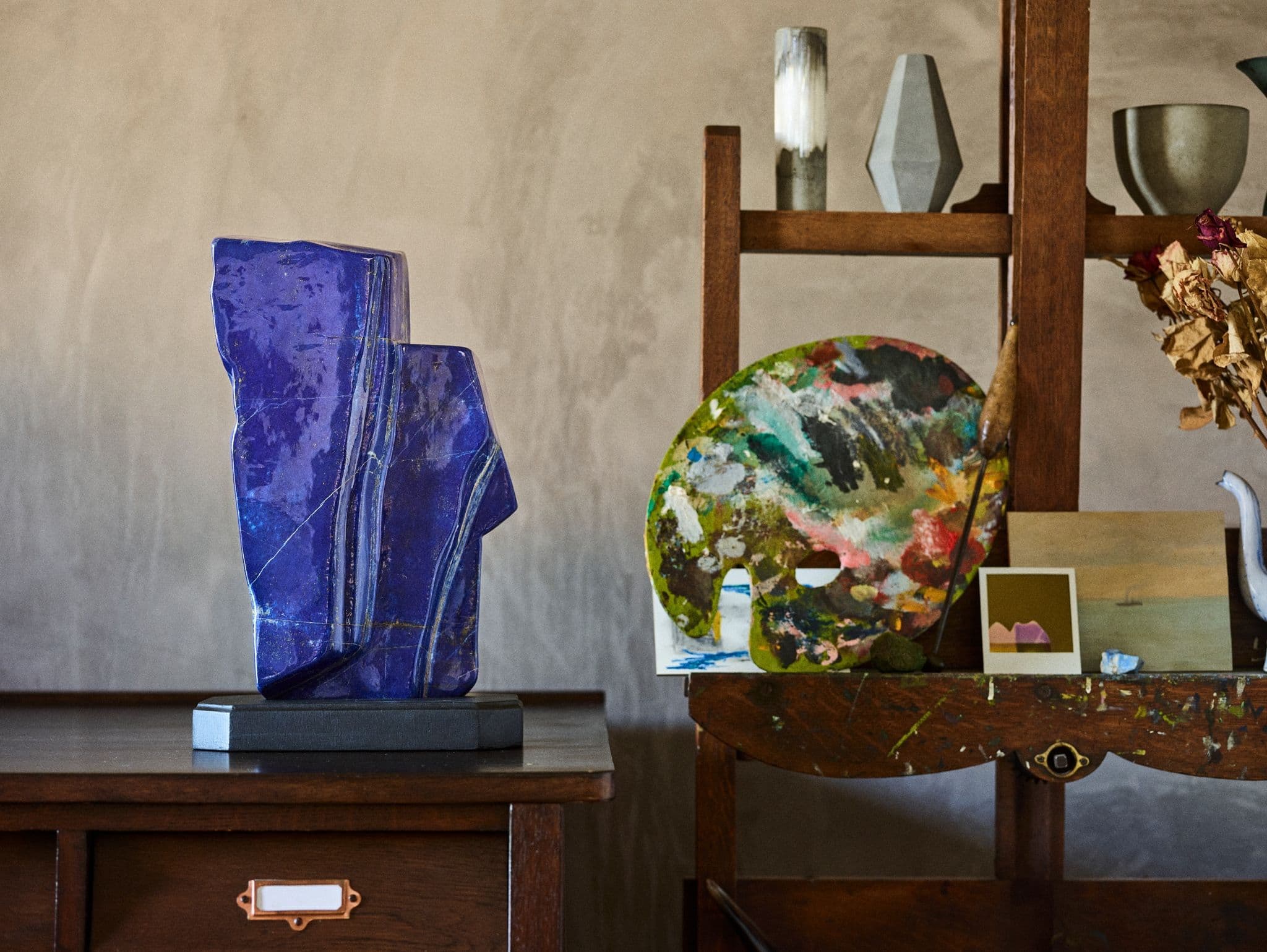
Substantial pieces of rough lapis can also be fashioned into spheres and sculptural forms. For auction purposes, this means the value of a lapis object cannot always be assessed from the quality of the stone alone.
A historic carving may be important because of its age, workmanship, origin or provenance. A natural specimen may instead be judged for its mineralogical character and appearance. The first question is therefore not simply “How good is the lapis?” but “What exactly is the object?”
Can Lapis Lazuli Be Dyed or Treated?
Yes. Lower-quality lapis can be dyed to intensify its blue colour or disguise pale calcite areas. Material may also be impregnated with wax or oil to improve colour and lustre. GIA notes that these treatments can be identified by a gemmologist.
Treatment does not mean every object is worthless, but it is an important distinction when assessing natural quality. For an owner, the practical advice is simple: do not attempt to clean, polish or test lapis yourself before valuation. Lapis has a Mohs hardness of approximately 5 - 6 depending on its composition, and some treatments can be affected by heat, solvents and inappropriate cleaning methods.
How Can You Tell if Lapis Lazuli Is Real?
Colour alone isn't enough. Natural lapis varies, and imitation materials have been produced specifically to reproduce its characteristic blue appearance. Glass, plastic and ceramic materials can all be used as lapis substitutes.
The familiar combination of blue, calcite and pyrite can provide useful visual information, but it should not be treated as a foolproof home test. This is particularly important because pyrite itself can be imitated, while genuine lapis can also be dyed. For a potentially important object, professional assessment is preferable to internet tests involving chemicals, scratching or solvents, all of which risk damaging the material.
Lapis Lazuli or Sodalite?
Blue sodalite is one of the natural materials most readily confused with lapis lazuli. The two can appear similar, particularly when lapis contains little visible pyrite. They are not, however, the same material.
Lapis lazuli is a rock composed of several minerals and derives much of its blue colour from lazurite. Sodalite is a distinct mineral species. Pyrite can be a useful clue when present naturally in lapis, but its absence does not prove that a blue stone is sodalite. For significant specimens or objects, identification should therefore be based on the material itself rather than a single visual characteristic.
Does the Size of Lapis Lazuli Affect Its Value?
Sometimes, but bigger isn't automatically better. Lapis rough can occur in substantial masses, so large objects are much more achievable than they are with many transparent gemstones. A large carving made from mediocre material is therefore not necessarily more valuable than a smaller object fashioned from exceptional lapis.
With significant decorative objects, size becomes more interesting when it is combined with quality of colour + quality of material + workmanship + age + provenance + condition. That combination is much more useful at auction than weight alone.